The Doppler effect
When an ambulance drives toward you with its siren on, you hear a higher pitch than you would if it were parked. After it passes you and drives away, you hear a lower pitch.
We call the object that emits a wave the source, and the object that detects it the observer. When the source or the observer moves through the medium, the frequency the observer detects is different from the frequency the source emits. This is the Doppler effect.
The Doppler effect depends on how the source and the observer move, not on how far apart they are. The siren also sounds louder as the ambulance gets closer, because the intensity increases as the distance decreases. This change in loudness is a separate effect from the change in pitch.
A moving source
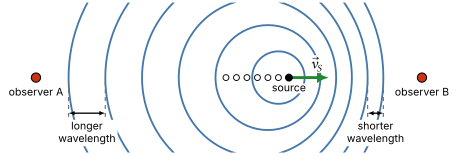
A source emits one wavefront every period. Each wavefront spreads out at the speed of sound from the point where the source was when it emitted that wavefront. In the figure, the open circles mark these points.
A moving source emits each new wavefront closer to the wavefronts ahead of it and farther from the wavefronts behind it. So the wavefronts bunch up ahead of the source and spread out behind it.
What the observers hear
Ahead of a moving source, the wavefronts are closer together, so observer B detects a shorter wavelength. The wavefronts still travel at the speed of sound, so they reach observer B more often. Observer B hears a higher frequency than the source emits.
Behind the source, the wavefronts are farther apart. Observer A detects a longer wavelength, and the wavefronts reach observer A less often. Observer A hears a lower frequency.
When the ambulance passes you, you go from being ahead of the source to being behind it. That is why the pitch of the siren decreases as it goes by.
The wavelength ahead of a moving source
Suppose the source emits frequency $f_0$, with period $T_0 = 1/f_0$, and moves toward the observer at speed $v_S$. It emits wavefront 1 at time $t = 0$ and wavefront 2 at $t = T_0$. During that period, wavefront 1 travels a distance $vT_0$, while the source moves a distance $v_S T_0$ in the same direction.
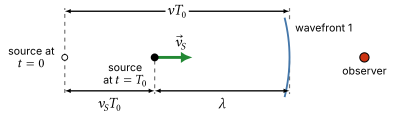
The wavelength the observer detects is the distance between the two wavefronts,
\[\lambda = vT_0 - v_S T_0 = \frac{v - v_S}{f_0}.\]The frequency from a moving source
The wavefronts travel toward the observer at the speed of sound $v$, so the observer detects the frequency
\[\begin{aligned} f &= \frac{v}{\lambda}\\ &= \frac{v}{v - v_S}\,f_0. \end{aligned}\]The denominator is smaller than the numerator, so $f$ is greater than $f_0$. A source moving toward the observer increases the frequency the observer detects.
If the source moves away from the observer, it moves a distance $v_S T_0$ away from the wavefronts it has emitted. The wavelength is then $\lambda = (v + v_S)/f_0$, and the observer detects
\[f = \frac{v}{v + v_S}\,f_0,\]which is less than $f_0$.
A moving observer
Now let the source be at rest, so the wavefronts are a wavelength $\lambda_0 = v/f_0$ apart. Let the observer move toward the source at speed $v_O$.
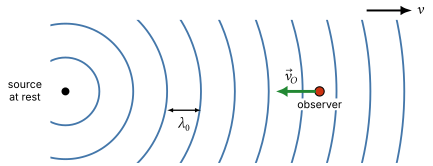
The wavefronts move toward the observer at speed $v$, and the observer moves toward them at speed $v_O$. So relative to the observer, the wavefronts approach at speed $v + v_O$.
The frequency for a moving observer
The wavefronts are still a distance $\lambda_0$ apart, but they approach the observer at speed $v + v_O$. So the observer meets them more often than an observer at rest would, and detects the frequency
\[\begin{aligned} f &= \frac{v + v_O}{\lambda_0}\\ &= \frac{v + v_O}{v}\,f_0. \end{aligned}\]An observer moving away from the source meets the wavefronts less often. It detects the frequency
\[f = \frac{v - v_O}{v}\,f_0.\]A moving observer does not change the wavelength. It changes how often the observer meets the wavefronts.
Check your understanding: A source emits sound with frequency $f_0$ in still air.
- The source moves toward an observer at rest at 20% of the speed of sound, $v_S = 0.200v$. What frequency does the observer detect, as a multiple of $f_0$?
- Now the source is at rest, and the observer moves toward it at $v_O = 0.200v$. What frequency does the observer detect?
Answer
1. For a source moving toward the observer,
\[f = \frac{v}{v - 0.200v}\,f_0 = \frac{f_0}{0.800} = 1.25 f_0.\]2. For an observer moving toward the source,
\[f = \frac{v + 0.200v}{v}\,f_0 = 1.20 f_0.\]The Doppler equation
In both cases, the source and the observer approach each other at the same speed, but the frequencies are different. The Doppler effect depends on how the source and the observer each move relative to the medium, not only on how they move relative to each other.
We can combine our results into one equation for a moving source, a moving observer, or both. Choose the $+x$ direction to point from the source toward the observer. Then the observer detects the frequency
\[\boxed{f = \frac{v - v_{O,x}}{v - v_{S,x}}\,f_0.}\]Here $v_{S,x}$ and $v_{O,x}$ are the $x$ components of the velocities of the source and the observer, measured relative to the medium. The equation applies when the source and the observer move along the line between them, at speeds less than the speed of sound.
Signs in the Doppler equation
With the $+x$ direction pointing from the source toward the observer, the signs of the velocity components are as follows.
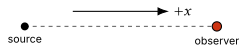
| Motion | Velocity component | Effect on $f$ |
|---|---|---|
| Source moves toward the observer | $v_{S,x} > 0$ | increases |
| Source moves away from the observer | $v_{S,x} < 0$ | decreases |
| Observer moves toward the source | $v_{O,x} < 0$ | increases |
| Observer moves away from the source | $v_{O,x} > 0$ | decreases |
Motion of either one toward the other increases the frequency the observer detects, and motion of either one away from the other decreases it. Use this to check the signs in every Doppler calculation.
The $+x$ direction depends on where the source and the observer are, not on which way they move. If the source passes the observer, the $+x$ direction reverses.
Example: An ambulance and a cyclist
An ambulance drives east along a straight road at $30.0\ \mathrm{m/s}$, with its siren emitting sound at $960\ \mathrm{Hz}$. A cyclist ahead of the ambulance rides east along the same road at $8.00\ \mathrm{m/s}$. The air is still, and the speed of sound is $343\ \mathrm{m/s}$.
- What frequency does the cyclist hear before the ambulance passes?
- What frequency does the cyclist hear after the ambulance passes?
Solution
1. Before the ambulance passes, the $+x$ direction points east, from the ambulance toward the cyclist. Both move east, so $v_{S,x} = +30.0\ \mathrm{m/s}$ and $v_{O,x} = +8.00\ \mathrm{m/s}$. The cyclist hears
\[f = \frac{343\ \mathrm{m/s} - 8.00\ \mathrm{m/s}}{343\ \mathrm{m/s} - 30.0\ \mathrm{m/s}}\,(960\ \mathrm{Hz}) = \frac{335}{313}\,(960\ \mathrm{Hz}) = 1027\ \mathrm{Hz},\]about $1.03\ \mathrm{kHz}$.
2. After the ambulance passes, it is east of the cyclist, so the $+x$ direction points west. Both still move east, so now $v_{S,x} = -30.0\ \mathrm{m/s}$ and $v_{O,x} = -8.00\ \mathrm{m/s}$. The cyclist hears
\[f = \frac{343\ \mathrm{m/s} + 8.00\ \mathrm{m/s}}{343\ \mathrm{m/s} + 30.0\ \mathrm{m/s}}\,(960\ \mathrm{Hz}) = \frac{351}{373}\,(960\ \mathrm{Hz}) = 903\ \mathrm{Hz}.\]Sources faster than sound
As the speed of a source moving toward an observer approaches the speed of sound, the denominator $v - v_{S,x}$ of the Doppler equation approaches zero. The source keeps up with its wavefronts, which pile up in front of it.
A source moving faster than sound moves ahead of its wavefronts. They overlap along a cone, called a shock wave, where the pressure changes abruptly.
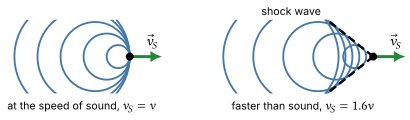
When the shock wave from a supersonic aircraft passes you, you hear a sonic boom. The cone travels with the aircraft, so people hear the boom all along its path, not only where it first reaches the speed of sound.
Summary
When a source or an observer moves relative to the medium, the frequency the observer detects differs from the frequency the source emits. With the $+x$ direction pointing from the source toward the observer, $f = f_0 (v - v_{O,x})/(v - v_{S,x})$. Motion of either one toward the other increases the frequency.