Sound waves
Sound is a mechanical wave that travels through a medium, such as air, water, or the tissues of your body.
A source of sound, such as a loudspeaker cone or a tuning fork, vibrates back and forth. As the source moves forward, it pushes on the air next to it and squeezes that air into a smaller volume, so the pressure of that air increases. As the source moves back, the air next to it expands, and the pressure there decreases.
The squeezed air in turn pushes on the air beyond it, so the disturbance travels away from the source. In a sound wave, the disturbance is a change in the pressure (and the density) of the medium from its undisturbed value.
Transverse and longitudinal waves
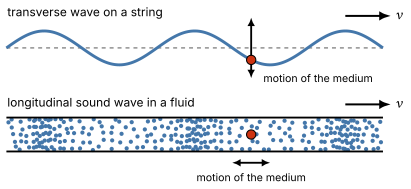
In a wave on a string, each piece of the string moves perpendicular to the direction the wave travels. This is a transverse wave. In a sound wave in a fluid (a gas or a liquid), the particles of the medium move back and forth along the same direction the wave travels. This is a longitudinal wave.
Compressions and rarefactions
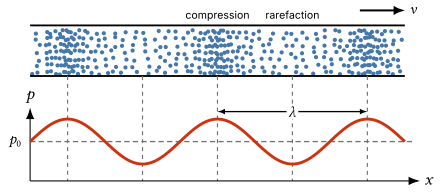
The figure below shows a cartoon of a fluid carrying a sinusoidal sound wave at one instant. Each dot is a small piece of the fluid. Where the dots are crowded together, the density and pressure are higher than in the undisturbed fluid. This is a compression. Where the dots are spread apart, the density and pressure are lower. This is a rarefaction.
A particle model of a sound wave
As the wave passes, each piece of the fluid moves back and forth about its equilibrium position, in simple harmonic motion at the frequency of the source. The fluid itself does not travel with the wave.
Neighboring pieces of the fluid are slightly out of step with each other, so they crowd together in some places and spread apart in others. This pattern of compressions and rarefactions travels through the fluid at the speed of sound.
The dots are only a cartoon. Each one stands for a small parcel of fluid that contains a huge number of molecules. As we saw in the chapter on kinetic theory, the molecules themselves move in random directions at hundreds of meters per second. A sound wave adds a small, organized back-and-forth motion of each parcel as a whole.
Sound as a pressure wave
We will describe a sound wave by the pressure of the medium. If $p_0$ is the pressure with no wave present, the disturbance is the pressure variation $\Delta p = p - p_0$. It is positive in a compression and negative in a rarefaction.
A sinusoidal sound wave traveling in the $+x$ direction has the same wave function as a wave on a string, with $\Delta p$ in place of $y$:
\[\Delta p(x,t) = \Delta p_{\max}\sin(kx - \omega t).\]The amplitude $\Delta p_{\max}$ is the pressure amplitude.
At a fixed position, the pressure oscillates in time at the frequency of the source. A microphone, or your eardrum, responds to this oscillating pressure.
The pressure variations in sound are tiny. In ordinary conversation, the pressure amplitude is a few hundredths of a pascal, less than a millionth of atmospheric pressure.
The speed of sound
Like any wave, the speed of sound is set by the medium, not by the frequency or the loudness of the sound. For two media with the same density, sound travels faster in the one that is harder to compress. For two media that are equally hard to compress, sound travels more slowly in the denser one.
| Medium | Speed of sound |
|---|---|
| Air ($20^\circ\mathrm{C}$) | $343\ \mathrm{m/s}$ |
| Water ($20^\circ\mathrm{C}$) | $1480\ \mathrm{m/s}$ |
| Soft tissue (typical) | $1540\ \mathrm{m/s}$ |
Water is about 800 times as dense as air, but it is far harder to compress. As a result, sound travels about four times as fast in water as in air.
The speed of sound in air increases with temperature. We will use $v = 343\ \mathrm{m/s}$, its value at $20^\circ\mathrm{C}$, unless a problem says otherwise.
Example: Wavelengths of sound
A tuning fork vibrates at $440\ \mathrm{Hz}$, the frequency of the musical note A above middle C.
- What is the wavelength of the sound wave it produces in air at $20^\circ\mathrm{C}$?
- The sound passes from the air into a swimming pool of water at $20^\circ\mathrm{C}$. What are the frequency and the wavelength of the sound in the water?
Solution
1. In air, the speed of sound is $343\ \mathrm{m/s}$, so the wavelength is
\[\lambda = \frac{v}{f} = \frac{343\ \mathrm{m/s}}{440\ \mathrm{Hz}} = 0.780\ \mathrm{m}.\]2. The frequency is set by the source, so it is still $f = 440\ \mathrm{Hz}$ in the water. The speed of sound in water is $1480\ \mathrm{m/s}$, so the wavelength is
\[\lambda = \frac{v}{f} = \frac{1480\ \mathrm{m/s}}{440\ \mathrm{Hz}} = 3.36\ \mathrm{m}.\]Spherical waves
Sound in three dimensions
A wave on a string travels in one dimension, along the string. Sound spreads out through three-dimensional space.
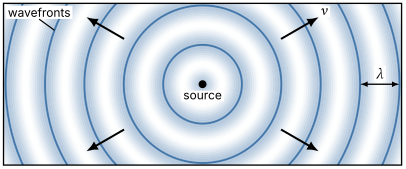
A point source that sends out sound equally in every direction produces a spherical wave. The compressions form spheres centered on the source, called wavefronts, with rarefactions midway between them. Neighboring wavefronts are one wavelength apart, and every wavefront moves outward at the speed of sound.
Energy spreads out
A sound wave carries energy away from its source. For a point source, this energy spreads out over the wavefronts.
As a wavefront moves outward, its area increases, so the same energy is spread over a larger and larger area. In the figure, the energy that passes through one square at distance $r$ spreads over 4 squares at distance $2r$, and over 9 squares at distance $3r$.
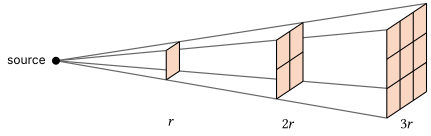
This is why a sound gets quieter as you move away from its source.
Summary
Sound in a fluid is a longitudinal wave of compressions and rarefactions. We describe it by the pressure variation, $\Delta p(x,t) = \Delta p_{\max}\sin(kx - \omega t)$. Its speed is set by the medium, about $343\ \mathrm{m/s}$ in air.