Internal energy of a gas
Internal energy of a monatomic ideal gas
The average kinetic energy allows us to calculate the internal energy of the ideal gas. We will start by considering a monatomic ideal gas, in which the gas particles are single atoms. The noble gases (helium, neon, argon, etc.) can be modeled as monatomic ideal gases.
In the ideal gas model, we neglect potential energy between molecules. For a monatomic ideal gas, all of the internal energy is random translational kinetic energy:
\[E_{\mathrm{int}} = K_{\mathrm{tot}}.\]For $N$ particles, the total kinetic energy is $N$ times the average kinetic energy of a single particle,
\[K_{\mathrm{tot}}=NK_{\mathrm{av}}.\]Multiplying the average kinetic energy $K_{\mathrm{av}} = \tfrac{3}{2}k_BT$ by the number of particles $N$, we get the total internal energy of a monatomic ideal gas:
\[\boxed{E_{\mathrm{int}}=\frac{3}{2}Nk_BT}\quad \text{or}\quad \boxed{E_{\mathrm{int}}=\frac{3}{2}nRT.}\]For a fixed amount of a monatomic ideal gas, this means that the internal energy changes by
\[\Delta E_{\mathrm{int}}=\frac{3}{2}nR\,\Delta T\]when the temperature changes by $\Delta T$. This is consistent with our earlier statement that the internal energy is a state function, since it only depends on the state variable $T$.
Example: Warming a helium balloon
Lucia fills a balloon with $10.0\ \mathrm{L}$ of helium, a monatomic ideal gas, at $101.3\ \mathrm{kPa}$ and $20.0^\circ\mathrm{C}$. She carries it outside, where the sun warms the helium to $40.0^\circ\mathrm{C}$, and the balloon expands as it warms. Assume the pressure of the helium stays constant.
- What is the change in the internal energy of the helium?
- How much work is done on the helium?
- How much heat flows into the helium?
Solution
1. Converting the givens to SI units, with temperatures in kelvin,
\[p = 1.013\times 10^{5}\ \mathrm{Pa}, \qquad V_i = 1.00\times 10^{-2}\ \mathrm{m^3}, \qquad T_i = 293\ \mathrm{K}, \qquad T_f = 313\ \mathrm{K}.\]The pressure is atmospheric pressure and stays constant. The internal energy of a monatomic ideal gas changes by
\[\Delta E_{\mathrm{int}} = \frac{3}{2}nR\,\Delta T.\]We could find $n$ from the initial state, $n = pV_i/RT_i$. Instead, we can avoid computing $n$ by using the ideal gas law, $pV = nRT$, directly. At constant pressure, a change in temperature only changes the volume, so $p\,\Delta V = nR\,\Delta T$, and
\[\Delta E_{\mathrm{int}} = \frac{3}{2}p\,\Delta V.\]To find $\Delta V$, note that $n$ and $p$ stay fixed, so the ideal gas law gives $V_i/T_i = V_f/T_f$, or
\[V_f = \frac{T_f}{T_i}V_i = \frac{313\ \mathrm{K}}{293\ \mathrm{K}}\,(10.0\ \mathrm{L}) = 10.68\ \mathrm{L}.\]The helium’s volume increases by $\Delta V = V_f - V_i = 0.683\ \mathrm{L} = 6.83\times 10^{-4}\ \mathrm{m^3}$. Then
\[\Delta E_{\mathrm{int}} = \frac{3}{2}\left(1.013\times 10^{5}\ \mathrm{Pa}\right)\left(6.83\times 10^{-4}\ \mathrm{m^3}\right) = 103.7\ \mathrm{J} \approx 104\ \mathrm{J}.\]2. The pressure stays constant, so the work done on the helium is
\[W = -p\,\Delta V = -\left(1.013\times 10^{5}\ \mathrm{Pa}\right)\left(6.83\times 10^{-4}\ \mathrm{m^3}\right) = -69.1\ \mathrm{J}.\]The work is negative because the helium expands, pushing the surrounding air outward.
3. The first law of thermodynamics relates the heat to the results of parts 1 and 2:
\[\Delta E_{\mathrm{int}} = Q + W.\]Solving for $Q$,
\[Q = \Delta E_{\mathrm{int}} - W = 103.7\ \mathrm{J} - (-69.1\ \mathrm{J}) = 173\ \mathrm{J}.\]The heat from the sun increases the helium’s internal energy by $104\ \mathrm{J}$, with the other $69\ \mathrm{J}$ leaving as work the helium does pushing the surrounding air.
Specific heats of gases
Specific heats of gases
In the chapter on specific heat, we introduced the concept of specific heat, which measures how much heat is required to raise the temperature of a substance by a given amount:
\[Q = m c \Delta T.\]We specifically excluded gases from that discussion. One reason to treat gases differently is that the specific heat depends on the process by which the gas is heated (e.g., constant volume vs. constant pressure).
The first law of thermodynamics tells us that
\[Q = \Delta E_{\mathrm{int}} - W.\]While the internal energy change depends only on the temperature change, the heat and work transfer depend on the process.
Molar specific heats
When working with gases, it is common to use the molar specific heat, which measures the heat required to raise the temperature of one mole of the gas by a given amount:
\[Q = n C \Delta T,\]where $n$ is the number of moles and $C$ is the molar specific heat.
The molar specific heat at constant volume $C_V$ is defined by
\[\boxed{Q_V = n C_V \Delta T.}\]Similarly, the molar specific heat at constant pressure is defined by
\[\boxed{Q_P = n C_P \Delta T.}\]Specific heat at constant volume
If a gas is heated or cooled in a rigid container at constant volume, no work is done on the gas, so the heat added goes entirely into changing the internal energy:
\[Q_V = \Delta E_{\mathrm{int}} = \frac{3}{2} n R \Delta T.\]Comparing this to the definition of $C_V$, we find that for a monatomic ideal gas
\[C_V = \frac{3}{2} R \approx 12.47\ \mathrm{J/(mol\cdot K)}.\]Although the heat transfer $Q$ depends on the process, the internal energy change for any process is
\[\Delta E_{\mathrm{int}} = nC_V\Delta T\]because $E_{\mathrm{int}}$ is a state function.
Specific heat at constant pressure
If a gas is instead heated or cooled at constant pressure, the volume of the gas will change. In this case, work is done on the gas by the environment, and a different amount of heat $Q_P$ is required to change the temperature of the gas.
For example, consider the scenario in which we heat a gas in a flexible container (like a balloon) such that the gas stays at atmospheric pressure. The ideal gas law tells us that
\[V = \frac{n R T}{p},\]so the volume of the gas will increase as the temperature increases.
Since the gas expands, energy is transferred out of the gas as work. This means that not all of the energy added to the gas as heat ends up increasing the internal energy. Compared to a constant volume process, we would need to add more heat to the gas to produce the same temperature increase, to account for the energy “lost” as work.
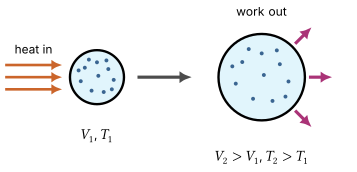
Using the first law and the work $W = - p\Delta V$ for a constant pressure process, the heat transfer into a gas in a constant pressure process is
\[Q_P = \Delta E_{\mathrm{int}} + p\Delta V.\]If the pressure is constant, then the ideal gas law tells us that
\[p \Delta V = n R \Delta T,\]so
\[Q_P = \Delta E_{\mathrm{int}} + n R\Delta T.\]As we noted earlier, the internal energy change for any process is $\Delta E_{\mathrm{int}} = n C_V \Delta T$. Plugging $\Delta E_{\mathrm{int}}$ into the equation for $Q_P$, we get
\[Q_P = n C_V \Delta T + n R \Delta T = n (C_V + R) \Delta T.\]Comparing this to the definition of $C_P$, we see that the constant pressure specific heat is related to the constant volume specific heat by
\[\boxed{C_P = C_V + R.}\]This is a general relation for any ideal gas. For monatomic gases, we find
\[C_P = \frac{5}{2}R \approx 20.79\ \mathrm{J/(mol\cdot K)}.\]Specific heats of monatomic gases
The following figure shows measured values of $C_V$ and $C_P$ for real gases at $25^\circ\mathrm{C}$ and $1\ \mathrm{atm}$. Note that both panels are zoomed in, and the measured values are within about one percent of the prediction.
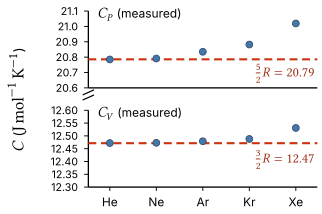
Data: Air Liquide Gas Encyclopedia.
The equipartition theorem
The equipartition theorem
The expression $E_{\mathrm{int}} = \tfrac{3}{2} N k_B T$ for the internal energy of a monatomic ideal gas is a special case of a general principle known as the equipartition theorem. The equipartition theorem says that each quadratic energy term in the microscopic energy of a system contributes $\frac{1}{2} k_B T$ to the thermal energy when we average over all microscopic states.
By “quadratic energy term,” we mean an energy that is proportional to the square of a microscopic variable. For example, the kinetic energy of a single particle
\[K = \tfrac{1}{2} m v_x^2 + \tfrac{1}{2} m v_y^2 + \tfrac{1}{2} m v_z^2\]has three quadratic energy terms, one for each component of the velocity.
Diatomic molecules
Although a monatomic ideal gas only has translational kinetic energy, more complex molecules can have additional types of energy, such as rotational and vibrational energy. These other types of energy also have quadratic energy terms, leading to different expressions for the thermal energy and specific heat of the gas.
Let’s consider a diatomic molecule, which has the following additional types of motion:
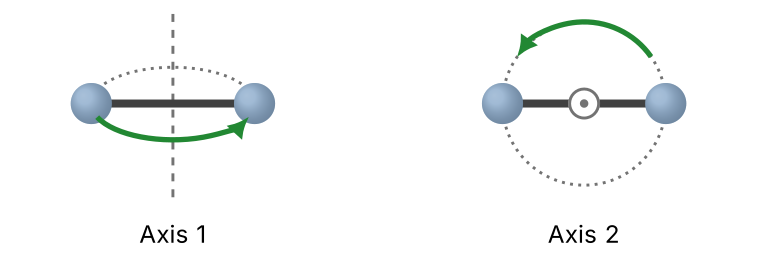
- Rotational motion about the two axes perpendicular to the line connecting the two atoms.
- Vibrational motion of the two atoms along the line connecting them.
Rotational energy of a diatomic molecule
The molecule can rotate about either of the two axes perpendicular to the bond, and each rotation contributes a quadratic energy term to the total energy.
Vibrational energy of a diatomic molecule
The two atoms can also vibrate along the line connecting them, with the bond acting as a spring. This gives two quadratic energy terms: kinetic energy and elastic potential energy.
\[E_{\mathrm{vib}} = \frac{1}{2} m v_s^2 + \frac{1}{2} k_s s^2.\]
Specific heat of a diatomic gas
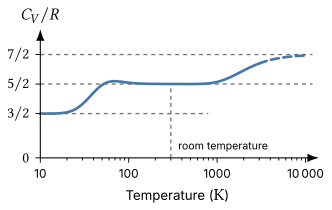
When all of these motions are active, a diatomic molecule has a total of seven quadratic energy terms: three from translational motion, two from rotational motion, and two from vibrational motion. The equipartition theorem would then predict an internal energy $E_{\mathrm{int}} = \tfrac{7}{2}Nk_B T$.
However, the vibrational motion requires higher energies to become active. At everyday temperatures, the vibrational motion is not active, so a diatomic ideal gas has only five quadratic energy terms, and the internal energy is
\[E_{\mathrm{int}} = \frac{5}{2} N k_B T = \frac{5}{2}nRT,\]so the constant volume specific heat for a diatomic gas is
\[C_V = \frac{5}{2}R.\]Rotation becomes active at about $100\ \mathrm{K}$, and vibration only becomes active above about $1000\ \mathrm{K}$. The following figure shows the theoretical $C_V$ for $\mathrm{H_2}$ gas.