Intensity
How loud a sound seems depends on how much energy the wave carries to your ear each second. Since the energy of a sound wave spreads out, what matters is the power that passes through each unit of area.
The intensity of a wave is the power per unit area that it carries,
\[\boxed{I = \frac{P}{a}.}\]Here $P$ is the power carried by the wave through a surface of area $a$ that faces the direction the wave travels. For waves, we write area as a lowercase $a$, because $A$ is already the amplitude.
Recall that power is energy per unit time, measured in watts ($\mathrm{W} = \mathrm{J/s}$). The SI unit of intensity is $\mathrm{W/m^2}$.
The loudness of a sound roughly corresponds to its intensity. A more intense sound generally sounds louder.
Intensity of a point source
A point source with power $P_{\mathrm{source}}$ sends its energy out equally in every direction. All of this power passes through each spherical wavefront. At distance $r$ from the source, the wavefront is a sphere with area $4\pi r^2$, so the intensity is
\[\boxed{I = \frac{P_{\mathrm{source}}}{4\pi r^2}.}\]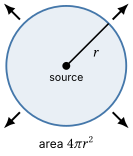
The intensity is inversely proportional to the square of the distance from the source, $I \propto 1/r^2$. This is an inverse-square law. Doubling the distance decreases the intensity by a factor of 4.
This model ignores any energy absorbed by the medium and any sound reflected from the ground or walls. It works best outdoors, away from reflecting surfaces.
Power delivered to a detector
A detector, such as a microphone diaphragm or your eardrum, responds to the sound that reaches it. If the wave has intensity $I$ at the detector, and the detector has area $a_{\mathrm{det}}$ facing the source, the sound power reaching the detector is
\[P_{\mathrm{det}} = I a_{\mathrm{det}}.\]This assumes that the detector is small enough that the intensity is the same everywhere across it. (A real detector reflects part of this power.)
For a point source, combining this with $I = P_{\mathrm{source}}/(4\pi r^2)$ gives
\[P_{\mathrm{det}} = \frac{a_{\mathrm{det}}}{4\pi r^2}\,P_{\mathrm{source}}.\]The detector receives the fraction $a_{\mathrm{det}}/(4\pi r^2)$ of the power of the source, the fraction of the sphere’s area that it covers.
Check your understanding: You stand $2.0\ \mathrm{m}$ from a small speaker that sends out sound equally in every direction.
- You back away to $6.0\ \mathrm{m}$ from the speaker. By what factor does the intensity of the sound change?
- How far from the speaker would you need to stand for the intensity to be $1/100$ of its value at $2.0\ \mathrm{m}$?
Answer
1. The intensity is proportional to $1/r^2$, and $r$ triples, so the intensity decreases by a factor of 9 (to $1/9$ of its value).
2. We need $I/I_1 = (r_1/r)^2 = 1/100$, so $r_1/r = 1/10$. This gives $r = 10 r_1 = 20\ \mathrm{m}$.
Example: Sound reaching your eardrum
A small loudspeaker sends out sound equally in every direction, with a total sound power of $0.200\ \mathrm{W}$.
- What is the intensity of the sound at a distance of $4.00\ \mathrm{m}$ from the speaker?
- Model your eardrum as a circle with a diameter of $8.00\ \mathrm{mm}$ that faces the speaker. How much sound power reaches your eardrum when you stand $4.00\ \mathrm{m}$ from the speaker?
Solution
1. The sound power spreads over a sphere of radius $4.00\ \mathrm{m}$, so the intensity is
\[I = \frac{P_{\mathrm{source}}}{4\pi r^2} = \frac{0.200\ \mathrm{W}}{4\pi(4.00\ \mathrm{m})^2} = 9.95\times 10^{-4}\ \mathrm{W/m^2}.\]2. The eardrum has radius $4.00\ \mathrm{mm}$, so its area is
\[a_{\mathrm{det}} = \pi(4.00\times 10^{-3}\ \mathrm{m})^2 = 5.03\times 10^{-5}\ \mathrm{m^2}.\]The sound power reaching it is
\[P_{\mathrm{det}} = I a_{\mathrm{det}} = (9.95\times 10^{-4}\ \mathrm{W/m^2})(5.03\times 10^{-5}\ \mathrm{m^2}) = 5.00\times 10^{-8}\ \mathrm{W},\]or $50\ \mathrm{nW}$.
Pitch, loudness, and timbre
Pitch
The pitch of a sound is how high or low it seems. The pitch of a pure sinusoidal sound, called a pure tone, is set by its frequency. A higher frequency gives a higher pitch.
A young person with healthy hearing can typically hear frequencies from about $20\ \mathrm{Hz}$ to about $20\ \mathrm{kHz}$. The upper limit decreases with age. In air, these frequencies have wavelengths from about $17\ \mathrm{m}$ down to about $1.7\ \mathrm{cm}$.
Sound with frequencies below this range is called infrasound, and sound with frequencies above it is called ultrasound. Medical ultrasound imaging, which we will study in the chapter on ultrasound, uses frequencies of several megahertz.
The pitch of a periodic sound
Most sounds, like a musical note or a sung vowel, are not pure tones. But if the pressure repeats with a period $T$, we hear a definite pitch, set by the frequency $f = 1/T$ at which the waveform repeats.
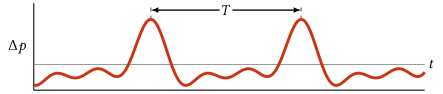
As we saw in the chapter on sinusoidal waves, we can build this wave from sinusoids. A wave that repeats with frequency $f$ is a sum of sinusoids with frequencies $f$, $2f$, $3f$, and so on, called harmonics. The lowest one, with frequency $f$, is the fundamental.
Loudness
The loudness of a sound is how strong it seems to a listener. A more intense sound generally sounds louder, but loudness is a perception, not a physical quantity that an instrument can measure directly.
Loudness depends on frequency. Our hearing is most sensitive to frequencies of a few thousand hertz. A very low or very high tone must be much more intense than a tone of a few thousand hertz to sound equally loud. Loudness also depends on how long a sound lasts, and it differs from one listener to another.
In this course, we will work with intensity, which we can measure, and use it as a rough guide to loudness.
Timbre
A flute and a clarinet playing the same note have the same fundamental frequency and pitch. They still sound different, largely because their waves contain different mixtures of harmonics. This quality is called timbre (pronounced “TAM-ber”).
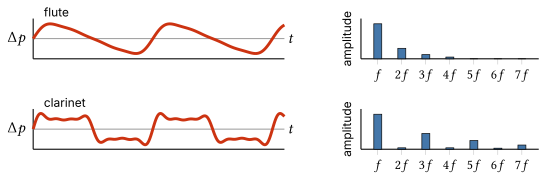
These spectra are simplified. A clarinet’s low notes contain mostly odd harmonics, and we will see why when we study standing waves in pipes.
Sound intensity level
A huge range of intensities
Our hearing responds to an enormous range of intensities. The faintest sounds a person with healthy hearing can detect have intensities of around $10^{-12}\ \mathrm{W/m^2}$. Sounds become painful at around $1\ \mathrm{W/m^2}$, a trillion ($10^{12}$) times as intense.
Our sense of loudness responds roughly to ratios of intensity, not differences. Multiplying the intensity by 10 makes a sound seem louder by about the same factor, whether we start from a whisper or from the noise of a busy street.
So it makes sense to describe sound on a logarithmic scale. A logarithm turns equal ratios into equal steps, so each factor of 10 in intensity adds the same fixed amount. It also fits the huge range of intensities into a manageable range of numbers.
Sound intensity level
The sound intensity level $\beta$ (Greek “beta”) of a sound with intensity $I$ is
\[\boxed{\beta = (10\ \mathrm{dB})\log_{10}\frac{I}{I_0}.}\]The reference intensity $I_0 = 1.0\times 10^{-12}\ \mathrm{W/m^2}$ is close to the intensity of the faintest sound a person can hear at $1000\ \mathrm{Hz}$.
We measure $\beta$ in decibels (dB). A decibel is one tenth of a bel, a unit named after Alexander Graham Bell.
A sound with intensity $I_0$ has $\beta = 0\ \mathrm{dB}$. Each factor of 10 in intensity adds $10\ \mathrm{dB}$: a sound with intensity $10 I_0$ has $\beta = 10\ \mathrm{dB}$, a sound with intensity $100 I_0$ has $\beta = 20\ \mathrm{dB}$, and so on.
To find the intensity from the sound intensity level, we undo the logarithm,
\[I = I_0 \cdot 10^{\beta/(10\ \mathrm{dB})}.\]Typical sound intensity levels
The figure shows typical sound intensity levels for some familiar sounds. Each step of $10\ \mathrm{dB}$ along the scale multiplies the intensity by 10.
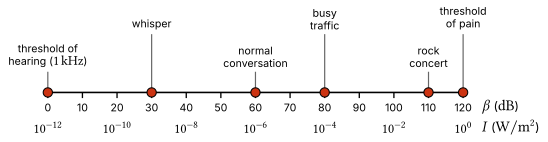
Loud or prolonged exposure to sound can permanently damage hearing, even when the sound is not painful.
Comparing sound intensity levels
For two sounds with intensities $I_1$ and $I_2$, the difference in their sound intensity levels is
\[\begin{aligned} \beta_2 - \beta_1 &= (10\ \mathrm{dB})\log_{10}\frac{I_2}{I_0} - (10\ \mathrm{dB})\log_{10}\frac{I_1}{I_0}\\ &= (10\ \mathrm{dB})\log_{10}\frac{I_2}{I_1}. \end{aligned}\]The difference depends only on the ratio of the two intensities.
Multiplying the intensity by 10 adds $10\ \mathrm{dB}$, and multiplying it by 100 adds $20\ \mathrm{dB}$. Doubling the intensity adds $(10\ \mathrm{dB})\log_{10}2 \approx 3\ \mathrm{dB}$.
Sound intensity levels do not add. For two independent sources, like two people talking, the intensities add. If each person alone produces $60\ \mathrm{dB}$ at your position, the two together double the intensity and produce $63\ \mathrm{dB}$, not $120\ \mathrm{dB}$.
Sound intensity level and distance
For a point source, $I \propto 1/r^2$. If you move from a distance $r_1$ to a distance $r_2$ from the source, the intensity changes by the factor $I_2/I_1 = (r_1/r_2)^2$. The sound intensity level changes by
\[\begin{aligned} \beta_2 - \beta_1 &= (10\ \mathrm{dB})\log_{10}\Big(\frac{r_1}{r_2}\Big)^2\\ &= (20\ \mathrm{dB})\log_{10}\frac{r_1}{r_2}. \end{aligned}\]Doubling your distance from the source decreases the sound intensity level by $(20\ \mathrm{dB})\log_{10}2 \approx 6\ \mathrm{dB}$. Moving 10 times as far away decreases the intensity by a factor of 100, but it decreases the sound intensity level by only $20\ \mathrm{dB}$.
Check your understanding:
- One violin playing alone produces a sound intensity level of $60\ \mathrm{dB}$ at your seat. What sound intensity level do ten violins, each playing just as loudly, produce at your seat?
- The sound intensity level at your position increases from $60\ \mathrm{dB}$ to $90\ \mathrm{dB}$. By what factor does the intensity increase?
Answer
1. Ten violins give ten times the intensity of one, so $\beta$ increases by $(10\ \mathrm{dB})\log_{10}10 = 10\ \mathrm{dB}$, to $70\ \mathrm{dB}$.
2. The increase of $30\ \mathrm{dB} = (10\ \mathrm{dB})\log_{10}(I_2/I_1)$ gives $I_2/I_1 = 10^3 = 1000$.
Example: A speaker on the lawn
A speaker on an open lawn sends out sound equally in every direction. At a distance of $2.00\ \mathrm{m}$ from the speaker, the sound intensity level is $80.0\ \mathrm{dB}$.
- What is the intensity of the sound at a distance of $2.00\ \mathrm{m}$ from the speaker?
- What is the total sound power of the speaker?
- What is the sound intensity level at a distance of $20.0\ \mathrm{m}$ from the speaker?
Solution
1. Undoing the logarithm,
\[I = I_0 \cdot 10^{\beta/(10\ \mathrm{dB})} = (1.0\times 10^{-12}\ \mathrm{W/m^2})(10^{8.00}) = 1.0\times 10^{-4}\ \mathrm{W/m^2}.\]2. All of the sound power passes through a sphere of radius $2.00\ \mathrm{m}$, so
\[P_{\mathrm{source}} = I \cdot 4\pi r^2 = (1.0\times 10^{-4}\ \mathrm{W/m^2})(4\pi)(2.00\ \mathrm{m})^2 = 5.0\times 10^{-3}\ \mathrm{W}.\]3. The distance increases by a factor of 10, so the sound intensity level decreases by
\[(20\ \mathrm{dB})\log_{10}10 = 20\ \mathrm{dB},\]to $60.0\ \mathrm{dB}$.
Summary
A point source produces spherical waves. The intensity is $I = P/a$, which for a point source is $I = P_{\mathrm{source}}/(4\pi r^2)$. The sound power reaching a detector of area $a_{\mathrm{det}}$ is $P_{\mathrm{det}} = I a_{\mathrm{det}}$.
The pitch of a sound is set by its frequency, and its timbre depends largely on its mixture of harmonics. Its loudness depends mainly on its intensity, but also on its frequency.
The sound intensity level is $\beta = (10\ \mathrm{dB})\log_{10}(I/I_0)$. Multiplying the intensity by 10 adds $10\ \mathrm{dB}$, and doubling the distance from a point source decreases $\beta$ by about $6\ \mathrm{dB}$.