Viscosity
Real fluids resist flowing
If you pour water and honey out of two jars, the water flows out readily, while the honey flows much more slowly. Both are pulled downward by gravity, but honey has a much greater resistance to flow.
A fluid’s resistance to flow is called its viscosity. Viscosity is a form of internal friction between layers of fluid sliding past one another. We measure the strength of this friction with the viscosity coefficient $\eta$ (Greek “eta”), usually just called the viscosity.
In Physics 5A, we used $\eta$ to describe the drag on a sphere moving slowly through a fluid: $F_d = bv$, with $b = 6\pi\eta r$. In this chapter we will consider how the same viscous drag affects the fluid itself as it flows through a tube.
Defining viscosity
Consider a layer of fluid of thickness $d$ between two flat plates of area $A$. The bottom plate is fixed, and the top plate moves at constant speed $v$. The fluid in contact with each plate moves with that plate, so the layers in between slide past one another.
To keep the top plate moving at constant speed, we must apply a force $F$ to balance the viscous friction. Experiments show that this force is proportional to $A$ and $v$ and inversely proportional to $d$. The viscosity $\eta$ is the constant of proportionality:
\[F = \frac{\eta A v}{d}. \qquad \text{Units of } \eta\text{: } \mathrm{Pa\,s}\]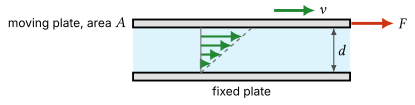
Viscosities of common fluids
The SI unit of viscosity is the pascal second: $1\ \mathrm{Pa\,s} = 1\ \mathrm{N\,s/m^2}$. Here are some typical values:
| Fluid | Viscosity |
|---|---|
| air ($20^\circ\mathrm{C}$) | $1.8\times 10^{-5}\ \mathrm{Pa\,s}$ |
| water ($20^\circ\mathrm{C}$) | $1.0\times 10^{-3}\ \mathrm{Pa\,s}$ |
| water ($37^\circ\mathrm{C}$) | $0.7\times 10^{-3}\ \mathrm{Pa\,s}$ |
| whole blood ($37^\circ\mathrm{C}$) | $3.5\times 10^{-3}\ \mathrm{Pa\,s}$ |
| olive oil ($20^\circ\mathrm{C}$) | $0.08\ \mathrm{Pa\,s}$ |
| honey ($20^\circ\mathrm{C}$) | about $10\ \mathrm{Pa\,s}$ |
Blood is about five times as viscous as water at the same temperature. Its viscosity varies with its red blood cell content, and it decreases when neighboring layers slide past one another faster. We will approximate blood as a fluid with constant viscosity, $\eta = 3.5\times 10^{-3}\ \mathrm{Pa\,s}$.
What sets the viscosity?
Viscosity depends strongly on temperature. In a liquid, the internal friction comes mainly from the attraction between neighboring molecules. Warmer molecules move fast enough to break free of their neighbors more easily, so a liquid’s viscosity decreases as it warms. This is why warm honey pours more easily than cold honey.
In a gas, the molecules are far apart, and the friction comes from molecules colliding as they wander between layers. Warmer molecules move and collide more, so a gas’s viscosity increases with temperature.
The viscosity of blood depends mostly on its hematocrit, the fraction of its volume occupied by red blood cells (typically about 35 to 50% in healthy adults). More red blood cells mean more viscous blood. Dehydration can increase the hematocrit and the viscosity.
Viscous flow in a tube
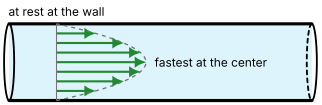
In a tube, the fluid in contact with the wall is at rest. Internal friction between neighboring layers makes the flow speed increase from the wall toward the center. For steady laminar flow in a long, straight, round tube, a graph of the speed across the tube is a parabola.
Since the speed varies across the tube, we must use the average flow speed in the continuity equation. The volume flow rate is $Q = v_{\mathrm{avg}}A$, so $v_{\mathrm{avg}} = Q/A$. For steady flow of an incompressible fluid, $Q$ is still the same at every cross-section of the tube.
Pressure difference in viscous flow
A block sliding at constant speed on a rough floor needs a force to balance friction. Similarly, a viscous fluid flowing steadily through a tube needs a forward force to balance the friction from the walls.
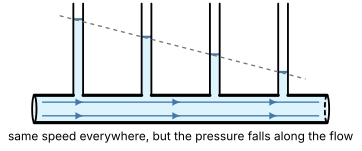
This force comes from the pressure. In a uniform horizontal tube, the pressure must decrease steadily along the direction of flow, so that the pressure behind each bit of fluid is greater than the pressure ahead of it.
Where does the energy go?
We can apply the energy principle to the fluid in a uniform horizontal tube, as we did for Bernoulli’s equation. Since the tube is uniform, the flow speed does not change, so $\Delta K = 0$. Since the tube is horizontal, $\Delta U_g = 0$. The pressure forces still do net work $W_{\mathrm{ext}} = (p_1 - p_2)\,\Delta V$ as a volume $\Delta V$ flows through, and this work increases the thermal energy:
\[\Delta E_{\mathrm{th}} = (p_1 - p_2)\,\Delta V.\]The pressure drop is the energy per unit volume that viscous friction turns into thermal energy.
Dividing the work by $\Delta t$, we find the power needed to maintain the flow: $P = \Delta p\, Q$. For the left side of the heart, $\Delta p \approx 95\ \mathrm{mmHg} = 1.3\times 10^{4}\ \mathrm{Pa}$ and $Q \approx 8.3\times 10^{-5}\ \mathrm{m^3/s}$, so it does work on the blood at a rate of about $1\ \mathrm{W}$.
Poiseuille’s law
Poiseuille’s experiments
Jean Poiseuille was a French physician who wanted to understand the flow of blood. In his 1828 medical thesis, he measured the blood pressure in the arteries of animals with a mercury manometer, an early step toward the mmHg we still use for blood pressure.
Because flow inside living vessels is difficult to control and measure, Poiseuille studied water flowing through narrow glass tubes. His experiments showed how the flow rate depends on the pressure difference, the length of the tube, and its radius. We will use his result to model blood flow.
Poiseuille’s law
Consider a fluid of viscosity $\eta$ in steady laminar flow through a long, straight, rigid round tube of radius $r$ and length $L$. If the pressure difference between the ends of the tube is $\Delta p = p_1 - p_2$, then the volume flow rate through the tube is
\[\boxed{Q = \frac{\pi r^4}{8\eta L}\,\Delta p.}\]This is Poiseuille’s law. We want to know the pressure difference required to drive a given flow rate. Solving for $\Delta p$,
\[\Delta p = \frac{8\eta L Q}{\pi r^4}.\]For a horizontal tube, the pressure decreases steadily along the direction of flow. It is higher at the upstream end and lower at the downstream end.
Reading Poiseuille’s law
We can understand how the flow rate depends on each variable by holding the others fixed:
- The flow rate is proportional to the pressure difference, $Q \propto \Delta p$. Doubling the pressure difference doubles the flow rate.
- The flow rate is inversely proportional to the viscosity, $Q \propto 1/\eta$. A more viscous fluid has a smaller flow rate for the same pressure difference.
- The flow rate is inversely proportional to the length, $Q \propto 1/L$. A longer tube has more wall to exert friction on the fluid.
- The flow rate is proportional to the fourth power of the radius, $Q \propto r^4$. Doubling the radius increases the flow rate by a factor of $2^4 = 16$.
Viscous flow depends strongly on the radius
The fourth power makes the flow rate especially sensitive to the radius. Why the fourth power? A wider tube has more area, $A = \pi r^2$. In a wider tube, most of the fluid is also farther from the walls, so its average speed is larger, $v_{\mathrm{avg}} \propto r^2$. Since $Q = v_{\mathrm{avg}}A$, these two factors give $Q \propto r^4$.
Check your understanding: The radius of a blood vessel decreases by 10%, while its length and the viscosity of the blood stay the same.
- If the flow rate through the vessel stays the same, by what factor does the pressure difference along it change?
- If instead the pressure difference stays the same, by what factor does the flow rate change?
Answer
1. At fixed $Q$, the pressure difference is proportional to $1/r^4$, so it increases by a factor of $1/0.9^4 = 1.52$, about 50%.
2. At fixed $\Delta p$, the flow rate is proportional to $r^4$, so it falls to $0.9^4 = 0.66$ of its original value, a drop of about a third.
Example: The aorta and an arteriole
The heart pumps blood (viscosity $3.5\times 10^{-3}\ \mathrm{Pa\,s}$) into the aorta at $5.0\ \mathrm{L/min}$. Give your answers to parts 1 and 2 in mmHg.
- Model the aorta as a tube of diameter $2.0\ \mathrm{cm}$. What is the pressure drop along a $30\ \mathrm{cm}$ length of the aorta?
- Farther downstream, model the arterioles, the smallest arteries, as $1.0\times 10^{8}$ identical tubes of diameter $20\ \mu\mathrm{m}$ that share the total flow equally. What is the pressure drop along a $1.0\ \mathrm{mm}$ length of one arteriole?
- Compare your two answers.
Solution
1. The flow rate in the aorta is $Q = 5.0\ \mathrm{L/min} = 8.33\times 10^{-5}\ \mathrm{m^3/s}$, and its radius is $r = 0.010\ \mathrm{m}$. Poiseuille’s law gives the pressure drop
\[\Delta p = \frac{8\eta L Q}{\pi r^4} = \frac{8(3.5\times 10^{-3}\ \mathrm{Pa\,s})(0.30\ \mathrm{m})(8.33\times 10^{-5}\ \mathrm{m^3/s})}{\pi(0.010\ \mathrm{m})^4} = 22\ \mathrm{Pa}.\]Since $1\ \mathrm{mmHg} = 133\ \mathrm{Pa}$, this is $\Delta p = 0.17\ \mathrm{mmHg}$.
2. By continuity, each arteriole carries an equal share of the total flow,
\[Q_{\mathrm{art}} = \frac{Q}{N} = \frac{8.33\times 10^{-5}\ \mathrm{m^3/s}}{1.0\times 10^{8}} = 8.33\times 10^{-13}\ \mathrm{m^3/s}.\]An arteriole has radius $r_{\mathrm{art}} = 1.0\times 10^{-5}\ \mathrm{m}$, so the pressure drop along $1.0\ \mathrm{mm}$ of one arteriole is
\[\Delta p = \frac{8\eta L Q_{\mathrm{art}}}{\pi r_{\mathrm{art}}^4} = \frac{8(3.5\times 10^{-3}\ \mathrm{Pa\,s})(1.0\times 10^{-3}\ \mathrm{m})(8.33\times 10^{-13}\ \mathrm{m^3/s})}{\pi(1.0\times 10^{-5}\ \mathrm{m})^4} = 743\ \mathrm{Pa},\]or $\Delta p = 5.6\ \mathrm{mmHg}$.
3. The pressure drop along $1.0\ \mathrm{mm}$ of one arteriole is about 30 times the drop along $30\ \mathrm{cm}$ of the aorta. Each arteriole carries a much smaller flow rate, but its radius is 1000 times smaller, and $\Delta p \propto 1/r^4$.
How good is the model?
Poiseuille’s law assumes steady flow of a fluid with constant viscosity through a long, straight, rigid tube. Real arteries are elastic, they curve and branch, and the flow pulses with each heartbeat.
Blood is a suspension of cells in plasma rather than a uniform fluid. In the smallest vessels, red blood cells nearly fill the tube and pass through capillaries in single file, so the effective viscosity of blood depends on the size of the vessel.
Vessels of the same type also vary in radius and length. These calculations help us understand how strongly the pressure drop depends on the radius, but they cannot predict the pressures in a particular person’s circulation.
Where the pressure decreases
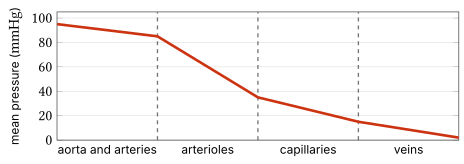
The measured mean pressure decreases only slightly along the large arteries, and it decreases most across the small arteries and arterioles. These are the body’s main resistance arteries. The pressure reaches a few mmHg where the veins return blood to the heart. The graph shows typical values, which differ from organ to organ.
Controlling blood flow
The walls of the arterioles contain rings of smooth muscle. When this muscle contracts, the vessel narrows (vasoconstriction). When it relaxes, the vessel widens (vasodilation). Since $Q \propto r^4$ for a fixed pressure difference, a small change in radius can produce a large change in blood flow. Your body uses this to increase the flow to working muscles during exercise, or to the skin when it needs to lose heat.
If the small arteries and arterioles stay narrowed, the heart must supply a larger pressure difference to push the same flow through them. This is one of the main contributors to high blood pressure (hypertension).