Laminar and turbulent flow
When does flow become turbulent?
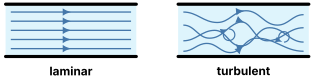
Poiseuille’s law, like Bernoulli’s equation, assumes laminar flow. If you turn on a faucet gently, you’ll see a smooth stream. If you increase the flow, the stream appears rougher, indicating that the flow has become turbulent.
Viscosity tends to suppress turbulence by damping out small disturbances in the flow. When the fluid’s inertia (its tendency to keep moving) is large compared with the viscous friction, these disturbances can grow into swirling eddies instead of dying out.
The Reynolds number
In Physics 5A we met the Reynolds number, a dimensionless number that compares the effects of a fluid’s inertia with the effects of its viscosity. For flow through a tube of diameter $d$ at average speed $v$,
\[\mathrm{Re} = \frac{\rho v d}{\eta}.\]Increasing the flow speed, the tube diameter, or the fluid density increases the Reynolds number, while increasing the viscosity decreases it. A larger Reynolds number means that inertia is more important relative to viscosity, which makes turbulence more likely.
As a rule of thumb, flow in a smooth tube is laminar when $\mathrm{Re}$ is below about 2000 and tends to become turbulent when $\mathrm{Re}$ is well above 2000. The changeover is not sharp, and the details depend on the tube and on how the fluid enters it.
Flow past a cylinder at low Reynolds number
For flow past an object, the length in the Reynolds number is the size of the object. Photographs of fluid flowing from left to right past a cylinder, with $d$ the cylinder’s diameter, show how the flow changes as the Reynolds number grows.
At $\mathrm{Re} = 1.54$, viscosity dominates. The flow follows the surface all the way around the cylinder and closes up smoothly behind it: tracer streaks bend around the top and bottom of the cylinder, never cross, and form no swirls. At $\mathrm{Re} = 26$, the flow separates from the back of the cylinder and leaves two swirling eddies behind it, one above the other, turning in opposite directions. These eddies stay in place, so the flow is still steady and laminar.
Flow past a cylinder at high Reynolds number
At $\mathrm{Re} = 2000$, the flow stays smooth over the front of the cylinder, but it separates from the surface and the wake behind the cylinder is turbulent: the region directly behind the cylinder is filled with disordered streaks pointing in all directions. At $\mathrm{Re} = 10{,}000$, the turbulent wake is wider and swings from side to side as large eddies form on alternate sides.
How a jet becomes turbulent
A photograph of a jet of fluid flowing to the right out of a round nozzle at $\mathrm{Re} = 10{,}000$ shows the jet leaving the nozzle in smooth, laminar flow.
Small ripples on the edges of the jet grow as it moves downstream and roll into swirls. A short distance later the jet breaks up into turbulence. At this large Reynolds number, viscosity is too weak to damp out the small disturbances, so they grow into eddies.
The photographs shown in lecture are from M. Van Dyke, An Album of Fluid Motion (1982): cylinder at $\mathrm{Re} = 1.54$ and $26$ by S. Taneda; cylinder at $\mathrm{Re} = 2000$, ONERA photograph, Werlé and Gallon (1972); cylinder at $\mathrm{Re} = 10{,}000$ by T. Corke and H. Nagib; and jet by R. Drubka and H. Nagib.
Effects of turbulent flow
The swirling eddies of turbulent flow dissipate mechanical energy much more rapidly than laminar flow does. Poiseuille’s law no longer applies, and maintaining the same flow rate requires a larger pressure difference than the law predicts. In the circulation, this means the heart must do more work to maintain the flow.
Turbulent flow can also be noisy. The eddies can shake the vessel walls and surrounding tissue strongly enough for a doctor to hear the vibrations through a stethoscope. Smooth laminar flow is nearly silent, so doctors listen for the sounds of disturbed flow:
- A heart murmur is an extra sound made by disturbed blood flow in the heart or the large vessels next to it. It can come from a narrowed or leaky valve, from an abnormal opening between chambers, or simply from a large flow through a healthy heart.
- A bruit is a similar sound heard over a blood vessel, often from disturbed flow just past a narrowing such as a stenosis.