Buoyancy
The buoyant force
Because pressure increases with depth, a submerged object feels a larger upward push on its bottom than the downward push on its top. The net upward force from the fluid pressure is the buoyant force $\vec{F}_B$. The buoyant force is what lifts a helium balloon and what makes you feel lighter in a swimming pool.
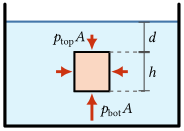
Derivation: The buoyant force
Consider a cylinder of height $h$ and face area $A$, with its top submerged at depth $d$. The horizontal pressure forces on its sides cancel. The net upward force is the difference between the pressure forces on its bottom and top:
\[F_B = p_{\mathrm{bot}}A - p_{\mathrm{top}}A = \bigl[p_0 + \rho_f g (d + h)\bigr] A - \bigl(p_0 + \rho_f g \, d\bigr) A = \rho_f g \underbrace{hA}_{V}.\]Notice that the surface pressure $p_0$ and the depth $d$ both cancel. The buoyant force depends on the volume of fluid displaced, not on how far below the surface the cylinder is.
Archimedes’ principle
This result holds for any shape. The quantity $\rho_f V g$ is the weight of the displaced fluid, so we can state the result as
The magnitude of the buoyant force on an object equals the weight of the fluid it displaces.
This is called Archimedes’ principle. As an equation,
\[\boxed{F_B = \rho_f \, V_{\mathrm{disp}} \, g}\]In this equation, $\rho_f$ is the density of the fluid, and $V_{\mathrm{disp}}$ is the volume of the object below the fluid surface.
Float or sink?
Whether an object floats depends on its density compared to the fluid’s. For an object of volume $V$ and density $\rho_o$ fully submerged in a fluid of density $\rho_f$, the net force is
\[F_{\mathrm{net},y} = F_B - mg = \rho_f V g - \rho_o V g = (\rho_f - \rho_o) V g.\]The direction of the net force depends on the relative densities:
- If $\rho_o > \rho_f$, the net force is downward, so the object sinks.
- If $\rho_o = \rho_f$, the object is in equilibrium while fully submerged. This is called neutral buoyancy.
- If $\rho_o < \rho_f$, the net force is upward, so the object rises and floats at the surface.
Floating, sinking, and neutral buoyancy
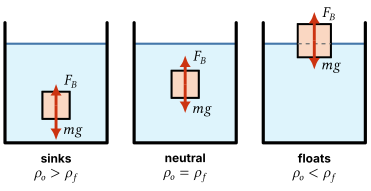
A floating object is in equilibrium when the buoyant force equals its weight. By Archimedes’ principle, this means that the displaced fluid weighs as much as the object: $F_B = \rho_f V_{\mathrm{disp}}\, g = mg$.
Apparent weight
Even when a submerged object is dense enough to sink, the buoyant force supports part of its weight. The additional force that must be applied to keep an object in equilibrium is called the apparent weight:
\[w_{\mathrm{app}} = mg - F_B.\]This apparent weight is what a scale supporting an object measures.
This is the principle behind hydrostatic weighing for body composition. Weighing a person in air and again underwater gives their volume, and hence their average density. Since fat is less dense than muscle and bone, the average density can be used to estimate body fat.
Example: A floating cube
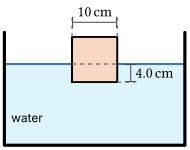
A solid cube with side length $10\ \mathrm{cm}$ floats in water with the bottom face of the cube $4.0\ \mathrm{cm}$ below the surface. What is the density of the cube?
Solution
The cube floats in equilibrium, so the buoyant force equals its weight, $F_B = mg$. Let $A$ be the area of the cube’s bottom face. The submerged part of the cube has volume $V_{\mathrm{disp}} = (0.040\ \mathrm{m})A$, and the whole cube has volume $(0.10\ \mathrm{m})A$, so
\[\rho_w g\,(0.040\ \mathrm{m})A = \rho_c g\,(0.10\ \mathrm{m})A.\]Canceling $g$ and $A$ and solving for the density of the cube,
\[\rho_c = (0.40)(1000\ \mathrm{kg/m^3}) = \boxed{400\ \mathrm{kg/m^3}}.\]