Energy in simple harmonic motion
Mechanical energy of a mass on a spring
Recall from Physics 5A that the total mechanical energy of a system is the sum of its kinetic and potential energies, $E_{\mathrm{mech}} = K + U$. For the mass-spring system, the kinetic energy of the block and the elastic potential energy stored in the spring are
\[K = \tfrac{1}{2} m v_x^2, \qquad U_{\mathrm{el}} = \tfrac{1}{2} k_s x^2.\]Assuming no friction or external forces, the total mechanical energy
\[E_{\mathrm{mech}} = K + U_{\mathrm{el}}\]stays constant. As the block oscillates, energy changes back and forth between kinetic and potential, but the total never changes.
Derivation: The energy of an oscillator
Since $E_{\mathrm{mech}}$ is the same at every instant, we can find it by looking at whichever instant is easiest. The simplest choice is a turning point.
At a turning point, the block is at $x = \pm A$ and is momentarily at rest, so $v_x = 0$. The kinetic energy is zero, and all of the energy is elastic potential energy:
\[K = 0, \qquad U_{\mathrm{el}} = \tfrac{1}{2} k_s A^2.\]So the mechanical energy at the turning point, and therefore at every instant, is
\[E_{\mathrm{mech}} = K + U_{\mathrm{el}} = 0 + \tfrac{1}{2} k_s A^2.\]Mechanical energy and amplitude
The mechanical energy of an oscillator depends only on the spring constant and the amplitude:
\[\boxed{E_{\mathrm{mech}} = \tfrac{1}{2} k_s A^2.}\]For a given spring, doubling the amplitude quadruples the energy. In phase space, an oscillator with greater energy traces out a larger circle.
The phase determines how the total energy divides between kinetic and potential energy. The potential energy is $U_{\mathrm{el}} = \tfrac{1}{2} k_s x^2 = \tfrac{1}{2} k_s A^2\cos^2\phi$, a fraction $\cos^2\phi$ of the total. The kinetic energy, $K = E_{\mathrm{mech}} - U_{\mathrm{el}}$, is a fraction $1 - \cos^2\phi = \sin^2\phi$.
Energy bar charts
These energy bar charts show how the mechanical energy is split up at three different phases.
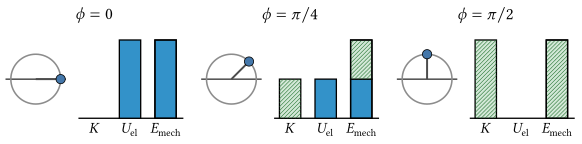
At a turning point, all of the energy is potential. As the mass passes its equilibrium position, all of it is kinetic.
Energy as a function of time
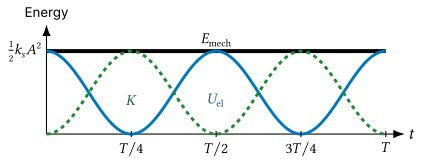
Here are the energies plotted against time for $\phi_0 = 0$. As the kinetic energy increases, the potential energy decreases by the same amount, so their sum stays fixed. Each energy form repeats twice for every cycle of the motion, because the block is at rest twice per cycle, once at each turning point.
Energy and the maximum speed
At equilibrium, $U_{\mathrm{el}} = 0$, so all of the energy is kinetic. Conservation of mechanical energy gives $\tfrac{1}{2} m v_{\mathrm{max}}^2 = \tfrac{1}{2} k_s A^2$. Solving for the maximum speed, we get $v_{\mathrm{max}} = A\sqrt{k_s/m} = A\omega$, which is what we found from $v_x(t)$.
Energy conservation also gives the speed at any position, without needing the time or the phase.
Example: Speed from energy
The $0.500\ \mathrm{kg}$ block from the example in the chapter on simple harmonic motion oscillates on a spring with $k_s = 20.0\ \mathrm{N/m}$ with an amplitude of $10.0\ \mathrm{cm}$. What is its mechanical energy? How fast is it moving when it is $5.0\ \mathrm{cm}$ from equilibrium?
Solution
The mechanical energy is
\[E_{\mathrm{mech}} = \tfrac{1}{2} k_s A^2 = \tfrac{1}{2}(20.0\ \mathrm{N/m})(0.100\ \mathrm{m})^2 = 0.100\ \mathrm{J}.\]At $x = 5.0\ \mathrm{cm}$, the elastic potential energy is
\[U_{\mathrm{el}} = \tfrac{1}{2} k_s x^2 = \tfrac{1}{2}(20.0\ \mathrm{N/m})(0.050\ \mathrm{m})^2 = 0.025\ \mathrm{J},\]so the kinetic energy is $K = E_{\mathrm{mech}} - U_{\mathrm{el}} = 0.075\ \mathrm{J}$, and the speed is
\[v = \sqrt{\frac{2K}{m}} = \sqrt{\frac{2(0.075\ \mathrm{J})}{0.500\ \mathrm{kg}}} = 0.55\ \mathrm{m/s}.\]The simple pendulum
Describing a pendulum
A simple pendulum is a small mass $m$ hanging from a massless string or rod of length $L$ and swinging under the influence of gravity.
We describe its position by the angle $\theta$ between the string and the vertical, or by the arc length $s$ measured along the bob’s path from the equilibrium point. With $\theta$ in radians,
\[s = L\theta.\]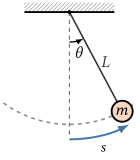
Newton’s second law for the pendulum
There are two forces on the mass: tension and gravity. The tension points along the string, perpendicular to the bob’s path, so it has no component along the path. The weight has a component $mg\sin\theta$ along the path, pointing back toward equilibrium.
Taking $+s$ in the direction of increasing $\theta$, Newton’s second law along the path is
\[F_{\mathrm{net},s} = -mg\sin\theta = m a_s.\]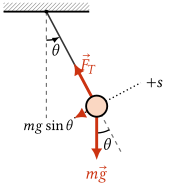
The small-angle approximation
The restoring force is proportional to $\sin\theta$, not to $\theta$, so the pendulum does not quite fit the SHM pattern. But for small angles measured in radians, $\sin\theta \approx \theta$:
| $\theta$ (degrees) | $\theta$ (radians) | $\sin\theta$ | Difference |
|---|---|---|---|
| $5^\circ$ | 0.0873 | 0.0872 | 0.1% |
| $10^\circ$ | 0.1745 | 0.1736 | 0.5% |
| $20^\circ$ | 0.3491 | 0.3420 | 2.1% |
| $30^\circ$ | 0.5236 | 0.5000 | 4.7% |
| $45^\circ$ | 0.7854 | 0.7071 | 11% |
The last column is how much larger $\theta$ is than $\sin\theta$. This small-angle approximation is accurate to within about 1% up to $15^\circ$, and it gets steadily worse at larger angles.
The pendulum moves in SHM
With $\sin\theta \approx \theta$, Newton’s second law becomes $m a_s = -mg\theta$. Substituting $\theta = s/L$ and canceling the mass,
\[a_s = -\frac{g}{L}\, s.\]The acceleration is proportional to minus the displacement, which shows that this is SHM. Comparing with $a_x = -\omega^2 x$, the angular frequency of a simple pendulum is
\[\boxed{\omega = \sqrt{\frac{g}{L}}.}\]The period $T = 2\pi\sqrt{L/g}$ depends only on the length and on $g$. The mass canceled, so a heavy bob and a light one on strings of the same length have the same period. For small angles, the period does not depend on the amplitude either.
Two different circles
The bob really does move along a physical circle of radius $L$, but only back and forth over a short arc, speeding up and slowing down. The reference circle is a circle in phase space, and its state point goes all the way around at the steady rate $\omega$.
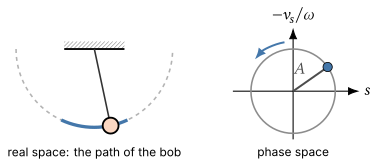
The angular frequency $\omega = \sqrt{g/L}$ is the rate at which the phase changes, not the rate at which the string swings through the angle $\theta$.
Summary: two simple harmonic oscillators
The mass on a spring and the simple pendulum both have a restoring acceleration proportional to the displacement, so both move in simple harmonic motion:
| System | Equation of motion | Angular frequency |
|---|---|---|
| Mass on a spring | $a_x = -(k_s/m)\,x$ | $\omega = \sqrt{k_s/m}$ |
| Simple pendulum (small angles) | $a_s = -(g/L)\,s$ | $\omega = \sqrt{g/L}$ |
In both, $x(t) = A\cos(\omega t + \phi_0)$ (or the same with $s$ in place of $x$), with $v_{\mathrm{max}} = A\omega$ and $a_{\mathrm{max}} = A\omega^2$. The period depends on the system’s physical properties but not on the amplitude.