Describing fluid flow
Describing a moving fluid
In steady flow, the flow pattern does not change with time. We can describe this flow using streamlines, the paths followed by small parcels of fluid. Streamlines never cross.
Flow in which the fluid moves in smooth layers is called laminar. Laminar flow need not be steady: blood flow in most arteries is laminar even though it pulses with each heartbeat. Flow that is not laminar is called turbulent: the fluid swirls in eddies, the layers mix, and the motion is chaotic.
Turbulent flow is much more difficult to analyze, and understanding turbulence remains a major open problem in physics. We will assume laminar flow in this chapter and discuss turbulence qualitatively in a later chapter.
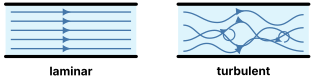
Laminar and turbulent flow in photographs
We can make streamlines visible by adding a tracer, such as dye or fine particles, to a moving fluid. In photographs of laminar flow past a fixed object, such as an airfoil or a cylinder, the tracer lines stay smooth and never cross. They spread apart in front of the object, crowd together as they pass it, and close up again behind it.
In turbulent flow, the tracer breaks up into swirling eddies of many sizes, and neighboring parcels of fluid mix. The motion at any point changes rapidly and unpredictably. Laminar flow that passes through a grid becomes turbulent downstream, and so does a jet of fluid entering still fluid.
The photographs shown in lecture are from M. Van Dyke, An Album of Fluid Motion (1982): airfoil by H. Werlé (ONERA), cylinder by S. Taneda, grid by T. Corke and H. Nagib, and jet by Dimotakis, Lye, and Papantoniou (1981).
Steady, incompressible flow
Real fluids are complicated, so we will make several simplifying assumptions in our model. The first two are:
- The fluid is incompressible, so its density $\rho$ is constant. This is a good approximation for liquids, and for gases flowing at speeds well below the speed of sound.
- The flow is steady and laminar, so the fluid moves in smooth layers and the flow pattern does not change with time.
These two assumptions are enough to relate the flow speed to the size of a tube. We make no assumption about friction within the fluid, so these results apply to viscous fluids such as blood.
Blood flow changes with each heartbeat, so steady flow is only a first approximation to blood flow.
Flow rate and continuity
Flow through a tube
We will focus on fluid flowing through a tube. The tube’s cross-sectional area $A$ and the flow speed $v$ may change along its length, but we assume the flow is laminar and that the speed is the same everywhere across a given cross-section.
In the chapter on viscosity, we will see that friction (viscosity) makes the speed vary across a tube. The results in this chapter still hold if $v$ is the average flow speed.
Since fluid cannot pass through the walls, the walls of the tube are themselves streamlines. In fact, any bundle of streamlines acts like a tube (no fluid crosses a streamline), so what we learn about tubes applies to flow around obstacles too. We can use this model to study flow through blood vessels, airways, pipes, and IV lines.
Volume flow rate
The basic quantity describing flow through a tube is the volume flow rate $Q$: the volume of fluid that passes through a cross-section of the tube per unit time,
\[\boxed{Q = \frac{\Delta V}{\Delta t}.} \qquad \text{Units: } \mathrm{m^3/s}\]In medicine, flow rates are usually quoted in liters per minute. At rest, your heart pumps about $5\ \mathrm{L/min}$ of blood (the cardiac output), which is about $8\times 10^{-5}\ \mathrm{m^3/s}$.
Caution: We use the symbol $Q$ for volume flow rate, even though we used the same symbol for heat in thermodynamics. These are different physical quantities. In our discussion of fluids, $Q$ will always refer to the volume flow rate.
Flow rate, speed, and area
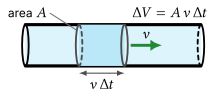
Consider fluid moving at speed $v$ through a tube of cross-sectional area $A$. In a time $\Delta t$, the fluid moves a distance $v\,\Delta t$, so the volume that passes through a given cross-section is $\Delta V = A\,v\,\Delta t$. Dividing by $\Delta t$ gives
\[\boxed{Q = vA.}\]The flow rate $Q$ measures volume per unit time, while the flow speed $v$ measures distance per unit time. The cross-sectional area of the tube relates the two through $Q = vA$.
The continuity equation
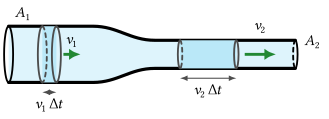
In steady flow, fluid does not accumulate anywhere inside the tube. Because mass is conserved, the mass passing through each cross-section per unit time must be the same. For an incompressible fluid, the density is constant, so the volume flow rate is also the same at every cross-section:
\[Q_1 = Q_2 \qquad\Longrightarrow\qquad \boxed{v_1 A_1 = v_2 A_2.}\]This is called the continuity equation.
Flow speed and tube size
The continuity equation tells us that the flow speed increases where the tube narrows and decreases where it widens. Since the same volume must pass through each cross-section in a given time, a smaller area requires a greater flow speed.
Check your understanding: Fluid flows through a tube whose diameter doubles from one section to the next. By what factor does the flow speed change? What if the diameter is halved instead?
Answer
The area is proportional to the square of the diameter, $A = \pi d^2/4$. Doubling the diameter multiplies the area by 4, so the flow speed decreases to one quarter of its value. Halving the diameter divides the area by 4, so the flow speed increases by a factor of 4.
Branching tubes
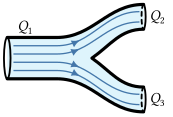
When a tube splits into branches, all of the fluid entering the junction must leave through the branches, so the total volume flow rate is conserved:
\[Q_1 = Q_2 + Q_3.\]If a tube carrying a volume flow rate $Q$ splits into $N$ identical branches, the flow rate in each branch will be $Q/N$. We can use this to model the circulatory system, where the aorta branches many times into billions of capillaries.
The circulation as a branching tree
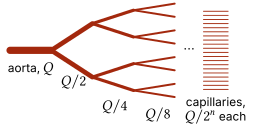
The aorta branches into arteries, which branch into smaller and smaller vessels, ending in the capillaries (in which oxygen and nutrients are exchanged with tissues). A simple model of this network treats each vessel as splitting into two identical branches.
After $n$ splits there are $2^{n}$ vessels. By the continuity equation, their flow rates add up to the flow rate $Q$ in the aorta. Because the branches are identical, the flow divides equally, and each vessel carries $Q/2^{n}$.
Example: Blood flow in a single capillary
Model the arterial side of the circulation as a branching tube network. The aorta (diameter $2.0\ \mathrm{cm}$) splits into two equal vessels, each of those splits into two equal vessels, and so on. In this model, the blood reaches the capillaries after 32 successive splits, and each capillary has diameter $8.0\ \mu\mathrm{m}$. The heart pumps $5.0\ \mathrm{L/min}$ of blood into the aorta.
- What is the volume flow rate in the aorta in SI units, and what is the flow speed of the blood there?
- How many capillaries does this model have? What is the volume flow rate through a single capillary?
- What is the flow speed of the blood in a single capillary?
- A capillary is about $1\ \mathrm{mm}$ long. If a red blood cell moves at the average flow speed, how long does it spend in one capillary?
Solution
1. Converting to SI units, the flow rate in the aorta is
\[Q = 5.0\ \mathrm{L/min} = 8.3\times 10^{-5}\ \mathrm{m^3/s}.\]The aorta has area $A = \pi(0.010\ \mathrm{m})^2 = 3.1\times 10^{-4}\ \mathrm{m^2}$, so the flow speed there is
\[v = \frac{Q}{A} = 0.27\ \mathrm{m/s}.\]2. After 32 splits there are $2^{32} \approx 4.3\times 10^{9}$ capillaries, so each one carries
\[Q_{\mathrm{cap}} = \frac{Q}{2^{32}} = 1.9\times 10^{-14}\ \mathrm{m^3/s}.\]3. A capillary has area $A_{\mathrm{cap}} = \pi(4.0\ \mu\mathrm{m})^2 = 5.0\times 10^{-11}\ \mathrm{m^2}$, so
\[v_{\mathrm{cap}} = \frac{Q_{\mathrm{cap}}}{A_{\mathrm{cap}}} = 3.9\times 10^{-4}\ \mathrm{m/s},\]about $0.4\ \mathrm{mm/s}$. That is roughly 700 times slower than in the aorta.
4. Moving at the average flow speed, a red blood cell spends a time
\[t = \frac{L}{v_{\mathrm{cap}}} = \frac{1.0\times 10^{-3}\ \mathrm{m}}{3.9\times 10^{-4}\ \mathrm{m/s}} \approx 2.6\ \mathrm{s}\]inside one capillary. Oxygen and nutrients cross the capillary wall by diffusion, which takes time. The low flow speed allows more time for this exchange.
Faster or slower?
We found that in a single tube, the flow speeds up where the tube narrows. So how can blood flow so much more slowly in the capillaries than in the aorta, when each capillary is so narrow? In a branching network, we must consider the total cross-sectional area of all the vessels at a given stage. For $N$ identical capillaries,
\[v_{\mathrm{cap}} = \frac{Q}{N A_{\mathrm{cap}}}.\]The total area $N A_{\mathrm{cap}}$ is hundreds of times larger than the area of the aorta, so the flow speed is much smaller.
When you apply continuity, check whether the fluid flows through a single tube or through a set of parallel branches.