Fluid mechanics and fluid properties
Fluid mechanics
A fluid is matter in a phase that can flow: a liquid or a gas. Fluid mechanics is a broad field with a range of practical applications, including weather prediction, aircraft and automobile design, oceanography, and cooling systems. In the life sciences, fluid mechanics is used to understand blood flow, respiratory systems, and the movement of fluids within cells and tissues.
We will divide our study of fluid mechanics into two subtopics:
- Fluid statics: forces and pressure in fluids in static equilibrium.
- Fluid dynamics: fluids in motion, including both ideal flow without dissipation and viscous flow.
Mass density
One basic property of a fluid is its mass density $\rho$, its mass per unit volume:
\[\rho = \frac{M}{V}. \qquad \text{Units: } \mathrm{kg/m^3}\]We will treat the density of any given fluid as a uniform constant. Here are a few densities of common fluids for reference:
| Fluid | Density |
|---|---|
| air (sea level) | $1.2\ \mathrm{kg/m^3}$ |
| seawater | $1030\ \mathrm{kg/m^3}$ |
| whole blood | $1060\ \mathrm{kg/m^3}$ |
| mercury | $1.36\times 10^{4}\ \mathrm{kg/m^3}$ |
Liquids are nearly incompressible
The compressibility of a fluid measures how much the fluid’s volume changes due to applied pressure. Most liquids have a very low compressibility, so their density remains nearly constant under typical conditions. Gases, on the other hand, are highly compressible, and their density can change significantly with pressure.
For an increase in pressure of $\Delta p = 1\ \mathrm{kPa}$, the fractional change in volume of air will be about
\[\lvert \Delta V\rvert /V \approx 1\%\]while for water it will be about
\[\lvert \Delta V\rvert /V \approx 0.000045\%.\]For this reason, we will treat liquids as effectively incompressible, meaning their density stays constant.
Pressure
The other basic property we need is the pressure $p$. As we saw for the ideal gas in the chapter on ideal gases, the pressure is the force per unit area that the fluid exerts on any surface in contact with it:
\[p = \frac{F_{\perp}}{A}. \qquad \text{Units: } \mathrm{Pa} = \mathrm{N/m^2}\]Note that pressure is a scalar, but the force due to the pressure is directed perpendicular to whatever surface it acts on. The pressure at a point in a fluid is the same in every direction.
The pressure is generally different at different points in a fluid. For example, it can change with depth and flow speed. Most of what we will study in fluid mechanics is how pressure differs between two points in a fluid.
Static fluid pressure
Pressure increases with depth
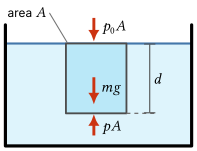
For a fluid in equilibrium, the fluid at any depth $d$ below the surface must support the total downward force of the fluid above it. The pressure therefore increases with depth. The upward force from below must balance both the weight of the fluid column and the force due to the pressure at the surface.
Pressure at depth $d$ in a static fluid
Consider a column of fluid of density $\rho$, cross-sectional area $A$, and depth $d$, with pressure $p_0$ at the surface. If the column is in equilibrium, then the vertical net force on the column must be zero:
\[F_{\mathrm{net},y} = pA - p_0 A - mg = 0.\]The mass of the column is $m = \rho V = \rho A d$. Substituting this into the force equation and canceling the area $A$, we get
\[\boxed{p = p_0 + \rho g d.}\]This is the static fluid pressure at depth $d$ below the surface of a fluid of density $\rho$ with pressure $p_0$ at the surface. Note that $p_0$ does not have to be atmospheric pressure.
Why didn’t this matter for gases?
When we studied the ideal gas law, we never worried about the pressure varying with height inside the container. Why not? The mass densities of air and water are
\[\rho_{\mathrm{air}} \approx 1.2\ \mathrm{kg/m^3}, \qquad \rho_{\mathrm{water}} \approx 1000\ \mathrm{kg/m^3}.\]Over a height of $1.0\ \mathrm{m}$, the pressure changes by
\[\Delta p_{\mathrm{air}} \approx 12\ \mathrm{Pa} \quad (0.01\%\ \text{of } p_{\mathrm{atm}}), \qquad \Delta p_{\mathrm{water}} \approx 9800\ \mathrm{Pa} \quad (10\%\ \text{of } p_{\mathrm{atm}}).\]Over distances of multiple kilometers, the variation in air pressure does matter. This is why atmospheric pressure drops with altitude. (Because air is compressible, its density decreases along with the pressure, and the decrease is exponential rather than linear.)
Same pressure at the same height
Since the pressure depends only on the depth, we can conclude:
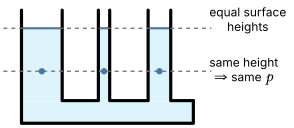
In a connected fluid in equilibrium, the pressure is the same at any two points at the same height.
If a container open to the atmosphere has several arms, the fluid surface sits at the same height in every arm, regardless of each arm’s shape or width. The surface is where $p = p_{\mathrm{atm}}$.
Gauge pressure
So far we have worked with the absolute pressure $p$, the pressure relative to vacuum. However, nearly every practical instrument measures pressure relative to the atmosphere. We call this difference the gauge pressure:
\[\boxed{p_g = p - p_{\mathrm{atm}}.}\]Tire gauges, blood pressure cuffs, and most laboratory gauges all read gauge pressure. A flat tire at $p_g = 0$ is still at one atmosphere of absolute pressure.
Example: The height of an IV bag
An IV bag delivers saline (density approximately $1000\ \mathrm{kg/m^3}$) through a tube to a needle in a patient’s arm. The gauge pressure in the patient’s vein is about $10\ \mathrm{mmHg}$ ($1300\ \mathrm{Pa}$). What is the minimum height the bag must hang above the arm for fluid to flow in?
Solution
The saline will only flow into the vein if its pressure at the needle is greater than the pressure in the vein. At the minimum height $d$, the two pressures are equal, so the gauge pressure at the needle is $p_g = 1300\ \mathrm{Pa}$. The surface of the saline in the bag is open to the atmosphere, so its gauge pressure is $p_{0,g} = 0$. The static pressure equation says
\[p_g = p_{0,g} + \rho g d = \rho g d.\]Solving for $d$,
\[d = \frac{p_g}{\rho g} = \frac{1300\ \mathrm{Pa}}{(1000\ \mathrm{kg/m^3})(9.8\ \mathrm{m/s^2})} = 0.13\ \mathrm{m} = \boxed{13\ \mathrm{cm}}.\]This height is an underestimate. At $13\ \mathrm{cm}$, the blood pressure and the pressure in the saline are balanced, so the saline won’t actually flow. The bag has to hang higher for the saline to flow into the vein. Our result also treats the saline as static. Once it flows, viscosity decreases its pressure along the narrow tube and needle (see the chapter on viscosity), further increasing the height of the bag required to get a useful flow rate.
Measuring pressure
Barometers
We can use the static pressure equation $p = p_0 + \rho g d$ to measure atmospheric pressure from the height of a fluid column. An instrument that measures atmospheric pressure is called a barometer.
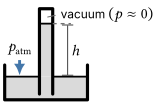
Consider a tube of fluid inverted in an open dish, with a vacuum above the column. At the bottom of the column, the pressure is $\rho g h$. This must equal the atmospheric pressure on the fluid in the dish at the same height, so
\[p_{\mathrm{atm}} = \rho g h.\]Historically, barometers used mercury because of its high density ($1.36\times 10^{4}\ \mathrm{kg/m^3}$). A pressure of $1\ \mathrm{atm}$ supports $760\ \mathrm{mm}$ of mercury.
Manometers
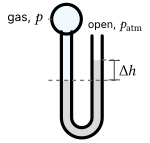
A manometer measures the pressure in a gas. One way to build a manometer is to connect one arm of a U-shaped tube to the gas and leave the other arm open to the atmosphere. The gas exerts pressure $p$ on the lower mercury surface.
At the same height in the open arm, the pressure is $p_{\mathrm{atm}} + \rho g \, \Delta h$, and the height difference gives us the gauge pressure of the gas: $p_g = \rho g \, \Delta h$.
This is the origin of the pressure unit millimeters of mercury (mmHg, also called the torr): $\Delta h = 1.00\ \mathrm{mm}$ of mercury $\iff \Delta p = 133\ \mathrm{Pa}$.
Units of pressure
Many different units of pressure are commonly used. Here are a few of the ones you are most likely to encounter:
| Unit | Description | Conversion |
|---|---|---|
| pascal | SI unit | — |
| atmosphere (atm) | standard sea-level pressure | $101.3\ \mathrm{kPa}$ |
| mmHg | 1 mm mercury column | $133\ \mathrm{Pa}$ |
| psi | pound per square inch | $6.89\ \mathrm{kPa}$ |
Blood pressure
A blood pressure reading like “120 over 80” specifies two gauge pressures in mmHg: the arterial pressure at the peak of the heartbeat (systolic) and its minimum between beats (diastolic).
In a manual measurement with a sphygmomanometer, a cuff is inflated around the upper arm until it squeezes the artery shut, then is slowly released until blood starts to flow again. The cuff’s gauge pressure at that moment provides an estimate of the systolic pressure.
The cuff should be at the same height as the heart, with the patient’s arm resting on a support such as a desk. If the cuff is a distance $\Delta h$ below the heart, the weight of the blood column increases the pressure at the cuff by $\rho_{\mathrm{blood}} g\,\Delta h$.