Periodic motion
Period and frequency
We now begin a new unit on oscillations and waves. We start with motion that repeats itself at regular time intervals, which is called periodic motion.
The time it takes for the motion to repeat is called the period $T$. Each full repetition of the motion is called a cycle. The number of cycles per unit time is the frequency $f$ of the motion. The frequency and period are related by
\[f = \frac{1}{T}.\]The unit of frequency is the hertz: $1\ \mathrm{Hz} = 1\ \mathrm{s^{-1}}$, or one cycle per second.
Periodic motion in living things
Living things are full of periodic motion. The table gives some typical frequencies and periods.
| Motion | Frequency | Period |
|---|---|---|
| Breathing at rest | $0.25\ \mathrm{Hz}$ (15 breaths per minute) | $4\ \mathrm{s}$ |
| Resting heartbeat | $1.2\ \mathrm{Hz}$ (72 beats per minute) | $0.8\ \mathrm{s}$ |
| Swing of a leg while walking | about $1\ \mathrm{Hz}$ | about $1\ \mathrm{s}$ |
| Hummingbird wingbeat | about $50\ \mathrm{Hz}$ | about $20\ \mathrm{ms}$ |
| Vibration of your vocal folds | $100$ to $250\ \mathrm{Hz}$ | $4$ to $10\ \mathrm{ms}$ |
| Mosquito wingbeat | about $500\ \mathrm{Hz}$ | about $2\ \mathrm{ms}$ |
Periodic motion only has to repeat. A heartbeat repeats, but the shape of each beat is complicated. In this chapter we will study the simplest kind of periodic motion. It describes a mass on a spring, a pendulum swinging through small angles, and, as we will see in the chapter on sinusoidal waves, each point on a string carrying a sinusoidal wave.
Example: Your heartbeat
You measure your resting pulse and count 66 beats in one minute. What are the frequency and the period of your heartbeat?
Solution
The frequency is the number of beats per second:
\[f = \frac{66\ \text{beats}}{60\ \mathrm{s}} = 1.10\ \mathrm{Hz}.\]The period is the time for one beat:
\[T = \frac{1}{f} = 0.909\ \mathrm{s}.\]Uniform circular motion
You have already studied one kind of periodic motion in Physics 5A: uniform circular motion (UCM), motion in a circle at constant speed. In UCM, the period $T$ is the time for one revolution, and the frequency $f = 1/T$ is the number of revolutions per unit time.
In one period, the object travels one circumference, so its speed is
\[v = \frac{2\pi r}{T} = 2\pi r f.\]Circular motion will give us a way to describe oscillations, so let’s review it, this time describing the object’s position by an angle.
Angular position
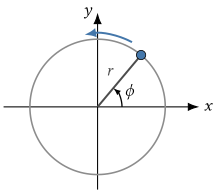
We can describe the position of an object on a circle by giving the angle $\phi$ between the radius to the object and a reference direction. We will always measure $\phi$ counterclockwise from the $+x$-axis.
We measure $\phi$ in radians. One full revolution is $\phi = 2\pi$ (equivalent to $360^\circ$), so adding $2\pi$ to $\phi$ brings the object back to the same point.
Angular frequency
In UCM, the angle $\phi$ increases at a steady rate. We call this rate the angular frequency $\omega$:
\[\omega = \frac{\Delta\phi}{\Delta t}.\]In one period $\Delta t = T$, the angle increases by one revolution, $\Delta\phi = 2\pi$, so
\[\boxed{\omega = \frac{2\pi}{T},}\qquad \text{ or }\qquad \boxed{\omega = 2\pi f.}\]To get the second equation we substitute $1/T = f$.
The frequency $f$ counts cycles per second. The angular frequency $\omega$ counts radians per second, and there are $2\pi$ radians in each cycle. We give $\omega$ in $\mathrm{rad/s}$, never in $\mathrm{Hz}$.
The angle as a function of time
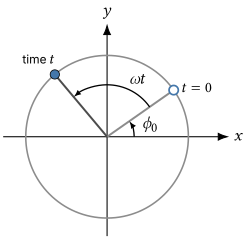
Suppose the object starts at angle $\phi_0$ at $t = 0$. After a time $t$, the angle has increased by $\omega t$, so
\[\phi(t) = \omega t + \phi_0.\]This has the same form as uniform motion, $x(t) = v_x t + x_0$, with the angle in place of the position.
The mass-spring system
A mass on a spring
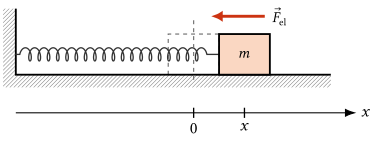
Our model oscillating system is a block of mass $m$ attached to an ideal spring and sliding on a frictionless horizontal surface. We take the $x$-axis along the spring, with $x = 0$ at the equilibrium position, where the spring is relaxed.
We will write the spring constant as $k_s$. When we study waves, we will need the letter $k$ for something else.
Newton’s second law for the mass
The spring exerts a restoring force: it always pulls or pushes the block back toward equilibrium. By Hooke’s law, its $x$-component is $F_{\mathrm{el},x} = -k_s x$. The spring force is the net force on the block, so Newton’s second law gives
\[-k_s x = m a_x.\]The acceleration $a_x = -(k_s/m)\,x$ depends on where the block is, so it changes as the block moves. The constant-acceleration kinematic equations from Physics 5A do not apply to this motion.
To describe the motion of a mass on a spring, we need to find a position function $x(t)$ such that the acceleration is always proportional to the negative of the position.
What does the motion look like?
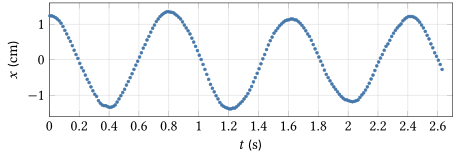
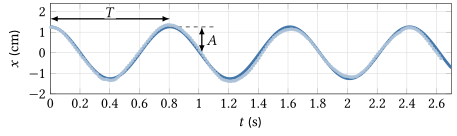
Instead of solving for $x(t)$ directly, let’s look at some data. Here is the position of a mass oscillating on a spring, measured from its equilibrium position. (This spring was vertical rather than horizontal, but that doesn’t affect our answer.)
An educated guess
The data look like a cosine curve. So let’s guess that the motion has the form
\[x = A\cos\phi.\](Physicists use the German word ansatz for such a guess, probably because that sounds more clever than “guess.”)
The amplitude $A$ is the maximum displacement from equilibrium. The position swings between $x = +A$ and $x = -A$.
The angle $\phi$ is called the phase. It increases with time, and each time it increases by $2\pi$, the motion completes one cycle.
Simple harmonic motion and circular motion
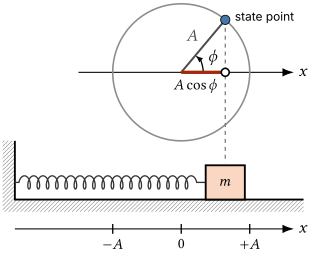
We can interpret $A\cos\phi$ as the $x$-coordinate of a point at angle $\phi$ on a circle of radius $A$ that we call the reference circle. As the point goes around the circle at a steady rate, its projection onto the $x$-axis moves back and forth exactly like the block.
The phase changes with time
There is no physical circular motion here. The phase $\phi$ is the angle of a point on the reference circle, which is a mathematical picture of the motion rather than a physical circle.
Just as in uniform circular motion, the phase increases at a steady angular frequency $\omega$:
\[\phi = \omega t + \phi_0.\]The phase constant $\phi_0$ is the phase at $t = 0$. Substituting this into $A\cos\phi$ gives the position of the block at any time:
\[\boxed{x(t) = A\cos(\omega t + \phi_0).}\]We call this motion that oscillates sinusoidally simple harmonic motion (SHM).
Derivation: Velocity and acceleration
We get the velocity and acceleration by taking derivatives with respect to time. By the chain rule, the derivative of $\cos(\omega t + \phi_0)$ is $-\omega\sin(\omega t + \phi_0)$, so the velocity is
\[v_x(t) = \frac{dx}{dt} = -A\omega\sin(\omega t + \phi_0).\]The derivative of $\sin(\omega t + \phi_0)$ is $\omega\cos(\omega t + \phi_0)$, so differentiating once more gives the acceleration:
\[a_x(t) = \frac{dv_x}{dt} = -A\omega^2\cos(\omega t + \phi_0).\]The defining feature of simple harmonic motion
If we compare the acceleration with the displacement $x(t) = A\cos(\omega t + \phi_0)$, we see that
\[a_x(t) = -\omega^2 \left[A\cos(\omega t + \phi_0)\right] = -\omega^2 x(t).\]That is, the acceleration is proportional to minus the displacement:
\[\boxed{a_x = -\omega^2 x.}\]This is the defining feature of SHM. Whenever an object’s acceleration is a negative constant times its displacement, we know it moves in SHM, and the proportionality constant is $\omega^2$.
The angular frequency of a mass on a spring
From Newton’s second law, we have $-k_s x = m a_x$. If we plug in $a_x = -\omega^2 x$, we get
\[-k_s x = -m\omega^2 x.\]For our guessed solution to obey Newton’s second law, we need $\omega^2 = k_s/m$, so the angular frequency must be
\[\boxed{\omega = \sqrt{\frac{k_s}{m}}.}\]For a given mass, a stiffer spring (larger $k_s$) gives a higher oscillation rate. For a given spring constant, a greater mass (larger $m$) gives a smaller rate.
Note that $\omega$ does not depend on $A$, so the oscillation rate is independent of the amplitude. This is always true for SHM.
Position, velocity, and acceleration
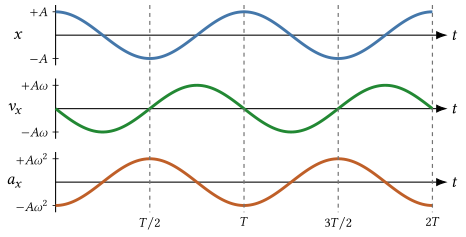
Here are $x$, $v_x$, and $a_x$ over two cycles for $\phi_0 = 0$. Dashed lines mark the turning points, where $x = \pm A$.
Maximum speed and acceleration
The sine and cosine functions range between $-1$ and $+1$. So the maximum speed and the maximum magnitude of the acceleration in SHM are
\[v_{\mathrm{max}} = A\omega, \qquad a_{\mathrm{max}} = A\omega^2.\]The block moves fastest as it passes through equilibrium, where $x = 0$ and the spring exerts no force. At the turning points, $x = \pm A$, the block is momentarily at rest, and the spring force and acceleration are largest.
Summary: the mass-spring oscillator
A mass $m$ on a spring with spring constant $k_s$ moves in simple harmonic motion with angular frequency $\omega = \sqrt{k_s/m}$. Its position, velocity, and acceleration are
\[\begin{aligned} x(t) & = A\cos(\omega t + \phi_0), \\ v_x(t) & = -A\omega\sin(\omega t + \phi_0), \\ a_x(t) & = -A\omega^2\cos(\omega t + \phi_0). \end{aligned}\]The maximum speed is $v_{\mathrm{max}} = A\omega$, reached at equilibrium, and the maximum magnitude of the acceleration is $a_{\mathrm{max}} = A\omega^2$, reached at the turning points.
Example: A block on a spring
A $0.500\ \mathrm{kg}$ block on a frictionless horizontal surface is attached to a spring with spring constant $20.0\ \mathrm{N/m}$. You pull the block $10.0\ \mathrm{cm}$ to the right of equilibrium and release it from rest at $t = 0$.
- What are the angular frequency and the period of the motion?
- What is the block’s maximum speed?
- What is the maximum magnitude of the block’s acceleration?
- Write an expression for the block’s position $x(t)$, taking $+x$ to the right.
Solution
1. The angular frequency is set by the spring and the mass:
\[\omega = \sqrt{\frac{k_s}{m}} = \sqrt{\frac{20.0\ \mathrm{N/m}}{0.500\ \mathrm{kg}}} = 6.32\ \mathrm{rad/s}, \qquad T = \frac{2\pi}{\omega} = 0.993\ \mathrm{s}.\]2. The block is released from rest $10.0\ \mathrm{cm}$ from equilibrium, so that is a turning point and the amplitude is $A = 0.100\ \mathrm{m}$. The maximum speed is
\[v_{\mathrm{max}} = A\omega = (0.100\ \mathrm{m})(6.32\ \mathrm{rad/s}) = 0.632\ \mathrm{m/s}.\]3. The maximum magnitude of the acceleration is
\[a_{\mathrm{max}} = A\omega^2 = \frac{A k_s}{m} = \frac{(0.100\ \mathrm{m})(20.0\ \mathrm{N/m})}{0.500\ \mathrm{kg}} = 4.00\ \mathrm{m/s^2}.\]4. At $t = 0$, the block is at $x = +A$. Since $x(0) = A\cos\phi_0$, we need $\cos\phi_0 = 1$, so $\phi_0 = 0$:
\[x(t) = (10.0\ \mathrm{cm})\cos\!\big[(6.32\ \mathrm{rad/s})\,t\big].\]With our cosine form, releasing an oscillator from rest at its positive turning point always gives $\phi_0 = 0$. (The radian in $\mathrm{rad/s}$ is a reminder that $\omega t$ is an angle. Multiplying by a time in seconds cancels the seconds and leaves an angle in radians.)
Phase in simple harmonic motion
The phase determines the state
The phase $\phi = \omega t + \phi_0$ tells where the oscillator is in its cycle. For a given oscillator, once you know $\phi$, you know both the position and the velocity:
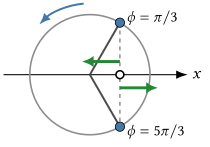
\[x = A\cos\phi, \qquad v_x = -A\omega\sin\phi.\]Knowing only the position is not enough. Between the turning points, the block passes through each position twice in every cycle, once moving left and once moving right. The phase is different at those two instants.
Special values of the initial phase
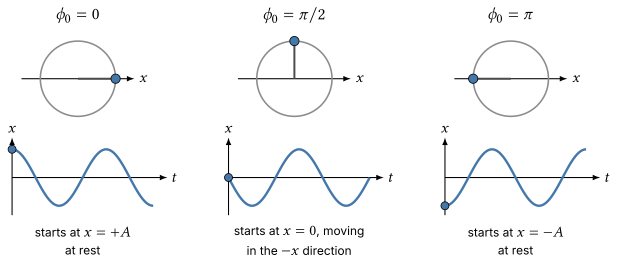
The initial phase $\phi_0$ tells us where in its cycle the oscillator starts at $t = 0$. Here are three important special cases:
- $\phi_0 = 0$: the oscillator starts at $x = +A$, at rest.
- $\phi_0 = \pi/2$: the oscillator starts at $x = 0$, moving in the $-x$ direction.
- $\phi_0 = \pi$: the oscillator starts at $x = -A$, at rest.
Check your understanding:
- At $t = 0$, a block on a spring passes through equilibrium moving in the $+x$ direction. Where on the reference circle does the state point start, and what is $\phi_0$?
- Two identical mass-spring systems oscillate with the same amplitude. One has $\phi_0 = 0$ and the other has $\phi_0 = \pi$. Describe how the motions of the two blocks compare.
Answer
1. The state point must start at the bottom of the reference circle, so $\phi_0 = 3\pi/2$ (equivalently, $-\pi/2$). Then $x(0) = A\cos(3\pi/2) = 0$ and $v_x(0) = -A\omega\sin(3\pi/2) = +A\omega$.
2. Their phases always differ by $\pi$, so $x_2(t) = -x_1(t)$. The blocks are always on opposite sides of equilibrium, at equal distances, moving in opposite directions.
Phase space
The reference circle is not a physical circle. The horizontal coordinate of the state point is the position, $x = A\cos\phi$. Its vertical coordinate is $A\sin\phi = -v_x/\omega$, which encodes the velocity.
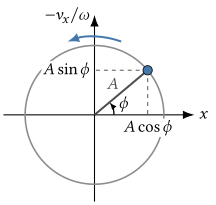
On the upper half of the circle, the block moves in the $-x$ direction. On the lower half, it moves in the $+x$ direction.
Each point on the circle stands for one state of the oscillator (its position together with its velocity). The space of all possible states is called phase space.
We saw this same idea in the context of $pV$ diagrams. A point on a $pV$ diagram is not a physical location. It represents the state of a gas, and a process is a path from one state to another. A point in phase space likewise represents the state of the oscillator, and its motion over time is a path in phase space. For SHM, that path is a circle.
In both pictures, the size of a curve tells you something physical. For a given amount of gas, an isotherm at higher temperature lies farther from the origin of a $pV$ diagram. For a given mass-spring system, a larger amplitude traces a larger circle in phase space, and we will see in the next chapter that it has more energy.