Specific heat
How does internal energy change with temperature?
In the previous chapter, we discussed the concepts of internal energy and temperature. Although we cannot measure internal energy directly, we can use temperature as an indirect measure of the internal energy of a system.
In general, there is no simple one-to-one relationship between the internal energy of a system and its temperature. However, we can often apply a simple empirical model relating a system’s internal energy change to its temperature change.
In particular, consider a solid or liquid that is heated or cooled with no work done on it, so the only energy transfer is in the form of heat. Then the first law reads
\[\Delta E_{\mathrm{int}} = Q.\]To measure the internal energy change, we only need to measure the heat transfer into or out of the system.
Specific heat
Experiments show that for many materials, the amount of heat required to change the temperature of a system by a small amount is proportional to the temperature change $\Delta T$ and the mass $m$ of the system:
\[\boxed{Q = mc\Delta T}\]The proportionality constant $c$ is called the specific heat capacity, or simply specific heat, of the material. It depends on the material and its phase (solid or liquid).
Together with the first law, this model tells us that
\[\Delta E_{\mathrm{int}} = mc\Delta T.\]This shows one important difference between the internal energy and the temperature: the internal energy change depends on temperature change as well as the size of the system, measured here by the mass $m$.
Water has an unusually large specific heat
Compared with most common substances, liquid water has a very large specific heat:
| Substance | $c$ ($\mathrm{J/(g\cdot{}^\circ C)}$) |
|---|---|
| Liquid water | 4.18 |
| Ethanol | 2.44 |
| Ice | 2.09 |
| Air | 1.01 |
| Aluminum | 0.900 |
| Copper | 0.385 |
This large specific heat is due to hydrogen bonds between water molecules. When water is heated, much of the added energy goes into stretching and breaking these bonds rather than into molecular motion, so the temperature rises less.
Water as a thermal buffer
Rearranging $Q = mc\Delta T$ gives
\[\Delta T = \frac{Q}{mc}.\]A system with a large $mc$ changes temperature only a little when heat flows in or out. We call such a system a thermal buffer.
Your body is mostly water, so its average specific heat is also large, roughly $3.5\ \mathrm{J/(g\cdot{}^\circ C)}$. Your body needs to stay near $37^\circ\mathrm{C}$, and its large specific heat helps with this. Lakes and oceans also act as thermal buffers. They warm and cool slowly, so their temperature changes much less than the air temperature from day to night.
Even at rest, a $70\ \mathrm{kg}$ adult produces heat at about $80\ \mathrm{W}$. Suppose all of this heat stays in the body, and model the body as a single object with the same temperature throughout. How long would it take to warm by $3^\circ\mathrm{C}$?
\[t = \frac{mc\Delta T}{P} = \frac{(70000\ \mathrm{g})(3.5\ \mathrm{J/(g\cdot{}^\circ C)})(3^\circ\mathrm{C})}{80\ \mathrm{W}} \approx 9200\ \mathrm{s}\]That is about two and a half hours. With the specific heat of aluminum, it would take about 40 minutes.
A large specific heat doesn’t stop your temperature from changing, but it does slow the change down, giving your body time to get rid of the extra heat.
Calorimetry
Suppose we place two systems at different temperatures in contact and allow heat to flow between them. How much heat must flow before they reach thermal equilibrium? What is the equilibrium temperature they come to? The use of temperature changes to measure the heat transfer between systems is called calorimetry.
Consider an isolated system containing two subsystems in contact. The first law applied to the system as a whole tells us that
\[\Delta E_1 + \Delta E_2 = 0.\]Assuming no work is done, we have $\Delta E_{\mathrm{int}} = Q$ for each subsystem, so
\[Q_1 + Q_2 = 0.\]Example: Copper in water
A $100\ \mathrm{g}$ piece of copper at $100^\circ\mathrm{C}$ is placed in an insulated container initially holding $200\ \mathrm{g}$ of water at $20^\circ\mathrm{C}$. When the copper and water come to thermal equilibrium, what is the final temperature of the system? The specific heat of copper is $0.385\ \mathrm{J/(g\cdot{}^\circ C)}$ and that of water is $4.18\ \mathrm{J/(g\cdot{}^\circ C)}$.
Solution
Label the copper as system 1 and the water as system 2. Both end at the same final temperature $T_f$, which we want to find:
- Copper: $m_1 = 100\ \mathrm{g}$, $c_1 = 0.385\ \mathrm{J/(g\cdot{}^\circ C)}$, $T_1 = 100^\circ\mathrm{C}$;
- Water: $m_2 = 200\ \mathrm{g}$, $c_2 = 4.18\ \mathrm{J/(g\cdot{}^\circ C)}$, $T_2 = 20^\circ\mathrm{C}$.
The container is insulated, so no heat enters or leaves the copper–water system. Whatever heat the copper gives up, the water absorbs:
\[Q_1 + Q_2 = 0.\]Neither substance changes phase, so the heat for each is $Q = mc\Delta T = mc\left(T_f - T_i\right)$. Substituting gives
\[m_1 c_1 \left(T_f - T_1\right) + m_2 c_2 \left(T_f - T_2\right) = 0.\]Distributing and moving the terms without $T_f$ to the right-hand side,
\[\begin{aligned} m_1 c_1 T_f - m_1 c_1 T_1 + m_2 c_2 T_f - m_2 c_2 T_2 &= 0 \\ \rightarrow\quad m_1 c_1 T_f + m_2 c_2 T_f &= m_1 c_1 T_1 + m_2 c_2 T_2. \end{aligned}\]Factoring out $T_f$ and solving,
\[\begin{aligned} \left(m_1 c_1 + m_2 c_2\right) T_f &= m_1 c_1 T_1 + m_2 c_2 T_2 \\ \rightarrow\quad T_f &= \frac{m_1 c_1 T_1 + m_2 c_2 T_2}{m_1 c_1 + m_2 c_2}. \end{aligned}\]Plugging in the numbers,
\[\begin{aligned} T_f &= \frac{(100\ \mathrm{g})(0.385\ \mathrm{J/(g\cdot{}^\circ C)})(100^\circ\mathrm{C}) + (200\ \mathrm{g})(4.18\ \mathrm{J/(g\cdot{}^\circ C)})(20^\circ\mathrm{C})}{(100\ \mathrm{g})(0.385\ \mathrm{J/(g\cdot{}^\circ C)}) + (200\ \mathrm{g})(4.18\ \mathrm{J/(g\cdot{}^\circ C)})} \\ &= \boxed{23.5^\circ\mathrm{C}}. \end{aligned}\]The system comes to equilibrium at $23.5^\circ\mathrm{C}$, only a few degrees above the water’s starting temperature of $20^\circ\mathrm{C}$ and far below the copper’s $100^\circ\mathrm{C}$. Water has both the larger mass and the much larger specific heat, so its temperature barely changes.
Phase changes
Phase changes and latent heat
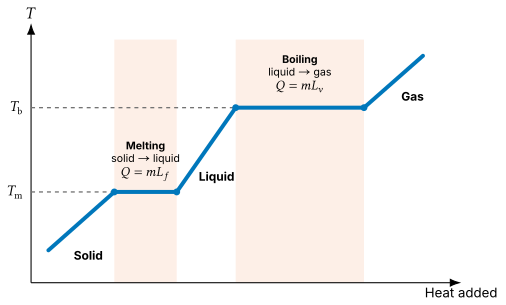
When a substance changes phase, for example melting from a solid to a liquid, or boiling from a liquid to a gas, its internal energy changes while its temperature remains constant. You can think about this change in internal energy as corresponding to the energy required to break chemical bonds between molecules in a substance, or the energy released when chemical bonds form.
We quantify the energy change during a phase transition using the latent heat $L$, which is the energy per unit mass that is absorbed or released during the phase change:
\[\boxed{\lvert Q \rvert = mL}\]Latent heat and the sign of $Q$
Whether heat is absorbed or released by a system during a phase change (that is, whether $Q$ is positive or negative) depends on the direction of the phase transition. Melting and boiling require heat input, while freezing and condensation release heat. The rule of thumb for the sign of $Q$ in a phase change is:
- When a substance changes from a more strongly bound phase to a more weakly bound phase, heat is absorbed and $Q = +mL$.
- When a substance changes from a more weakly bound phase to a more strongly bound phase, heat is released and $Q = -mL$.
Latent heat for different phase transitions
Different phase transitions have different latent heats. The latent heat for the transition between solid and liquid phases is called the heat of fusion $L_f$, while the latent heat for the transition between liquid and gas phases is called the heat of vaporization $L_v$.
The heat of fusion $L_f$ is typically much smaller than the heat of vaporization $L_v$. For example, water has a heat of fusion of $334\ \mathrm{J/g}$ and a heat of vaporization of $2260\ \mathrm{J/g}$. To vaporize a liquid, the bonds between molecules must be completely dissociated, whereas melting merely weakens the bonds.
Heating curve with phase changes
Example: Calorimetry with a phase change
Ice at $-10^\circ\mathrm{C}$ is added to a $1.0\ \mathrm{kg}$ water bath at $30^\circ\mathrm{C}$. When the system comes to thermal equilibrium, the water is at $10^\circ\mathrm{C}$. What mass of ice was added? Use the following values:
- specific heat of ice: $2.09\ \mathrm{J/(g\cdot{}^\circ C)}$
- heat of fusion of ice: $334\ \mathrm{J/g}$
- specific heat of water: $4.18\ \mathrm{J/(g\cdot{}^\circ C)}$
Solution
Label the ice as system 1 and the water bath as system 2. Both end at $T_f = 10^\circ\mathrm{C}$:
- Ice: $m_1 = {?}$, $c_1 = 2.09\ \mathrm{J/(g\cdot{}^\circ C)}$, $T_1 = -10^\circ\mathrm{C}$, $L_f = 334\ \mathrm{J/g}$;
- Water: $m_2 = 1000\ \mathrm{g}$, $c_2 = 4.18\ \mathrm{J/(g\cdot{}^\circ C)}$, $T_2 = 30^\circ\mathrm{C}$.
We converted the bath’s mass to grams to match the units of the specific heats. As in the previous example, no heat leaves the system, so
\[Q_1 + Q_2 = 0.\]The ice ends as liquid water at $10^\circ\mathrm{C}$, so the heat it absorbs has three terms:
- $Q_A$: warm the solid ice from $-10^\circ\mathrm{C}$ to its melting point, $0^\circ\mathrm{C}$;
- $Q_B$: melt the ice at constant temperature $0^\circ\mathrm{C}$;
- $Q_C$: warm the melted ice, now liquid water, from $0^\circ\mathrm{C}$ to $10^\circ\mathrm{C}$.
Each of the warming steps increases the temperature by $10^\circ\mathrm{C}$. For $Q_C$, we use $c_2$, the specific heat of liquid water, because the ice has melted by then:
\[\begin{aligned} Q_1 = Q_A + Q_B + Q_C &= \underbrace{m_1 c_1 (10^\circ\mathrm{C})}_{Q_A} + \underbrace{m_1 L_f}_{Q_B} + \underbrace{m_1 c_2 (10^\circ\mathrm{C})}_{Q_C} \\ &= m_1 \left[c_1 (10^\circ\mathrm{C}) + L_f + c_2 (10^\circ\mathrm{C})\right] \\ &= m_1 \left(396.7\ \mathrm{J/g}\right). \end{aligned}\]The water bath cools from $30^\circ\mathrm{C}$ to $10^\circ\mathrm{C}$ without changing phase:
\[Q_2 = m_2 c_2 \left(T_f - T_2\right) = m_2 c_2 (10^\circ\mathrm{C} - 30^\circ\mathrm{C}) = m_2 c_2 (-20^\circ\mathrm{C}) = -83600\ \mathrm{J}.\]Plugging both into $Q_1 + Q_2 = 0$ and solving for $m_1$,
\[\begin{aligned} m_1 \left(396.7\ \mathrm{J/g}\right) &= 83600\ \mathrm{J} \\ \rightarrow\quad m_1 &= \frac{83600\ \mathrm{J}}{396.7\ \mathrm{J/g}} = \boxed{210\ \mathrm{g}}. \end{aligned}\]So about $210\ \mathrm{g}$ of ice was added to the bath.