Why sinusoidal waves?
Waves don’t have to be sinusoidal
The pulse we studied in the previous chapter is a perfectly good wave, and it is not sinusoidal. Simple harmonic motion is always sinusoidal, but waves don’t have to be.
However, we will focus most of our time on sinusoidal waves, waves whose snapshots and time traces are sine curves. Why? Although most waves are not sinusoidal, it turns out that every wave can be described by adding together multiple sinusoidal waves. If we understand the physics of sinusoidal waves, we can apply this understanding to more general waves.
Building a pulse from sinusoids
The dashed curve below shows a pulse on a string with fixed ends. The solid curve is the sum of the first $N$ sinusoidal shapes that fit on the string, with their amplitudes chosen to match the pulse. The more sinusoids we include, the closer the sum gets to the pulse.
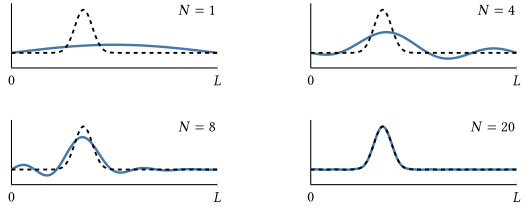
Fourier analysis
Any wave can be written as a sum of sinusoidal waves with different frequencies, amplitudes, and phases. Breaking a wave into its sinusoidal pieces is called Fourier analysis, after Joseph Fourier, who developed the idea in the early 1800s to study how heat flows.
On a string with fixed ends, each sinusoidal piece is a standing wave that keeps its shape and oscillates in place at its own frequency. When we add these pieces together with specific amplitudes and phase constants, the sum reproduces the traveling pulse.
If we understand sinusoidal waves, we can understand any wave on our ideal string by breaking it up into sinusoids. Your ear can tell a flute from a violin playing the same note largely because their sound waves contain different mixtures of sinusoids.
Sinusoidal waves
Making a sinusoidal wave
We can generate a sinusoidal wave on a string by moving one end of the string up and down in simple harmonic motion. Since each piece of the string pulls on the next one, the motion spreads along the string at the wave speed $v$.
Here is a snapshot of a long string, initially at rest, a little more than two periods after its left end started to oscillate. Beyond the front of the wave, the string has not yet started to move.
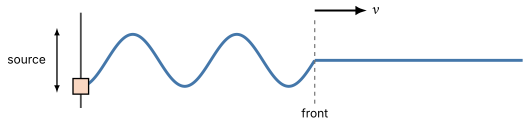
Points move in SHM with a frequency set by the source
Each point on the string is driven by the piece next to it to oscillate in simple harmonic motion. Because the frequency of a driven oscillator is determined by the driving force, the frequency of a wave is set by its source. Once the wave has arrived, each point on the string moves in simple harmonic motion, with the frequency of the source and the same amplitude $A$.
Since it takes time for the wave to travel to each point from the source, points further from the source will repeat the motion of the source at a later time. That is, the phase of each point’s oscillation lags behind that of the source.
Every point moves in simple harmonic motion
We can see this with reference circles, as in the chapter on simple harmonic motion. Each point has its own reference circle, and the height of each state point gives the displacement of the corresponding point on the string. Every state point goes around its circle at the same angular frequency $\omega$. Below, neighboring points are a quarter wavelength apart, and their state points are a quarter turn apart.
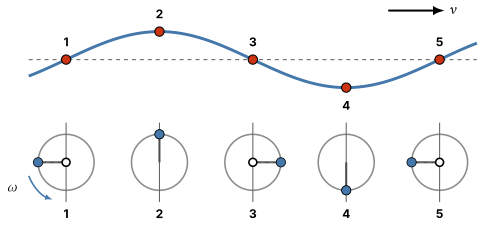
Period, frequency, and angular frequency
The period $T$ of a sinusoidal wave is the period of the simple harmonic motion of each point, or the time it takes any one point on the string to complete a full cycle. The time trace of every point is a sinusoid with period $T$.
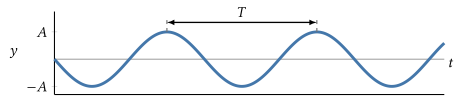
Just as in simple harmonic motion, the frequency is $f = 1/T$, and the angular frequency is $\omega = 2\pi f = 2\pi/T$. These are the frequency and angular frequency of the source.
Wavelength
If we fix one instant in time and look at a snapshot, the shape of the string is also a sinusoid. The distance over which it repeats is the wavelength $\lambda$ (Greek “lambda”). It is the distance between two neighboring peaks, or two neighboring valleys.
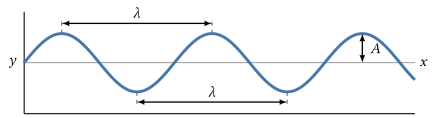
Points that are one wavelength apart move exactly in phase with each other.
The wave number
The phase of a point tells us where it is in its cycle. The angular frequency $\omega$ tells us how fast the phase changes in time: it changes by $2\pi$ in one period, so $\omega = 2\pi/T$.
The wave number $k$ tells us how fast the phase changes in space. Moving along the string at one instant, the phase changes by $2\pi$ over one wavelength, so
\[\boxed{k = \frac{2\pi}{\lambda}.}\]The unit of $k$ is $\mathrm{rad/m}$. (This $k$ is unrelated to the spring constant $k_s$.)
| Property | In time (one point) | In space (one instant) |
|---|---|---|
| The motion repeats after | a period $T$ | a wavelength $\lambda$ |
| The phase changes at the rate | $\omega = 2\pi/T$ | $k = 2\pi/\lambda$ |
Sinusoidal wave functions
The wave function of a sinusoidal wave
Putting the pieces together, a sinusoidal wave traveling in the $+x$ direction has the wave function
\[\boxed{y(x,t) = A\sin(kx - \omega t).}\]The argument of the sine, $\phi = kx - \omega t$, is the phase of the wave. At a fixed time, it changes by $2\pi$ over a distance $\lambda$, so the snapshot is a sinusoid with wavelength $\lambda$. At a fixed position, it changes by $2\pi$ in a time $T$, so the time trace is a sinusoid with period $T$.
A sinusoidal wave traveling in the $-x$ direction has the wave function
\[\boxed{y(x,t) = A\sin(kx + \omega t).}\]Why does the sign in front of $\omega t$ tell us the direction? To see, we need to recall how to shift a function.
Shifting a function
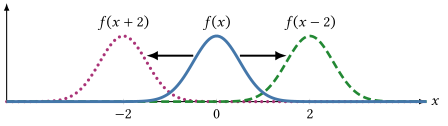
Replacing $x$ by $x - \Delta x$ in any function $f(x)$ shifts its graph to the right by $\Delta x$. Whatever value $f$ has at $x = 0$, $f(x - \Delta x)$ has at $x = \Delta x$. Replacing $x$ by $x + \Delta x$ shifts the graph to the left by $\Delta x$.
For example, if $f(x)$ has its peak at $x = 0$, then $f(x - 2)$ has its peak where $x - 2 = 0$, at $x = 2$, and $f(x + 2)$ has its peak at $x = -2$.
The snapshot moves
To see how the snapshot moves, we can factor $k$ out of the phase of the right-moving wave:
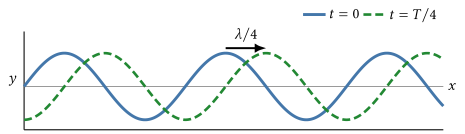
\[y(x,t) = A\sin\!\Big[k\Big(x - \frac{\omega}{k}\,t\Big)\Big].\]At $t = 0$, the snapshot is $y(x,0) = A\sin(kx)$. At a later time $t$, $x$ has been replaced by $x - (\omega/k)t$, so the snapshot has the same shape, shifted to the right by $\Delta x = (\omega/k)\,t$.
The fundamental relation of sinusoidal waves
The shift $\Delta x = (\omega/k)\,t$ increases steadily with time, so the whole sinusoidal pattern moves to the right at the speed $\omega/k$. This must be the wave speed:
\[v = \frac{\omega}{k}.\]Substituting $\omega = 2\pi f$ and $k = 2\pi/\lambda$ gives $v = 2\pi f/(2\pi/\lambda)$. The factors of $2\pi$ cancel, leaving the fundamental relation of sinusoidal waves:
\[\boxed{v = \lambda f.}\]Another way to think about this is that, in one period $T$, each point completes one cycle, and the wave pattern moves forward by exactly one wavelength. So $v = \lambda/T = \lambda f$.
Medium, source, and wavelength
The three quantities in $v = \lambda f$ are determined by different factors:
- The wave speed $v$ is set by the medium. On a string, $v = \sqrt{F_T/\mu}$.
- The frequency $f$ is set by the source.
- The wavelength then follows from the fundamental relation, $\lambda = v/f$.
If you drive the same string at twice the frequency, the wave travels at the same speed, so its wavelength is half as long. The wavelength is not a property of the medium or of the source alone. It depends on both.
A wave entering a new medium
When a wave travels from one medium into another, its frequency stays the same. The boundary between the two media oscillates at one frequency, and it acts as the source for the wave in the second medium. The wave speed changes, so by $\lambda = v/f$, the wavelength changes too. This happens when sound passes from air into water, or light passes from air into glass.
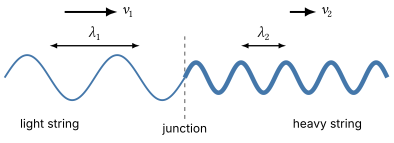
(Part of the wave also reflects at the junction, and the amplitude changes. We will ignore both effects for now.)
Example: A wave crossing a junction
A string with linear mass density $0.0100\ \mathrm{kg/m}$ is tied to a second string with linear mass density $0.0400\ \mathrm{kg/m}$, and the pair is stretched with a tension of $64.0\ \mathrm{N}$. You shake the free end of the lighter string up and down at $40.0\ \mathrm{Hz}$, sending a sinusoidal wave toward the junction.
- What are the speed and the wavelength of the wave on the lighter string?
- What are the frequency, the speed, and the wavelength of the wave after it passes into the heavier string?
Solution
1. On the lighter string,
\[v_1 = \sqrt{\frac{64.0\ \mathrm{N}}{0.0100\ \mathrm{kg/m}}} = 80.0\ \mathrm{m/s}, \qquad \lambda_1 = \frac{v_1}{f} = \frac{80.0\ \mathrm{m/s}}{40.0\ \mathrm{Hz}} = 2.00\ \mathrm{m}.\]2. The frequency is set by the source, so it is still $f = 40.0\ \mathrm{Hz}$. The tension is the same in both strings, so
\[v_2 = \sqrt{\frac{64.0\ \mathrm{N}}{0.0400\ \mathrm{kg/m}}} = 40.0\ \mathrm{m/s}, \qquad \lambda_2 = \frac{v_2}{f} = \frac{40.0\ \mathrm{m/s}}{40.0\ \mathrm{Hz}} = 1.00\ \mathrm{m}.\]The heavier string has four times the linear mass density, so the wave travels half as fast, and its wavelength is half as long.
Example: Reading a wave function
A wave on a string is described by the wave function
\[y(x,t) = (0.020\ \mathrm{m})\sin\!\big[(3.0\ \mathrm{rad/m})\,x - (15\ \mathrm{rad/s})\,t\big].\]Find the amplitude, wavelength, frequency, and speed of the wave. Which direction does it travel?
Solution
Comparing with $y(x,t) = A\sin(kx - \omega t)$, the amplitude is $A = 0.020\ \mathrm{m} = 2.0\ \mathrm{cm}$, the wave number is $k = 3.0\ \mathrm{rad/m}$, and the angular frequency is $\omega = 15\ \mathrm{rad/s}$. The wavelength and frequency are
\[\lambda = \frac{2\pi}{k} = \frac{2\pi}{3.0\ \mathrm{rad/m}} = 2.1\ \mathrm{m}, \qquad f = \frac{\omega}{2\pi} = \frac{15\ \mathrm{rad/s}}{2\pi} = 2.4\ \mathrm{Hz}.\]The wave speed is
\[v = \frac{\omega}{k} = \frac{15\ \mathrm{rad/s}}{3.0\ \mathrm{rad/m}} = 5.0\ \mathrm{m/s}.\]As a check, $\lambda f = (2.09\ \mathrm{m})(2.39\ \mathrm{Hz}) = 5.0\ \mathrm{m/s}$. The phase is $kx - \omega t$, so the wave travels in the $+x$ direction.
Summary
- A sinusoidal wave traveling in the $+x$ direction has the wave function $y(x,t) = A\sin(kx - \omega t)$. One traveling in the $-x$ direction has $y(x,t) = A\sin(kx + \omega t)$.
- Every point on the string moves in simple harmonic motion with the period $T$, frequency $f = 1/T$, and angular frequency $\omega = 2\pi f$ of the source. A snapshot repeats over one wavelength $\lambda$, and the wave number is $k = 2\pi/\lambda$.
- The wave speed is set by the medium, and the frequency is set by the source. The wavelength follows from the fundamental relation of sinusoidal waves, $v = \lambda f$.