Thermal energy
Dissipative forces
So far, we have not accounted for friction in the energy principle. Friction is one example of a dissipative force: a force that converts macroscopic mechanical energy into microscopic thermal energy. Fluid drag is another example of a dissipative force.
If we want to include the effect of friction and other dissipative forces in the energy principle, we need to go beyond the point particle model and consider the internal structure of objects.
All of the objects that we encounter in everyday life are made of a huge number of atoms and molecules. If we want to apply the energy principle to real-world systems, we have to account for the energy associated with the motion of and interactions between these particles.
Thermal energy
The microscopic particles that make up an object have kinetic and potential energy, just like the macroscopic systems that we have been studying. However, it’s practically impossible for us to account for the energy of all of the individual particles in a system.
Rather than treating the energy of the microscopic particles individually, we can treat the total energy of all of the microscopic particles in a system as a single quantity called thermal energy, which I’ll write as $E_\mathrm{th}$.
Since we can’t track the motion of the individual particles, this motion is effectively random from a macroscopic perspective. The thermal energy is the energy associated with this random motion, and is connected to the temperature of the system. Roughly speaking, the higher the temperature of a system, the more thermal energy it has.
Thermal energy and friction
When we work with macroscopic systems and include the effects of dissipative forces, we need to account for the thermal energy $E_\mathrm{th}$ of the system in addition to the macroscopic kinetic and potential energy. The change in the energy of the system is then
\[\Delta E_\mathrm{sys} = \Delta K + \Delta U + \Delta E_\mathrm{th}.\]To apply the energy principle when friction acts between an object and a surface, we need to include both the object and the surface in the system. That is, we account for the total change in thermal energy of the object and the surface.
Key result: In terms of the magnitude of the friction force and the total sliding distance $d$ of the object relative to the surface, the change in thermal energy is \(\boxed{\Delta E_\mathrm{th} = f_k d}\)
A block pushed across a table
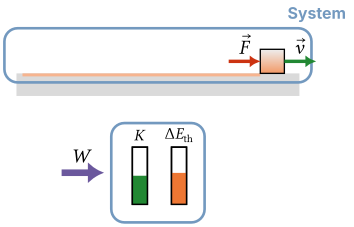
As an example, consider a block pushed along a table at constant speed. Choose the system to include the block and the table. The push force is an external force that does work on the system.
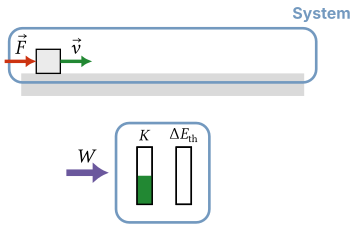
Since the kinetic energy of the system stays constant, the energy transferred into the system by the push force increases the thermal energy.
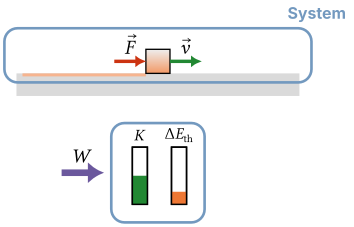
The greater the sliding distance, the more thermal energy is generated by friction.
Is energy lost to friction?
When conservative forces act in a system, energy can be stored reversibly as potential energy. What makes dissipative forces like friction different?
Since energy is conserved, energy can never be lost. However, when dissipative forces act, energy is transferred from macroscopic kinetic and potential energy into thermal energy associated with random microscopic motion.
Once thermal energy has been generated, it cannot be converted back to mechanical energy with perfect efficiency. (This is a consequence of the second law of thermodynamics, which you’ll learn more about in Physics 5B.) In this sense, thermal energy is “less useful” than other forms of energy, so we often casually refer to energy being “lost” to friction.
Can we calculate the work done by friction?
For conservative forces, we calculated the potential energy change by first calculating the work done by the force. But for friction, we jumped straight to writing down the change in thermal energy without calculating the work done by friction. Why is that?
It turns out that in general, it is not straightforward to calculate the work done by friction on, say, a block sliding on a surface. This is because the distance traveled by the point of application of the friction force cannot be easily determined.
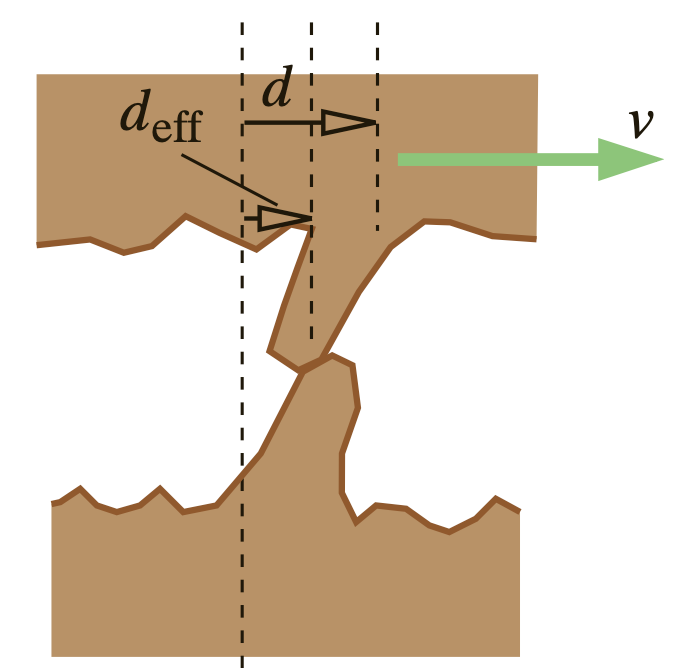
As we discussed previously, the bottom surface of a block does not uniformly contact the surface below it. Instead, the contact occurs at a number of microscopic “teeth” or asperities.
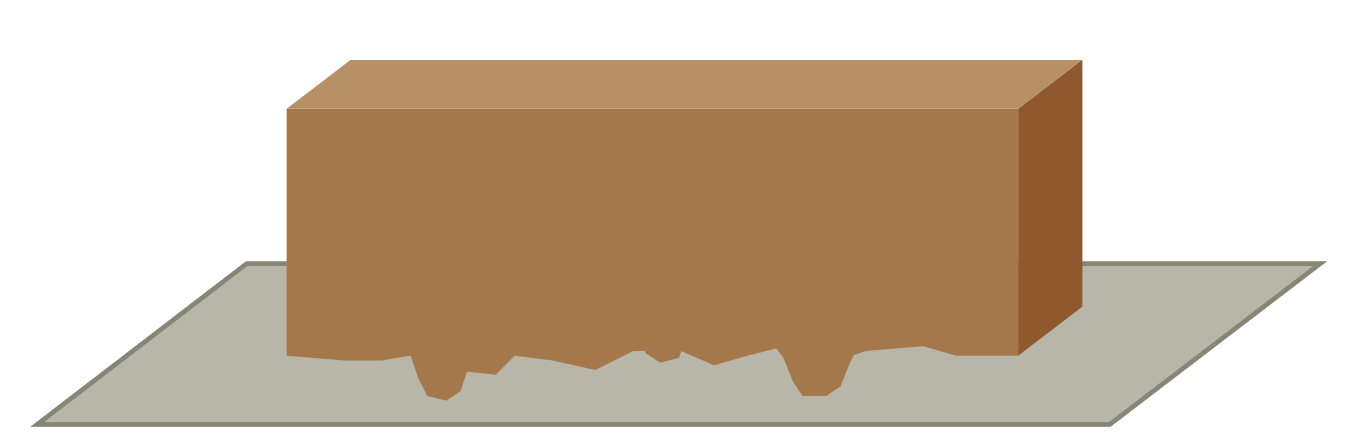
As a block slides, the teeth at the surface of the block make contact with the teeth in the bottom surface, and it is at these points of contact that the friction force is applied. Therefore, the effective distance $d_{\mathrm{eff}}$ traveled by the point of application of the friction force is not equal to the distance $d$ traveled by the block.
Energy changes including thermal energy
| Energy change or transfer | When is it nonzero? |
|---|---|
| $\Delta K$ | Difference in speed of an object between initial and final states. |
| $\Delta U_g$ | Difference in height of an object between initial and final states. |
| $\Delta U_s$ | Difference in extension of a spring or elastic material between initial and final states. |
| $\Delta E_\mathrm{th}$ | Friction or other dissipative forces act on the system while the point of application moves. |
| $W_{\mathrm{ext}}$ | External applied force acts on the system while the point of application moves. |
Solving problems with energy
Example: Spring launch with friction and a ramp
A $500\ \mathrm{g}$ block is held against a horizontal spring with spring constant $k = 500\ \mathrm{N/m}$, and the spring is initially compressed by $15.0\ \mathrm{cm}$ from its unstressed length. The block is released at rest and slides along a horizontal surface and then up a ramp. The ramp and horizontal surface are frictionless except for a $2.00\ \mathrm{m}$ long rough patch on the horizontal surface. The coefficient of kinetic friction between the block and the rough patch is $\mu_k = 0.300$.
When the block has moved up the ramp $40.0\ \mathrm{cm}$ vertically, how fast is it moving?
Solution
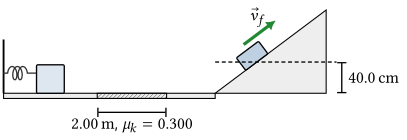
Take the system to include the block, the spring, Earth, and the rough patch of the surface. There is then no external work on the system, so the energy principle is
\[\Delta K + \Delta U_s + \Delta U_g + \Delta E_{\mathrm{th}} = 0.\]The spring starts compressed by $s_i = 0.150\ \mathrm{m}$ and is unstressed after the block leaves it, so
\[\Delta U_s = \frac{1}{2}ks_f^2 - \frac{1}{2}ks_i^2 = -\frac{1}{2}ks_i^2.\]The block starts at rest, so $\Delta K = \tfrac{1}{2}mv_f^2$, and it rises by $h = 0.400\ \mathrm{m}$, so
\[\Delta U_g = mgh.\]On the horizontal rough patch the normal force is $F_N = mg$, so the kinetic friction force has magnitude $f_k = \mu_k mg$, and the thermal energy generated as the block slides the length $d = 2.00\ \mathrm{m}$ of the patch is
\[\Delta E_{\mathrm{th}} = f_k d = \mu_k mgd.\]Plugging these into the energy principle gives
\[\frac{1}{2}mv_f^2 - \frac{1}{2}ks_i^2 + mgh + \mu_k mgd = 0\] \[\begin{aligned} \rightarrow \frac{1}{2}mv_f^2 &= \frac{1}{2}ks_i^2 - mgh - \mu_k mgd\\ \rightarrow v_f &= \sqrt{\frac{ks_i^2}{m} - 2gh - 2\mu_k gd}\\ &= \boxed{1.70\ \mathrm{m/s}.} \end{aligned}\]When do we solve problems using energy?
Many problems can be solved either by using Newton’s second law in combination with kinematics, or by using the energy principle. How do we know which approach to use? How do we identify problems that can only be solved using one of these approaches?
In general, I recommend using the energy approach to solve problems when possible, since it will usually require less work than the Newton’s second law approach. So the question is really: when is it not possible to use the energy approach?
There are a few types of questions that energy cannot help us answer:
- Questions about the time it takes for a process to occur.
- Questions about the direction of motion of an object at a particular instant in time. The kinetic energy only depends on the speed of an object, not the direction of its velocity.
- Questions about the shape of the path taken by an object between two points. For example, in projectile motion, questions about the horizontal range or launch angle of a projectile cannot be answered using energy alone.
One category of problems in which we must use energy is those in which the length of a spring is changing. In these problems, the spring force is a variable force, and we cannot use Newton’s second law to find the acceleration of the object.
Power and efficiency
Power
If you run a mile in 6 minutes, you expend about the same amount of energy as if you run a mile in 12 minutes, but your experience of the two runs will be very different! In many situations, it is important to know not just how much energy is expended, but also how quickly that energy is expended.
Key result: The rate at which energy is transferred or transformed is called power $P$. In general, \(\boxed{P = \frac{dE}{dt}}\) where $E$ stands for whatever form or transfer of energy we are interested in.
The SI unit of power is the watt ($\mathrm{W}$), defined as $1\ \mathrm{J/s}$.
The average power over a time interval $\Delta t$ is
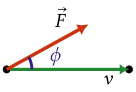
\[P_\mathrm{av} = \frac{\Delta E}{\Delta t}\]When a force $\vec{F}$ acts on a particle moving with velocity $\vec{v}$, the instantaneous power delivered by the force—that is, the rate at which the force does work on the particle—is
\[P = F v \cos\phi\]where $\phi$ is the angle between the force and the velocity vectors.
Check your understanding: A $70\ \mathrm{kg}$ person is climbing stairs. The height of their center of gravity increases at a constant rate of $3.0\ \mathrm{m}$ every $5.0\ \mathrm{s}$. What is their mechanical power output?
Solution
The useful mechanical energy output is the increase in gravitational potential energy,
\[\Delta U_g = mg\Delta h.\]The average mechanical power is therefore
\[\begin{aligned} P_{\mathrm{mech}} &= \frac{\Delta U_g}{\Delta t}\\ &= \frac{mg\Delta h}{\Delta t}\\ &= \frac{\left(70\ \mathrm{kg}\right) \left(9.8\ \mathrm{m/s^2}\right) \left(3.0\ \mathrm{m}\right)} {5.0\ \mathrm{s}}\\ &= 411.6\ \mathrm{W}. \end{aligned}\]To two significant figures,
\[\boxed{P_{\mathrm{mech}} = 410\ \mathrm{W}.}\]Efficiency
Although we can never lose energy in a physical process, we’ve seen that energy can become less useful, for example when thermal energy is generated by friction. We often want to measure how much of the energy input to a process ends up in a useful form—that is, we want to measure the efficiency of the process.
Key result: The efficiency $e$ of a process is defined as the ratio of the useful energy output to the total energy input: \(\boxed{e = \frac{\text{useful energy output}}{\text{total energy input}}}\)
For a continuous process, we can also express the efficiency in terms of power:
\[e = \frac{\text{useful power output}}{\text{total power input}}\]What counts as useful?
The question of what counts as “useful” is a subjective one, and the answer may change depending on the context.
For example, consider that about 10% of the chemical energy we consume in food is converted into thermal energy in the process of digestion. In this sense, the energy efficiency of eating is
\[e = \frac{\text{energy body can use}}{\text{total chemical energy in food}} \approx 0.90\]However, if we are interested in how efficiently we can convert chemical energy in food into mechanical energy for doing work, then the efficiency of eating is more like
\[e = \frac{\text{mechanical energy output}}{\text{total chemical energy in food}} \approx 0.25\]Check your understanding: Consider the scenario from earlier, in which a $70\ \mathrm{kg}$ person is climbing stairs, and they move up at a constant rate of $3.0\ \mathrm{m}$ every $5.0\ \mathrm{s}$. If the person is 25% efficient at converting chemical energy from food into mechanical energy for climbing, how much chemical energy from food is expended during a $30\ \mathrm{s}$ stair climb?
Solution
From the previous exercise, the mechanical power output is
\[P_{\mathrm{mech}} = 411.6\ \mathrm{W}.\]During a $30\ \mathrm{s}$ climb, the useful mechanical energy output is
\[\begin{aligned} E_{\mathrm{mech}} &= P_{\mathrm{mech}}\Delta t\\ &= \left(411.6\ \mathrm{W}\right)\left(30\ \mathrm{s}\right)\\ &= 1.23 \times 10^4\ \mathrm{J}. \end{aligned}\]The efficiency is
\[e = \frac{\text{useful energy output}}{\text{total energy input}},\]and here the total input is the chemical energy from food, so
\[\begin{aligned} E_{\mathrm{chem}} &= \frac{E_{\mathrm{mech}}}{e}\\ &= \frac{1.23 \times 10^4\ \mathrm{J}}{0.25}\\ &= \boxed{4.9 \times 10^4\ \mathrm{J}.} \end{aligned}\]For comparison, this is about 12 food Calories (kilocalories).