Circular motion
Circular motion appears in many different contexts and has important applications. For example:
- Motion of charged particles in magnetic fields, used for mass spectrometry
- Centrifugation
- Satellite motion
Understanding circular motion is also important for understanding oscillatory motion, like the swinging of a pendulum or the vibrations of a mass on a spring.
Let’s start by considering the motion of an object moving in a circle at constant speed $v$, which is called uniform circular motion (UCM).
Period and frequency in UCM
One essential feature of UCM is that it is periodic motion, which means that the motion repeats at regular time intervals. The time it takes for the motion to repeat is called the period $T$.
Each full circle the object completes is called a revolution or cycle. The number of revolutions per unit time is the frequency $f$ of the motion. The frequency measures the rate of repetition: higher frequency means the motion repeats more often.
The period and frequency are related by
\[\boxed{f = \frac{1}{T}}\]The units of frequency are $\mathrm{s^{-1}}$ or hertz ($\mathrm{Hz}$): $1\ \mathrm{Hz} = 1\ \mathrm{s^{-1}}$.
Kinematics of UCM
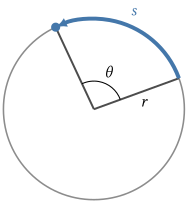
Consider a particle moving in a circle of radius $r$. We can represent the motion of a particle moving in a circle using the arc length $s = r\theta$ measured along the circle.
Speed in UCM
Since the speed of a particle in UCM is constant, we can calculate it using
\[v = \frac{\Delta s}{\Delta t}\]where $\Delta s$ is the distance traveled along the circle in time $\Delta t$.
Over one revolution, the particle travels a distance of one circumference, so $\Delta s = 2\pi r$. The time for one revolution is the period, so $\Delta t = T$. We find that the speed of a particle in UCM is
\[\boxed{v = \frac{2\pi r}{T}}\]We can also express the speed in terms of the frequency $f$ using $f = 1/T$:
\[v = 2\pi r f\]Velocity in UCM
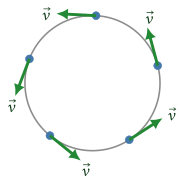
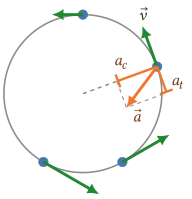
Even though the speed of a particle in UCM is constant, its velocity vector $\vec{v}$ is constantly changing. The velocity vector points tangent to the particle’s path along the circle, and it changes direction as the particle moves around the circle.
Acceleration in UCM
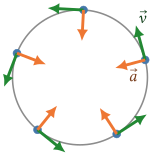
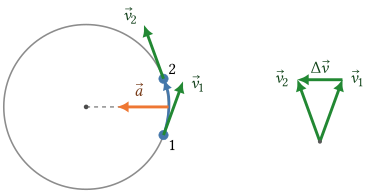
Because the velocity vector of a particle in UCM is changing direction, the particle is accelerating, even though its speed is constant. To keep the velocity pointing tangent to the circle, the acceleration vector $\vec{a}$ must point toward the center of the circle.
Proving this exactly requires some vector calculus. However, we can approximate the acceleration vector by taking the average acceleration over a short time interval $\Delta t$.
Centripetal acceleration
We refer to the component of the acceleration in the direction toward the center of the circle as the centripetal acceleration. The magnitude of the centripetal acceleration is given by
\[\boxed{a_c = \frac{v^2}{r}}\]where $v$ is the speed of the particle and $r$ is the radius of the circle.
Any particle moving in a circle will have a centripetal acceleration with this magnitude, even if the speed is not constant. If the speed changes, then the centripetal acceleration will change in magnitude.
Non-uniform circular motion
If a particle is moving in a circle but its speed is not constant, then in addition to the centripetal component of the acceleration, there will be a tangential component of the acceleration that points tangent to the circle.
Forces in circular motion
Since any particle moving in circular motion must have a centripetal acceleration $a_c = v^2/r$, Newton’s 2nd law tells us that the component of the net force toward the center of the circle must be
\[F_{\mathrm{net},c} = m a_c = \frac{mv^2}{r}.\]Key result: Caution: This is a constraint on the motion, not a new force! A common misconception about circular motion is that there is an additional “centripetal force” that acts on an object moving in a circle, but this is not the case! Instead, we just need the forces that are already present (weight, tension, normal force, friction, etc.) to add up to the required net force toward the center of the circle.
Solving circular motion problems
When solving problems involving the forces on an object in circular motion, we can use the same steps as we have previously: draw a free-body diagram, write down Newton’s 2nd law in component form, etc.
We just need to ensure that we
- Identify the direction toward the center of the circle, and choose one of our coordinate axes to point in that center direction.
- Apply the circular motion constraint that the acceleration in the center direction must equal $a_c = v^2/r$ (or equivalently, the net force in the center direction must equal $F_{\mathrm{net},c} = mv^2/r$).
Example: Minimum rotation frequency for a rotor ride
An amusement park ride consists of a large cylindrical drum with radius $3.0\ \mathrm{m}$. The riders are accelerated in contact with the floor, and once the ride gets up to speed, the floor is removed. The riders are pushed inward by the outer wall of the drum and prevented from slipping down by a static friction force exerted by the wall.
If the coefficient of static friction between a rider and the wall is $0.50$, what is the minimum rotation frequency the ride can have without the rider slipping down?
Solution
The normal force from the wall points toward the center of the circular path. Static friction points upward to prevent the rider from slipping down.
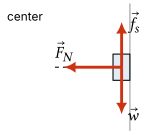
We find the static friction force required to prevent slipping by setting $a_y = 0$:
\[\begin{aligned} F_{\mathrm{net},y} &= f_s - mg = 0\\ \rightarrow f_s &= mg. \end{aligned}\]At the threshold for slipping, the static friction force takes its maximum value, so $f_s = f_{s,\max} = \mu_s F_N$, and we get
\[mg = \mu_s F_N.\]In the centripetal direction, the only force is the normal force, and we have the circular motion constraint $a_c = v^2/r$:
\[\begin{aligned} F_{\mathrm{net},c} &= m a_c\\ F_N &= \frac{m v^2}{r}. \end{aligned}\]Combining this with the friction condition,
\[\begin{aligned} mg &= \mu_s \frac{m v^2}{r}\\ v_{\min} &= \sqrt{\frac{gr}{\mu_s}}\\ &= \sqrt{\frac{\left(9.8\ \mathrm{m/s^2}\right)\left(3.0\ \mathrm{m}\right)}{0.50}}\\ &= 7.67\ \mathrm{m/s}. \end{aligned}\]Using $v = 2\pi r f$, the minimum frequency is
\[\begin{aligned} f_{\min} &= \frac{v_{\min}}{2\pi r}\\ &= \frac{7.67\ \mathrm{m/s}}{2\pi \left(3.0\ \mathrm{m}\right)}\\ &= \boxed{0.41\ \mathrm{Hz}.} \end{aligned}\]