Friction
We’ve discussed how, when two surfaces are in contact, there is a perpendicular or normal force that prevents the surfaces from passing through each other. There is also a parallel contact force called friction that resists sliding of the surfaces against each other.
Friction is the force that causes an object sliding on a surface to slow down and come to a stop. It’s also the force that causes your hands to warm up when you rub them together. Friction allows you to walk by pushing backward on the ground, and it allows a car to accelerate forward by pushing backward on the road with its tires.
Kinetic vs. static friction
There are two types of friction that we will consider:
- Kinetic friction (or sliding friction) $\vec{f}_k$ is the force that acts when two surfaces are sliding against each other. It acts opposite the relative motion of the surfaces.
- Static friction $\vec{f}_s$ is the force that acts to prevent sliding motion from starting. Static friction only acts when the surfaces are not sliding relative to each other and a force is applied that would otherwise cause sliding.
At a given pair of surfaces, only one of these types of friction can act at a time—the surfaces are either sliding against each other (kinetic friction) or they are not sliding (static friction).
Microscopic origin of friction
Both types of friction are due to the microscopic roughness of surfaces. If we zoom in on the contact area between two surfaces, we see that the surfaces are not perfectly smooth. There are many tiny “teeth” or asperities, and the surfaces make contact at these asperities.
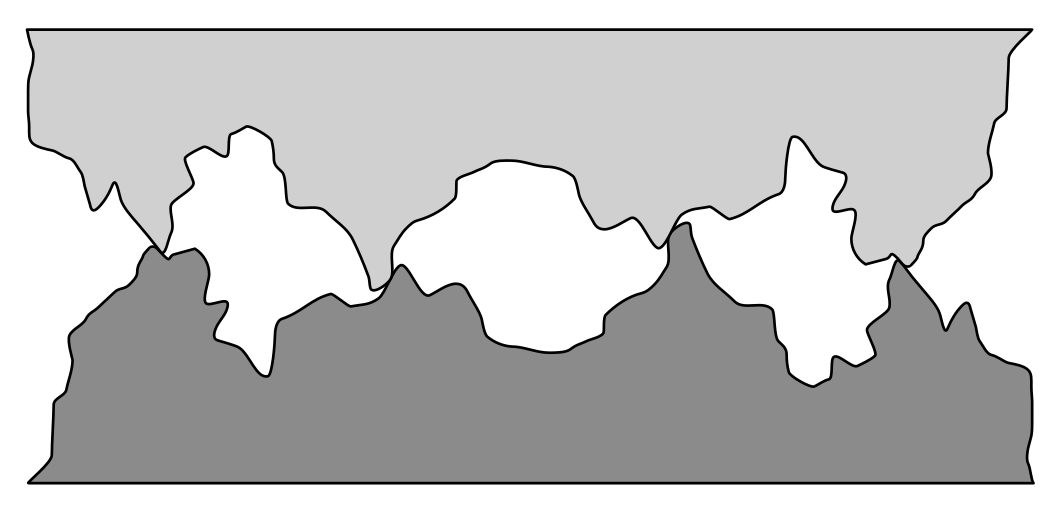
When surfaces slide against each other, the asperities on one surface catch on the asperities of the other surface and bond together.

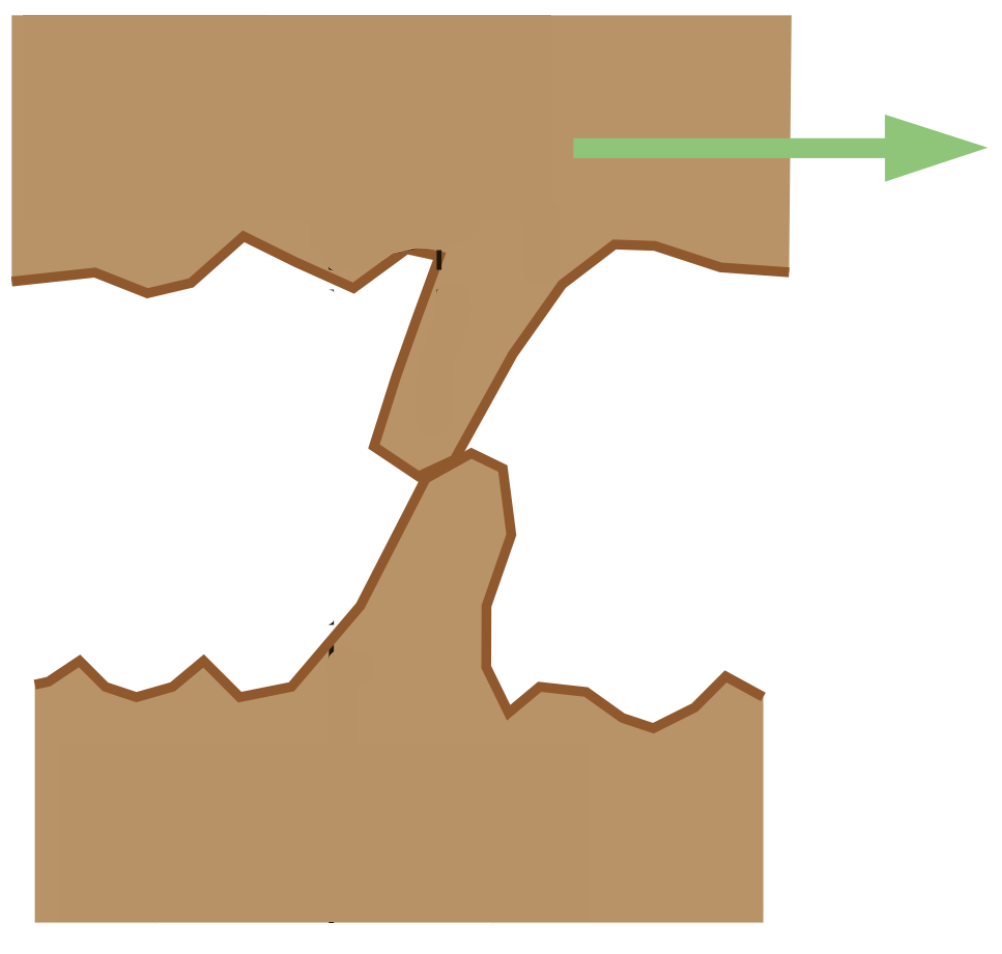
- Static friction arises because asperities in contact at rest form strong bonds that resist the start of sliding. To cause sliding to start, we must apply a force large enough to break these bonds.
- Kinetic friction is caused by the continuous breaking and reforming of these asperity bonds as the surfaces slide against each other, as well as harder asperities deforming softer asperities and “plowing” through the other surface.
Kinetic friction
Kinetic friction $\vec{f}_k$ is the parallel contact force that acts when two surfaces are sliding against each other.
A simple and widely effective model for kinetic friction is the Coulomb model, which says that the magnitude of the kinetic friction force is proportional to the normal force $F_N$ between the surfaces:
\[\boxed{f_k = \mu_k F_N.}\]The constant of proportionality $\mu_k$ (“mu sub k” or just “mu k”) is called the coefficient of kinetic friction, and is a dimensionless number that depends on the materials of the surfaces in contact.
Notably, the kinetic friction force does not depend on the sliding speed or the contact area between the surfaces.
Kinetic friction opposes relative motion
The direction of kinetic friction is opposite the relative sliding motion of the surfaces in contact. This does not necessarily mean that the kinetic friction force is “opposite the motion” of an object.
For example, consider a box in the bed of an accelerating truck, and suppose the box slips relative to the truck bed. That is, both the truck bed and the box accelerate forward, but the box accelerates more slowly than the truck bed.
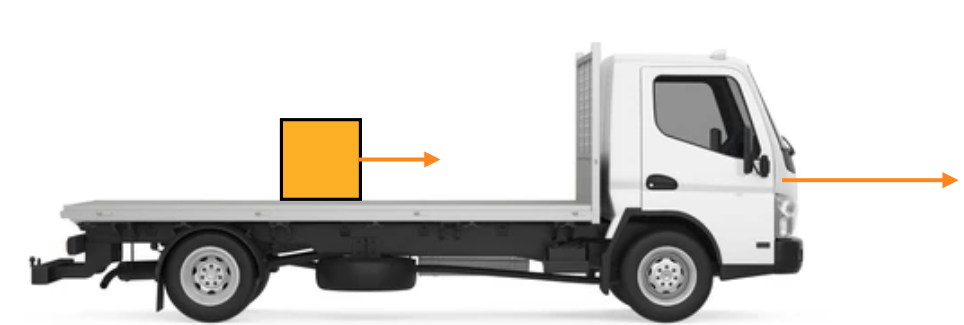
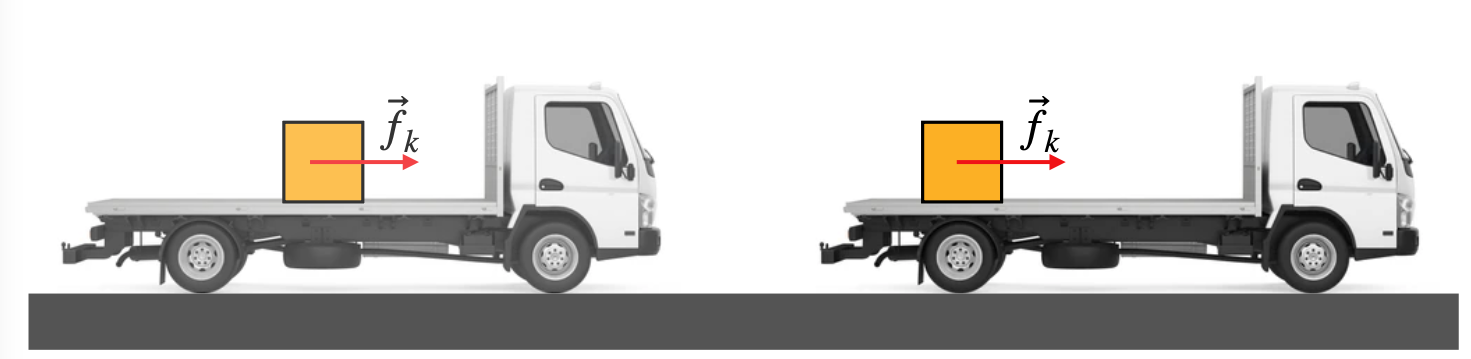
From the perspective of the truck bed, the box is sliding backward, even though someone on the ground would see the box accelerating forward. The kinetic friction force exerted by the truck bed is opposite the relative sliding motion of the box, so the force points forward on the box, in the direction of the box’s motion as seen by someone on the ground.
Working with kinetic friction
When working with kinetic friction, first identify the two surfaces in contact that are sliding against each other.
Finding the magnitude of kinetic friction:
- Find the perpendicular component of the net force on one of the objects in contact. Then apply the contact constraint to find the normal force $F_N$ between the surfaces.
- Use the Coulomb model $f_k = \mu_k F_N$ to find the magnitude of the kinetic friction force.
Finding the direction of kinetic friction:
- Decide which object you want to find the friction force on. Then, picture the motion of this object from the perspective of the other surface. The kinetic friction force on the first object will be opposite this relative motion.
Example: Kinetic friction with an angled pull
A $1.5\ \mathrm{kg}$ textbook is on a horizontal surface. The textbook is pulled across the surface by an $8.0\ \mathrm{N}$ force applied at an angle of $30^\circ$ above the horizontal. The coefficient of kinetic friction between the book and the surface is $\mu_k = 0.35$. What is the magnitude of the book’s acceleration?
Solution
Take $+x$ in the direction of the pull and $+y$ upward. Since the book slides to the right relative to the stationary surface, kinetic friction points to the left. The applied force has components
\[F_x = F\cos\theta, \qquad F_y = F\sin\theta.\]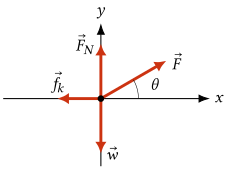
Step 1: Find the normal force. The book remains on the horizontal surface, so $a_y = 0$. Newton’s second law in the vertical direction gives
\[\begin{aligned} F_{\mathrm{net},y} &= m a_y\\ F_N + F\sin\theta - mg &= 0\\ F_N &= mg - F\sin\theta\\ &= (1.5\ \mathrm{kg})(9.8\ \mathrm{m/s^2}) - (8.0\ \mathrm{N})\sin(30^\circ)\\ &= 10.7\ \mathrm{N}. \end{aligned}\]Step 2: Find the kinetic friction force. The magnitude of the kinetic friction force is
\[\begin{aligned} f_k &= \mu_k F_N\\ &= (0.35)(10.7\ \mathrm{N}) = 3.75\ \mathrm{N}. \end{aligned}\]Step 3: Apply Newton’s second law horizontally. In the $x$ direction,
\[\begin{aligned} F_{\mathrm{net},x} &= m a_x\\ F\cos\theta - f_k &= m a_x\\ a_x &= \frac{F\cos\theta - f_k}{m}\\ &= \frac{(8.0\ \mathrm{N})\cos(30^\circ) - 3.75\ \mathrm{N}}{1.5\ \mathrm{kg}}\\ &= 2.12\ \mathrm{m/s^2}. \end{aligned}\]So the book’s acceleration has magnitude
\[\boxed{2.1\ \mathrm{m/s^2}.}\]Static friction
Static friction $\vec{f}_s$ is the force that acts to prevent sliding motion from starting. Static friction only acts when the surfaces are not sliding relative to each other and a force is applied that would otherwise cause sliding.
The static friction force is a constraint force: it will take whatever magnitude is required to prevent sliding, but only up to a certain maximum value. If the required static friction force exceeds this maximum value, then sliding will occur.
The maximum static friction force is proportional to the normal force $F_N$ between the surfaces:
\[\boxed{f_{s,\max} = \mu_s F_N}\]where $\mu_s$ is the coefficient of static friction.
The coefficient of static friction is generally larger than the coefficient of kinetic friction, that is $\mu_s > \mu_k$. This means that it is harder to make an object start sliding than it is to keep it sliding once it has started.
The actual static friction force $\vec{f}_s$ must be less than or equal to the maximum static friction force $f_{s,\max}$:
\[f_s \leq \mu_s F_N.\]The value of the static friction force required to prevent sliding is determined by the no-slip constraint, which is that there is no relative motion (and hence no relative acceleration) parallel to the contact surface:
\[a_{\parallel} = 0\]The direction of the static friction force is opposite the direction of sliding that would occur if there were no static friction. To determine the direction of static friction on an object, imagine how that object would slide relative to the other surface if there were no static friction. The static friction force will be opposite this.
Working with static friction
To determine if an object will start sliding:
- Identify the two surfaces in contact that might slide against each other.
- Write down the component of the net force parallel to the contact surface, including the static friction force.
- Apply the no-slip constraint to find the magnitude of the static friction force required to prevent sliding.
- Calculate the magnitude of the normal force and the maximum static friction force $f_{s,\max} = \mu_s F_N$.
- Compare the required static friction force to the maximum static friction force.
- If the required static friction force is less than or equal to the maximum static friction force, then the object will not slide and the static friction force will be equal to the required value.
- If the required static friction force is greater than the maximum static friction force, then the object will start sliding and there will be kinetic friction instead of static friction.
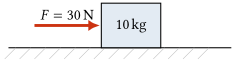
Check your understanding: A $10\ \mathrm{kg}$ box rests on a flat floor. The coefficient of static friction between the box and the floor is $\mu_s = 0.50$. The box is pushed horizontally with a force of magnitude $30\ \mathrm{N}$. What is the magnitude of the static friction force on the box?
Answer
Take $+x$ in the direction of the push and $+y$ upward. If the box does not slide, the no-slip constraint gives $a_x = 0$. Newton’s second law in the horizontal direction gives
\[\begin{aligned} F_{\mathrm{net},x} &= m a_x\\ F - f_s &= 0\\ f_s &= F = 30\ \mathrm{N}. \end{aligned}\]This is the amount of static friction required to keep the box at rest.
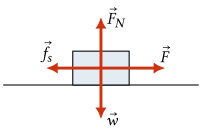
Now check whether static friction can provide that much force. In the vertical direction,
\[\begin{aligned} F_{\mathrm{net},y} &= m a_y\\ F_N - mg &= 0\\ F_N &= mg = (10\ \mathrm{kg})(9.8\ \mathrm{m/s^2}) = 98\ \mathrm{N}. \end{aligned}\]The maximum possible static friction force is
\[\begin{aligned} f_{s,\max} &= \mu_s F_N\\ &= (0.50)(98\ \mathrm{N}) = 49\ \mathrm{N}. \end{aligned}\]Since $30\ \mathrm{N} < 49\ \mathrm{N}$, the box does not slide. The static friction force has magnitude
\[\boxed{f_s = 30\ \mathrm{N}.}\]Example: Static friction on an incline
A $1.5\ \mathrm{kg}$ textbook is placed at rest on an inclined surface that is tilted at an angle $\theta$ from the horizontal. The coefficient of static friction between the book and the surface is $\mu_s = 0.45$ and the coefficient of kinetic friction is $\mu_k = 0.25$.
- If the angle of the incline is $\theta = 30^\circ$, will the book slide down the incline? If not, what is the magnitude of the static friction force on the book? If so, what is the magnitude of the book’s acceleration?
- What is the largest angle of the incline $\theta$ for which the book will remain at rest on the incline?
Solution
Choose $+x$ up the incline and $+y$ perpendicular to the surface, away from the incline. Without friction, the book would tend to slide down the incline, so friction points up the incline.
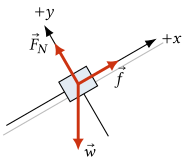
(a) First assume the book remains at rest. The no-slip constraint gives $a_x = 0$, so Newton’s second law along the incline gives
\[\begin{aligned} F_{\mathrm{net},x} &= m a_x\\ f_s - mg\sin\theta &= 0\\ f_{s,\mathrm{req}} &= mg\sin\theta. \end{aligned}\]At $\theta = 30^\circ$,
\[\begin{aligned} f_{s,\mathrm{req}} &= (1.5\ \mathrm{kg})(9.8\ \mathrm{m/s^2})\sin(30^\circ)\\ &= 7.35\ \mathrm{N}. \end{aligned}\]We find the normal force from the perpendicular Newton’s second law equation:
\[\begin{aligned} F_{\mathrm{net},y} &= m a_y\\ F_N - mg\cos\theta &= 0\\ F_N &= mg\cos\theta\\ &= (1.5\ \mathrm{kg})(9.8\ \mathrm{m/s^2})\cos(30^\circ)\\ &= 12.7\ \mathrm{N}. \end{aligned}\]Therefore the maximum possible static friction force is
\[\begin{aligned} f_{s,\max} &= \mu_s F_N\\ &= (0.45)(12.7\ \mathrm{N}) = 5.73\ \mathrm{N}. \end{aligned}\]Since
\[f_{s,\mathrm{req}} = 7.35\ \mathrm{N} \quad > \quad f_{s,\max} = 5.73\ \mathrm{N},\]static friction is not large enough to hold the book at rest. The book $\boxed{\text{slides down the incline}.}$
Since the book slides, kinetic friction applies, and the kinetic friction force is
\[f_k = \mu_k F_N = (0.25)(12.7\ \mathrm{N}) = 3.18\ \mathrm{N}.\]Newton’s second law along the incline then gives
\[\begin{aligned} f_k - mg\sin\theta &= m a_x\\ a_x &= \frac{f_k - mg\sin\theta}{m}\\ &= -g\sin\theta + \mu_k g\cos\theta\\ &= -(9.8\ \mathrm{m/s^2})\sin(30^\circ) + (0.25)(9.8\ \mathrm{m/s^2})\cos(30^\circ)\\ &= -2.78\ \mathrm{m/s^2}. \end{aligned}\]The negative sign means the acceleration points down the incline, and its magnitude is
\[\boxed{2.8\ \mathrm{m/s^2}.}\](b) The largest angle occurs at the threshold where the required static friction just equals the maximum static friction:
\[mg\sin\theta_{\max} = \mu_s mg\cos\theta_{\max}.\]Canceling $mg$ and dividing by $\cos\theta_{\max}$,
\[\begin{aligned} \tan\theta_{\max} &= \mu_s\\ \theta_{\max} &= \tan^{-1}(\mu_s) = \tan^{-1}(0.45) = \boxed{24^\circ.} \end{aligned}\]This agrees with part (a): $30^\circ$ is larger than $24^\circ$, so the book cannot remain at rest on a $30^\circ$ incline.
Image credits: Diagram of two surfaces in contact showing asperities, adapted from TotoBaggins, Mckdandy — own work based on Asperities.JPG, CC BY-SA 3.0, Wikimedia Commons, Asperities. Focused view of asperities in contact, adapted from R. W. Chabay, B. A. Sherwood, Matter & Interactions, 4th ed., p. 370.