Projectile motion
So far, we have only considered motion in one dimension. However, many real-world situations involve motion in two dimensions. For example, when you throw a ball, it follows a curved path through the air rather than moving in a straight line. Two-dimensional motion under the influence of gravity (like the motion of a thrown ball) is called projectile motion.
Studying two-dimensional projectile motion is no different from studying one-dimensional constant acceleration motion. The only difference is that we will have two independent coordinates—horizontal and vertical—instead of just one.
Acceleration in projectile motion
I will always choose to work in a coordinate system in which the $x$-axis is horizontal and the $y$-axis is vertical, with the positive $y$ direction pointing up. The horizontal and vertical coordinate functions are $x(t)$ and $y(t)$, and the velocity and acceleration vectors are $\vec{v} = (v_x, v_y)$ and $\vec{a} = (a_x, a_y)$.
Since we assume the only force acting on the projectile is gravity, the acceleration is the same as in free-fall motion: no acceleration in the horizontal direction, and a constant downward acceleration in the vertical direction with magnitude $g$:
\[\begin{aligned} a_x &= 0\\ a_y &= -g. \end{aligned}\]Horizontal and vertical motion are independent
The horizontal and vertical motions of a projectile are independent of each other. The horizontal motion does not affect the vertical motion, and vice versa. If you throw a ball horizontally, it will reach the ground in the same amount of time as if you dropped it straight down from the same height.
We can analyze the two motions separately, treating them as simultaneous one-dimensional motions:
- Since the horizontal acceleration is zero, the horizontal motion is uniform motion.
- The vertical motion is free-fall motion with constant downward acceleration $g$.
Since we’ve already covered both of these types of motion, we don’t need to learn any new equations to analyze projectile motion!
Equations for projectile motion
For the uniform motion in the $x$ direction, we have:
\[\begin{aligned} x(t) &= v_{x} t\\ v_x &= \text{constant}. \end{aligned}\](We could include an initial position $x_0$ if necessary, but we nearly always choose our coordinate system so that $x_0 = 0$.)
For the free-fall motion in the $y$ direction, we have:
\[\begin{aligned} y(t) &= y_0 + v_{0y} t - \frac{1}{2} g t^2\\ v_y(t) &= v_{0y} - g t\\ v_{y,f}^2 &= v_{y,i}^2 - 2 g \Delta y. \end{aligned}\]Decomposing the initial velocity
The initial velocity of a projectile is often given in terms of the launch speed $v_0$ and the launch angle $\theta$ above the horizontal. We can decompose the initial velocity into its horizontal and vertical components in the usual way:
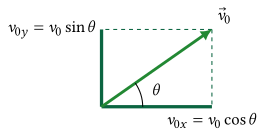
The components are
\[\begin{aligned} v_{0x} &= v_0 \cos \theta\\ v_{0y} &= v_0 \sin \theta. \end{aligned}\]Since the horizontal velocity is constant, we have $v_x = v_{0x} = v_0 \cos \theta$ for all time. The vertical velocity changes with time.
If we write the equations of motion in terms of the launch speed and angle, we have:
\[\begin{aligned} x(t) &= (v_0\cos\theta)\, t\\ v_x &= v_0 \cos \theta \end{aligned}\]for the horizontal motion, and
\[\begin{aligned} y(t) &= y_0 + (v_0 \sin\theta)\, t - \frac{1}{2} g t^2\\ v_y(t) &= v_0 \sin\theta - g t \end{aligned}\]for the vertical motion.
Trajectory of a projectile
Since $x(t)$ is a linear function of $t$ and $y(t)$ is a quadratic function of $t$, the path of the projectile (graph of $y$ vs. $x$) is a parabola.
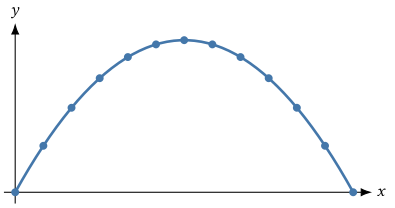
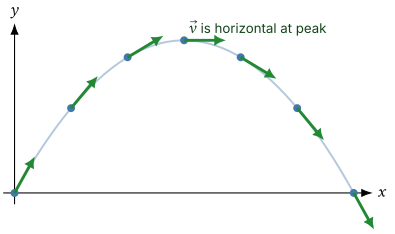
The velocity vector of the projectile is tangent to the projectile’s path at every point. At the peak of the motion, the velocity is purely horizontal.
Example: Ball launched horizontally from a lab bench
In a physics lab experiment, a small ball is launched from a $1.25\ \mathrm{m}$ high lab bench from a spring launcher. The ball leaves the launcher traveling horizontally at a speed of $5.00\ \mathrm{m/s}$.
- How long is the ball in the air?
- How far horizontally from the bench does the ball land?
Solution
Let the $+x$ axis point horizontally in the direction of launch and the $+y$ axis point vertically upward, with the origin on the floor directly below the launch point. Then $x_0 = 0$ and $y_0 = 1.25\ \mathrm{m}$. Because the launch is horizontal, the initial velocity has no vertical component:
\[v_{0x} = 5.00\ \mathrm{m/s}, \qquad v_{0y} = 0.\]The horizontal and vertical motions are independent: the horizontal motion is uniform ($a_x = 0$) and the vertical motion is free fall ($a_y = -g$):
\[x(t) = v_{0x}\, t, \qquad y(t) = y_0 - \tfrac{1}{2} g t^2.\](a) The ball lands when $y = 0$. Since $v_{0y} = 0$, the vertical equation has no linear term and we can solve directly:
\[\begin{aligned} 0 &= y_0 - \tfrac{1}{2} g t^2\\ \rightarrow t &= \sqrt{\frac{2 y_0}{g}} = \sqrt{\frac{2\left(1.25\ \mathrm{m}\right)}{9.8\ \mathrm{m/s^2}}} = \boxed{0.505\ \mathrm{s}.} \end{aligned}\]Notice this is the same time it would take the ball to fall straight down from the bench. The horizontal launch speed does not change how long the ball is in the air.
(b) The horizontal distance is the (constant) horizontal velocity times the time in the air:
\[x = v_{0x}\, t = \left(5.00\ \mathrm{m/s}\right)\left(0.505\ \mathrm{s}\right) = \boxed{2.53\ \mathrm{m}.}\]Example: Projectile launched at an angle
A ball is thrown from $1.50\ \mathrm{m}$ above the ground at $20.0\ \mathrm{m/s}$ and at an angle of $35.0^\circ$ above the horizontal.
- How long does it take the ball to reach its maximum height, and how fast is it moving at that point?
- How far horizontally does the ball travel before it hits the ground?
- What are the magnitude and direction of the ball’s velocity just before it hits the ground?
Solution
Let the $+x$ axis point horizontally and the $+y$ axis point vertically upward, with the origin at ground level directly below the launch point. The initial position is $x_0 = 0$, $y_0 = 1.50\ \mathrm{m}$. The launch speed is $v_0 = 20.0\ \mathrm{m/s}$ and the launch angle is $\theta = 35.0^\circ$, so the initial velocity components are
\[\begin{aligned} v_{0x} &= v_0 \cos\theta = \left(20.0\ \mathrm{m/s}\right)\cos 35.0^\circ = 16.4\ \mathrm{m/s},\\ v_{0y} &= v_0 \sin\theta = \left(20.0\ \mathrm{m/s}\right)\sin 35.0^\circ = 11.5\ \mathrm{m/s}. \end{aligned}\]The horizontal velocity is constant ($v_x = v_{0x}$) and the vertical motion is free fall with $g = 9.8\ \mathrm{m/s^2}$.
(a) At the maximum height, the vertical velocity is zero ($v_y = 0$). From the vertical velocity equation,
\[\begin{aligned} v_y(t_{\mathrm{max}}) &= v_{0}\sin\theta - g\, t_{\mathrm{max}} = 0\\ \rightarrow t_{\mathrm{max}} &= \frac{v_{0}\sin\theta}{g} = \frac{11.5\ \mathrm{m/s}}{9.8\ \mathrm{m/s^2}} = \boxed{1.17\ \mathrm{s}.} \end{aligned}\]At this instant the vertical velocity is zero, but the horizontal velocity is unchanged, so the speed at the top is just the horizontal component:
\[v = \sqrt{v_x^2 + 0^2} = v_{0}\cos\theta = \boxed{16.4\ \mathrm{m/s}.}\](b) To find the horizontal range, we first need the total time in the air. The ball hits the ground when $y = 0$:
\[y_0 + v_{0}\sin\theta\, t - \tfrac{1}{2} g t^2 = 0.\]Solving this quadratic for $t$,
\[t = \frac{v_{0}\sin\theta \pm \sqrt{(v_{0}\sin\theta)^2 + 2 g y_0}}{g} = \begin{cases}\phantom{-}2.47\ \mathrm{s}\quad (+)\\[2pt] -0.124\ \mathrm{s}\quad (-)\end{cases}\]The positive root is the time to reach the ground, $t_g = 2.47\ \mathrm{s}$. Plugging it into the horizontal position equation (carrying the unrounded value $t_g = 2.465\ \mathrm{s}$ to avoid rounding error),
\[x(t_g) = v_{0}\cos\theta \; t_g = \left(16.4\ \mathrm{m/s}\right)\left(2.465\ \mathrm{s}\right) = \boxed{40.4\ \mathrm{m}.}\](c) The horizontal component is unchanged, $v_x = 16.4\ \mathrm{m/s}$. The vertical component just before landing comes from the velocity equation at $t_g$:
\[v_y = v_0 \sin\theta - g\, t_g = 11.5\ \mathrm{m/s} - \left(9.8\ \mathrm{m/s^2}\right)\left(2.465\ \mathrm{s}\right) = -12.7\ \mathrm{m/s}.\]The magnitude and direction of the final velocity are
\[\begin{aligned} \lvert\vec{v}\rvert &= \sqrt{v_x^2 + v_y^2} = \sqrt{\left(16.4\ \mathrm{m/s}\right)^2 + \left(12.7\ \mathrm{m/s}\right)^2} = \boxed{20.7\ \mathrm{m/s},}\\ \theta_f &= \tan^{-1}\!\left(\frac{v_y}{v_x}\right) = \tan^{-1}\!\left(\frac{-12.7\ \mathrm{m/s}}{16.4\ \mathrm{m/s}}\right) = \boxed{-37.8^\circ,} \end{aligned}\]that is, $37.8^\circ$ below the horizontal.
Example: Jumping a river on a motorcycle (optional challenge)
This example was not covered in lecture. It is included here as an optional challenge problem for extra practice.
Ava attempts to jump across a river on a motorcycle. She takes off from a ramp inclined at $12^\circ$ above the horizontal. The river is $30\ \mathrm{m}$ wide, and the bank on the far side of the river is $4.0\ \mathrm{m}$ below the top of the takeoff ramp.
What is the minimum speed Ava must have when she leaves the ramp in order to make it across the river?
Solution
Put the origin at the takeoff point (the top of the ramp), with $+x$ horizontal toward the far bank and $+y$ upward. Ava leaves the ramp at speed $v_0$ and angle $\theta = 12^\circ$, so
\[v_{0x} = v_0 \cos\theta, \qquad v_{0y} = v_0 \sin\theta.\]The landing spot—the near edge of the far bank—is a horizontal distance $R = 30\ \mathrm{m}$ away and a vertical drop $H = 4.0\ \mathrm{m}$ below the takeoff, so its coordinates are $(x, y) = (R,\, -H)$.
Physical condition. The minimum launch speed is the one for which Ava just reaches the far edge: any slower and she lands short, in the river. So we require the trajectory to pass through the point $(R,\, -H)$. The projectile equations are
\[x(t) = v_0 \cos\theta \; t, \qquad y(t) = v_0 \sin\theta \; t - \tfrac{1}{2} g t^2.\]Eliminate the time. From the horizontal equation, the time to reach $x = R$ is $t = \dfrac{R}{v_0 \cos\theta}$. Substituting into the vertical equation and setting $y = -H$,
\[-H = R\tan\theta - \frac{g R^2}{2 v_0^2 \cos^2\theta}.\]Solve for $v_0$. Rearranging to isolate $v_0$,
\[\begin{aligned} \frac{g R^2}{2 v_0^2 \cos^2\theta} &= R\tan\theta + H\\ \rightarrow v_0^2 &= \frac{g R^2}{2\cos^2\theta \left(R\tan\theta + H\right)}\\ \rightarrow v_0 &= R\,\sqrt{\frac{g}{2\cos^2\theta \left(R\tan\theta + H\right)}}. \end{aligned}\]Plugging in the numbers, with $R\tan 12^\circ = \left(30\ \mathrm{m}\right)(0.2126) = 6.38\ \mathrm{m}$,
\[v_0 = \left(30\ \mathrm{m}\right)\sqrt{\frac{9.8\ \mathrm{m/s^2}}{2\cos^2 12^\circ\left(6.38\ \mathrm{m} + 4.0\ \mathrm{m}\right)}} = \boxed{21\ \mathrm{m/s}.}\](about $47\ \mathrm{mph}$).
Sanity check. At this launch speed the peak of Ava’s trajectory is only about $\Delta y_{\max} = \dfrac{(v_0\sin\theta)^2}{2g} \approx 1.0\ \mathrm{m}$ above the ramp—a shallow, fast jump, which makes sense for a low $12^\circ$ launch angle. If the far bank were lower (larger $H$), the denominator would grow and the required speed would drop, as expected: a bigger drop gives the projectile more time to cover the $30\ \mathrm{m}$.