Solving kinematics problems
We’re now in a position to start applying what we’ve learned to solve problems involving moving objects. Some of the questions we might want to answer include:
- Where will an object be at a specific time, or how far will it travel over a specific time interval?
- When will an object reach a specific position? When will two objects reach the same position?
- What will the velocity of an object be at a specific time or at a specific position?
- When will an object have a specific velocity?
You might be tempted to approach problems by asking “What formula should I use?” However, I encourage you not to think about problem solving this way.
Instead, problem solving is a creative, multi-step process that requires you to understand the problem, develop a strategy, and carry out that strategy. There is no exact recipe I can give you for how to solve every problem you’ll encounter. However, there are some general steps that you can follow to help guide your thinking:
- Draw a picture!
- Choose a coordinate system.
- Define symbols and list what you know.
- Identify the goal.
- Identify physical conditions or constraints.
- Select relevant equations and fill in known values.
- Solve algebraically, then plug in numbers.
- Check your answer.
Let’s go through a problem and practice applying these steps.
Example: Two dogs meeting
Two dogs, Max and Luna, run toward each other. Luna runs east at $5.0\ \mathrm{m/s}$. Max starts $50\ \mathrm{m}$ east of Luna and runs west at $4.0\ \mathrm{m/s}$.
a. How long does it take the dogs to meet?
b. Where are they when they meet?
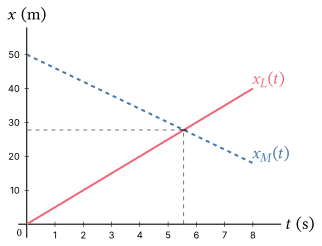
c. Sketch position vs. time graphs for the two dogs, and indicate the time and location the dogs meet on your graph.
Solution
We can use this problem to walk through the eight-step problem-solving process.
Step 1: Draw a picture. Sketch a horizontal $x$-axis pointing east. Luna is at the origin with a velocity arrow of magnitude $5.0\ \mathrm{m/s}$ pointing east (to the right), and Max is at $x = 50\ \mathrm{m}$ with a velocity arrow of magnitude $4.0\ \mathrm{m/s}$ pointing west (to the left).

Step 2: Choose a coordinate system. Take the $+x$ axis pointing east, with $x = 0$ at Luna’s starting position. With this choice, Luna moves in the $+x$ direction and Max moves in the $-x$ direction.
Step 3: Define symbols and list what you know. Let $d = 50\ \mathrm{m}$ be the initial distance between the dogs. Let $v_L = 5.0\ \mathrm{m/s}$ be Luna’s speed and $v_M = 4.0\ \mathrm{m/s}$ be Max’s speed.
Step 4: Identify the goal. We want the time $t_1$ when the dogs meet, and the position $x_1$ where they meet.
Step 5: Physical conditions. The dogs meet when they are at the same location, which means that their position functions are equal at time $t_1$: $x_L(t_1) = x_M(t_1)$.
Step 6: Write down relevant equations. Both dogs move in uniform motion, so their position functions are of the form
\[x(t) = x_0 + v_x t,\]where $x_0$ is the initial position and $v_x$ is the $x$-component of the velocity. For Luna, $x_{L,0} = 0$ and $v_{L,x} = v_L$, so
\[x_L(t) = v_L t.\]For Max, $x_{M,0} = d$ and $v_{M,x} = -v_M$ (negative because Max moves west), so
\[x_M(t) = d - v_M t.\]Step 7: Solve. Setting the two position functions equal and solving for $t_1$,
\[\begin{aligned} v_L t_1 &= d - v_M t_1\\ \rightarrow v_L t_1 + v_M t_1 &= d\\ \rightarrow (v_L + v_M)\, t_1 &= d\\ \rightarrow t_1 &= \frac{d}{v_L + v_M} \end{aligned}\]Plugging in the given numbers, we get
\[\begin{aligned} t_1 &= \frac{50\ \mathrm{m}}{5.0\ \mathrm{m/s} + 4.0\ \mathrm{m/s}}\\ &= \boxed{5.6\ \mathrm{s}.} \end{aligned}\]To find the meeting position $x_1$, we can plug $t_1$ into either position function (since the dogs are at the same position at that time). Using Luna’s position,
\[\begin{aligned} x_1 &= v_L t_1\\ &= (5.0\ \mathrm{m/s})(5.6\ \mathrm{s})\\ &= \boxed{28\ \mathrm{m}.} \end{aligned}\]Step 8: Check our answer.
- Units: The time is in seconds and the position is in meters, which are the correct units for these quantities. ✓
- Reasonable numbers: The dogs start 50 meters apart and run toward each other at (what we can assume are) realistic speeds for dogs, so it seems reasonable that they would meet after a few seconds. The meeting point is close to halfway between the dogs’ starting positions, and slightly closer to Max’s starting position, which makes sense since Luna is faster than Max. So the answers seem physically reasonable. ✓
- Changing parameters: If the dogs started farther apart, we expect the time it would take them to reach each other to increase, and we see that $t_1$ is directly proportional to $d$. If the dogs ran faster, we expect the meeting time to decrease, and $t_1$ is inversely proportional to the sum of the speeds. So the answers have the correct dependence on the parameters. ✓
Part (c): position vs. time graphs. Both position functions are straight lines. Luna’s line starts at the origin with slope $+5.0\ \mathrm{m/s}$, and Max’s line starts at $50\ \mathrm{m}$ with slope $-4.0\ \mathrm{m/s}$. The two lines cross at the meeting point, $t_1 = 5.6\ \mathrm{s}$ and $x_1 = 28\ \mathrm{m}$, which you can mark with a dot and dashed lines connecting it to the axes.