Potential energy
Let’s return to the example of the ball falling from rest. When we choose the system to include only the ball, we see that the system gains kinetic energy because Earth’s gravity, as an external force, does work on the system.
What if instead we choose the system to include both the ball and Earth? In this case, the gravitational force is an internal force, so it does no work on the system. However, the system still gains kinetic energy as the ball falls, and that energy must come from somewhere!

In order for energy conservation to apply to the Earth-ball system, there must be another form of energy in the system that is converted to kinetic energy as the ball falls.
This energy, which we call gravitational potential energy $U_g$, is due to the interaction between the ball and the Earth. More generally, potential energy $U$ is energy stored in a system due to interactions between particles or objects in the system.
In order for a system to have potential energy, it must include multiple interacting particles or objects. A single particle by itself cannot have potential energy, since there are no interactions between particles in the system.
Potential energy in the Earth-ball system
In a system including a ball and Earth, no energy is transferred into the system as work, because there are no external forces acting on the system:
\[W_{\mathrm{ext}} = 0\]The kinetic energy of the system still increases as the ball falls. If kinetic energy were the only energy form in the system, this would violate the energy principle. Instead, the gravitational potential energy decreases while kinetic energy increases, and the total energy of the system stays constant:
\[\Delta E_{\mathrm{sys}} = \Delta K+\Delta U_g = 0\]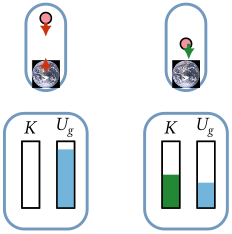
Conservative forces
Although potential energy is associated with interaction forces inside our system, not every force has a potential energy. Forces that have an associated potential energy are called conservative forces.
- A conservative force allows energy to be stored and recovered in a fully reversible way. If energy is converted into potential energy, all of that energy can be converted back to kinetic energy by the same force.
- Mathematically, a force is conservative if the work done by the force depends only on the initial and final states, not on the path between them.
- For example, the work done by gravity only depends on the initial and final heights of an object, not on the path taken between those heights, so gravity is a conservative force.
Defining potential energy
Suppose we have a conservative force acting as an external force on a particle. Then the energy principle gives
\[\Delta K = W_{\mathrm{cons}}\]If we include both interacting objects in the system, then the conservative force acts as an internal force, so it does no work on the system. In this case, the energy principle gives
\[\Delta K+\Delta U=0\]Since our choice of system is arbitrary, the energy accounting must be consistent regardless of how we choose our system. For these two versions of the energy principle to be consistent, we must define the change in potential energy for a conservative force as
\[\boxed{\Delta U=-W_{\mathrm{cons}}}\]Gravitational potential energy
The work done by gravity as an external force on an object with mass $m$ that undergoes a vertical displacement $\Delta h$ is
\[W_g=-mg\Delta h\]If we consider a system consisting of the object and the Earth, then since $\Delta U_g = - W_g$, the change in gravitational potential energy is
\[\boxed{\Delta U_g = mg\Delta h}\]Gravitational potential energy increases when the object moves upward and decreases when the object moves downward.
System convention
I will always use the convention that a mechanical system near Earth’s surface includes the Earth. Practically, this means that:
-
$\Delta E_{\mathrm{sys}}$ includes the change in gravitational potential energy:
\[\Delta E_{\mathrm{sys}}=\Delta K+\Delta U_g+\cdots\] -
Gravity does not do work on the system, so we do not include $W_g$ in $W_{\mathrm{ext}}$.
Applying the energy principle
Steps for applying the energy principle:
- Choose a system.
- Choose initial and final states.
- Write down energy changes for the system from the initial state to the final state: $\Delta K$, $\Delta U_g$, etc.
- Write down work done on the system by external forces: $W_{\mathrm{ext}}$.
- Set $\Delta E_{\mathrm{sys}}=W_{\mathrm{ext}}$ and solve.
| Energy change or transfer | When is it included? |
|---|---|
| $\Delta K$ | Difference in speed of an object between initial and final states. |
| $\Delta U_g$ | Difference in height of an object between initial and final states. |
| $W_{\mathrm{ext}}$ | External applied force acts on the system while the point of application moves. |
Example: Block pushed up an incline
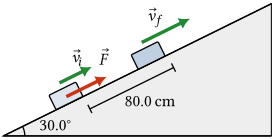
A block with mass $500\ \mathrm{g}$ starts at the bottom of a $30.0^\circ$ inclined ramp. The block starts with speed $2.00\ \mathrm{m/s}$ and is pushed up the ramp by a $4.00\ \mathrm{N}$ force applied parallel to the ramp. How fast is the block moving after it has been pushed $80.0\ \mathrm{cm}$ along the ramp?
Solution
Take the system to consist of the block and Earth. The only external work on the system is the work done by the applied force.
The block moves a distance $d = 0.800\ \mathrm{m}$ along the ramp. The applied force is parallel to the ramp, so
\[W_F = Fd.\]The block’s vertical displacement is
\[\Delta h = d\sin\theta,\]so the change in gravitational potential energy is
\[\Delta U_g = mg\Delta h = mgd\sin\theta.\]Applying the energy principle with $W_{\mathrm{ext}} = W_F$,
\[\Delta K + \Delta U_g = W_F.\]Plugging in $\Delta K = \tfrac{1}{2}mv_f^2 - \tfrac{1}{2}mv_i^2$, we have
\[\begin{aligned} \frac{1}{2}mv_f^2 - \frac{1}{2}mv_i^2 + mgd\sin\theta &= Fd\\ \rightarrow \frac{1}{2}mv_f^2 &= \frac{1}{2}mv_i^2 + Fd - mgd\sin\theta\\ \rightarrow v_f^2 &= v_i^2 + \frac{2}{m}\left(Fd - mgd\sin\theta\right)\\ \rightarrow v_f &= \sqrt{v_i^2 + \frac{2Fd}{m} - 2gd\sin\theta}\\ &= \boxed{2.99\ \mathrm{m/s}}. \end{aligned}\]Reference states
Only the difference $\Delta U$ in potential energy appears in the energy principle, so only changes in potential energy can be measured. However, it’s often convenient to assign a value for the potential energy $U$ of a system in a certain state.
We do this by choosing a reference state where we define $U=0$, then measuring potential energy relative to that state. For example, if the system contains a book and Earth, we might choose the reference state with the book at rest on a table.
If we then lift the book to a height $h$ above the table, the change in gravitational potential energy relative to the reference state is $\Delta U_g = mgh$, so we can assign a value of $U_g=mgh$ to the state where the book is at height $h$.
We conventionally choose the reference state for the gravitational potential energy when an object of interest is at height $h=0$, so the gravitational potential energy of an object at height $h$ is
\[\boxed{U_g = mgh}\]We are free to choose $h=0$ to be wherever we want.
Update form of the energy principle
So far, I’ve been writing the energy principle in the form
\[\Delta K + \Delta U = W_{\mathrm{ext}}\]where $\Delta K = K_f - K_i$ and $\Delta U = U_f - U_i$. This is what I will call the difference form of the energy principle.
Some people prefer to rearrange this equation to get the completely equivalent update form. Plugging in the differences and adding $K_i + U_i$ to both sides gives
\[K_f + U_f = K_i + U_i + W_{\mathrm{ext}}\]There is no practical difference between these two forms of the energy principle—they’re the same equation written in slightly different ways. Use whichever form you prefer.
Work done by variable forces
When all of the forces in a problem are constant, the energy principle is equivalent to combining Newton’s 2nd law with constant-acceleration kinematics. The energy principle becomes much more powerful when applied to a force that changes as an object moves. Elastic forces are the main example we will use: the spring force depends on how much the spring is stretched or compressed. To apply the energy principle in these cases, we need to calculate the work done by a force that changes with position.
Consider a changing force $\vec{F}(x)$ acting on a particle moving in one dimension along the $x$-axis. If the force were constant over the displacement, the work would be
\[W=F_x\Delta x\]With a force that changes, we can divide the displacement into many small intervals. Over each small interval, the force is approximately constant:
\[\Delta W_j \approx F_x(x_j)\Delta x_j\]Adding the work over all of the intervals gives a better and better approximation as the intervals get smaller. Taking the limit where the intervals become infinitesimally small gives us an integral:
\[\boxed{W=\int_{x_i}^{x_f} F_x(x)\,dx}\]This is the work done by the force $\vec{F}(x)$ on a particle that moves along the $x$-axis from initial position $x_i$ to final position $x_f$. The sign of $F_x$ matters: area above the $x$-axis contributes positive work, while area below the $x$-axis contributes negative work.
Remember that an integral is the area under the graph of a function. So the previous equation just says that
\[W=\text{area under } F_x \text{ vs. } x \text{ graph from } x_i \text{ to } x_f\]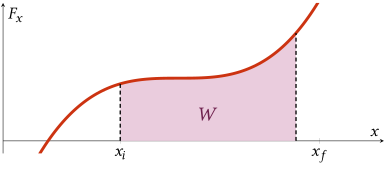
Elastic potential energy
Work done by a spring
The variable force we will see most often in this class is the spring or elastic force. Recall that Hooke’s law tells us that the spring force is proportional to the extension of the spring:
\[\lvert \vec{F}_{\mathrm{sp}}\rvert=ks\]Since the spring force changes as $s$ changes, the constant-force formula $W = F \Delta r \cos\phi$ does not apply.
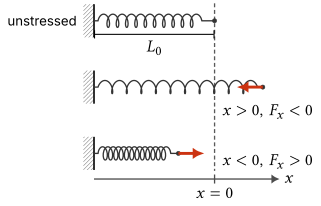
If we define the $x$-axis along the spring with $x=0$ at the unstressed length, then the component of the spring force along the $x$-axis is
\[F_{\mathrm{sp},x}=-kx\]The $x$-component includes an overall minus sign because the spring force always acts to restore the spring to its unstressed length, so the direction of the force is opposite to the direction of the extension.
Recall that $s= L -L_0$ is the extension or stretch of the spring. If the spring is stretched, $s>0$, and if the spring is compressed, $s<0$.
Derivation: Work done by a spring
The work done by a spring when the extension changes from $s_i$ to $s_f$ is
\[\begin{aligned} W_{s} &=\int_{s_i}^{s_f}F_{\mathrm{sp},x}(x)\,dx \\ &=\int_{s_i}^{s_f}(-kx)\,dx \\ &=-k\int_{s_i}^{s_f}x\,dx\\ &=-k\left[\frac{1}{2}x^2\right]_{s_i}^{s_f} \end{aligned}\]Evaluating the integral gives
\[W_{s}=-\left(\frac{1}{2}ks_f^2-\frac{1}{2}ks_i^2\right)\]Graphically, this work is the area under the $F_{\mathrm{sp},x}$ vs. $s$ graph:

Notice that the work done by the spring depends only on the initial and final extension of the spring, so the spring force is conservative.
Elastic potential energy
Since the spring force is conservative, there is a corresponding elastic potential energy $U_s$ associated with the spring. By definition, the change in elastic potential energy is related to the work done by the spring as $\Delta U_s=-W_s$, so for a system that includes the spring,
\[\boxed{\Delta U_{s}=\frac{1}{2}ks_f^2-\frac{1}{2}ks_i^2}\]Elastic potential energy increases when the spring is stretched or compressed farther from its unstressed length.
For elastic potential energy, the conventional reference state is the unstressed spring:
\[s=0,\qquad U_{s}=0\]Relative to the unstressed state, the elastic potential energy stored in a system containing a spring is
\[\boxed{U_{s}=\frac{1}{2}ks^2}\]Because the potential energy depends on $s^2$, both stretching and compression store positive elastic potential energy.
Energy changes including elastic PE
| Energy change or transfer | When is it nonzero? |
|---|---|
| $\Delta K$ | Difference in speed of an object between initial and final states. |
| $\Delta U_g$ | Difference in height of an object between initial and final states. |
| $\Delta U_s$ | Difference in extension of a spring or elastic material between initial and final states. |
| $W_{\mathrm{ext}}$ | External applied force acts on the system while the point of application moves. |
Example: Block compressing a horizontal spring
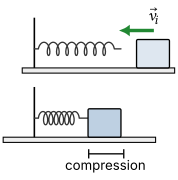
A $500\ \mathrm{g}$ block slides along a horizontal, frictionless surface with initial speed $2.0\ \mathrm{m/s}$. The block slides into contact with a horizontal spring with spring constant $400\ \mathrm{N/m}$. What is the maximum distance the spring is compressed?
Solution
Take the system to include the block and the spring. There is no work done by external forces on this system ($W_{\mathrm{ext}} = 0$) and no change in height ($\Delta U_g = 0$), so the energy principle gives
\[\Delta K + \Delta U_s = 0.\]At maximum compression the block is momentarily at rest, so $v_f = 0$, and the change in kinetic energy is
\[\Delta K = \frac{1}{2}mv_f^2 - \frac{1}{2}mv_i^2 = -\frac{1}{2}mv_i^2.\]The spring starts unstressed, so $s_i = 0$, and the final spring extension is the maximum compression $s_{\max}$ that we are solving for. The change in elastic potential energy is
\[\Delta U_s = \frac{1}{2}ks_f^2 - \frac{1}{2}ks_i^2 = \frac{1}{2}ks_{\max}^2.\]Plugging into the energy principle gives
\[\begin{aligned} -\frac{1}{2}mv_i^2 + \frac{1}{2}ks_{\max}^2 &= 0\\ \rightarrow \frac{1}{2}ks_{\max}^2 &= \frac{1}{2}mv_i^2\\ \rightarrow s_{\max} &= \sqrt{\frac{mv_i^2}{k}}\\ &= 0.071\ \mathrm{m}, \end{aligned}\]or
\[\boxed{s_{\max} = 7.1\ \mathrm{cm}.}\]Example: Block compressing a vertical spring
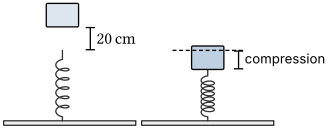
A $1.0\ \mathrm{kg}$ block and an unstressed vertical spring with spring constant $400\ \mathrm{N/m}$ are used in two trials.
- The block is placed at rest on the top of the unstressed spring. What is the maximum compression of the spring?
- If instead the block is dropped from rest at a height $20\ \mathrm{cm}$ above the top of the same unstressed spring, what is the maximum compression of the spring?
Solution
Take the system to include the block, the spring, and Earth. There is no work done by external forces ($W_{\mathrm{ext}} = 0$), so the energy principle gives
\[\Delta K + \Delta U_g + \Delta U_s = 0.\]In both parts the block starts from rest, so $K_i = 0$, and at maximum compression the block is at rest, so $K_f = 0$. The kinetic energy change is $\Delta K = 0$ throughout, so we have
\[\Delta U_g + \Delta U_s = 0.\](a) Let $\lvert s_{\max}\rvert$ be the maximum compression distance. The block moves downward a distance $\lvert s_{\max}\rvert$ from the top of the unstressed spring, so the vertical displacement is
\[\Delta h = -\lvert s_{\max}\rvert,\]and the change in gravitational potential energy is
\[\Delta U_g = mg\Delta h = -mg\lvert s_{\max}\rvert.\]The spring starts unstressed, so $s_i = 0$, and the final spring extension is $\lvert s_{\max}\rvert$. The change in elastic potential energy is
\[\Delta U_s = \frac{1}{2}ks_f^2 - \frac{1}{2}ks_i^2 = \frac{1}{2}k\lvert s_{\max}\rvert^2.\]Plugging these into the energy principle gives
\[-mg\lvert s_{\max}\rvert + \frac{1}{2}k\lvert s_{\max}\rvert^2 = 0.\]Dividing through by $\lvert s_{\max}\rvert$ (which is nonzero), we have
\[\begin{aligned} -mg + \frac{1}{2}k\lvert s_{\max}\rvert &= 0\\ \rightarrow \lvert s_{\max}\rvert &= \frac{2mg}{k} = 0.049\ \mathrm{m}, \end{aligned}\]so
\[\boxed{\lvert s_{\max}\rvert = 4.9\ \mathrm{cm}.}\](b) Now the block starts from rest a distance $d = 0.20\ \mathrm{m}$ above the top of the unstressed spring. By the time the spring reaches maximum compression, the block has moved downward a total distance $d + \lvert s_{\max}\rvert$. The only change from part (a) is the vertical displacement,
\[\Delta h = -\left(d + \lvert s_{\max}\rvert\right),\]so the change in gravitational potential energy is
\[\Delta U_g = -mg\left(d + \lvert s_{\max}\rvert\right).\]The energy principle now gives
\[\begin{aligned} -mg\left(d + \lvert s_{\max}\rvert\right) + \frac{1}{2}k\lvert s_{\max}\rvert^2 &= 0\\ \frac{1}{2}k\lvert s_{\max}\rvert^2 - mg\lvert s_{\max}\rvert - mgd &= 0. \end{aligned}\]This is a quadratic in $\lvert s_{\max}\rvert$. Using the quadratic formula,
\[\lvert s_{\max}\rvert = \frac{mg \pm \sqrt{\left(mg\right)^2 + 2kmgd}}{k} = \begin{cases} -0.077\ \mathrm{m} & (-)\\ \phantom{-}0.126\ \mathrm{m} & (+) \end{cases}\]Since $\lvert s_{\max}\rvert$ is the magnitude of the compression, it must be positive, so we want the positive root:
\[\boxed{\lvert s_{\max}\rvert = 13\ \mathrm{cm}.}\]