Energy
The law of conservation of energy is one of the most fundamental principles—and one of the most powerful tools—in physics. It says that the total energy of the universe does not change over time. In other words, energy cannot be created or destroyed, but it can change forms or be transferred from one object to another.
Energy conservation allows us to study physical systems and processes by tracking flows of energy, without needing to know all of the details of the forces and interactions involved.
What is energy?
Mathematically, energy is a scalar quantity assigned to a system, and its value depends on the state of the system. Energy is not a tangible material or substance. Instead, it’s more like an “accounting tool” that we can use to track changes in a system.
We can account for energy in many different forms, and the concept of energy is useful because changes in the different forms of energy can be related to one another. For example, when an ion pump moves ions across a cell membrane, energy conservation lets us relate the chemical energy released by ATP to the increase in the ions’ electrochemical potential energy and other energy changes.
You already use the concept of energy in everyday life, even if you don’t think about it in those terms. For example:
- Food provides your body energy for motion and biochemical processes.
- The battery in your phone or laptop stores energy used to produce electrical signals, light, sound, etc.
- Gasoline or electrical energy stored in a battery provides energy to make a car move.
- Cooking transfers energy to food, changing its temperature and chemical properties.
System and environment
To apply the principle of energy conservation, we choose a system to study and treat everything else in the universe as the environment. Since the total energy of the universe does not change, if we add together the energy change of our system $\Delta E_{\mathrm{sys}}$ and the energy change of the environment $\Delta E_{\mathrm{env}}$, we must have
\[\Delta E_{\mathrm{sys}} + \Delta E_{\mathrm{env}} = 0.\]The energy in our system can increase or decrease, but any increase in energy of the system must be balanced by a decrease in energy of the environment, and vice versa.
The energy principle
Rather than explicitly including the energy change for the environment, we restate conservation of energy in terms of the system alone. Specifically, we can relate the change in energy of the system to flows of energy into or out of the system:
\[\Delta E_{\mathrm{sys}} = \text{net flow of energy into the system}\]I will refer to this as the energy principle. This is the fundamental way that we will apply energy conservation in this class. In order to apply the energy principle, we must identify the forms of energy that can change in the system—that is, what we include in our $\Delta E_{\mathrm{sys}}$—and the ways that energy can flow into or out of the system.
Examples of energy forms
The energy in a system can take many different forms. The examples that we will see in this class include:
- Kinetic energy $K$ – energy due to motion of particles/objects
- Potential energy $U$ – energy stored due to interactions between particles/objects inside a system. For example, gravitational potential energy $U_g$ stored due to gravitational interactions, or elastic potential energy $U_s$ stored in an elastic material under strain.
- Thermal energy $E_{\mathrm{th}}$ – energy due to “random” molecular motion and interactions inside a system
- Chemical energy $E_{\mathrm{chem}}$ – energy that can be released or absorbed in chemical reactions inside a system
Examples of energy transfers
Energy can also be transferred into or out of a system in many different ways. In this course, the only energy transfer we will consider is work $W$, which is a mechanical energy transfer due to an external force acting on the system.
Some other energy transfers that appear in other contexts include:
- Heat $Q$ – spontaneous energy transfer due to temperature difference
- Radiation $R$ – energy carried by electromagnetic waves
- Energy transfer due to mass transfer (e.g., evaporation or fluid flow)
Explicit form of the energy principle
Including the energy forms and energy transfers that we will consider in this course, we can write the energy principle in the following explicit form:
\[\boxed{\Delta K + \Delta U + \Delta E_{\mathrm{th}} + \Delta E_{\mathrm{chem}} = W_{\mathrm{ext}}}\]We will use this form of the energy principle any time we apply energy conservation to analyze a system in this class. This is the most general form of the energy principle. In most cases, we will not need to include all of the terms in this equation.
Kinetic energy
The energy that a system has due to the motion of particles or other objects is called kinetic energy. For a particle with mass $m$ moving with speed $v$, the kinetic energy is
\[\boxed{K = \frac{1}{2} m v^2}\]The kinetic energy is a scalar, like all energy forms and transfers. Because it is a scalar, it is a single numerical quantity that does not have components or a direction. (There is no such thing as “kinetic energy in the $x$-direction,” for example.)
The $v$ in this equation is the speed of the particle, which is the magnitude of the velocity vector: $v = \lvert\vec{v}\rvert$. This means that the kinetic energy does not depend on the direction of motion, only on how fast the particle is moving.
When the speed of a particle changes from an initial value $v_i$ to a final value $v_f$, the change in kinetic energy is
\[\Delta K = K_f - K_i = \frac{1}{2} m v_f^2 - \frac{1}{2} m v_i^2\]If a system includes multiple particles, then the total kinetic energy of the system is the sum of the kinetic energies of all of the particles in the system:
\[K = \frac{1}{2} m_1 v_1^2 + \frac{1}{2} m_2 v_2^2 + \cdots\]Energy units
The SI unit of energy is the joule ($\mathrm{J}$). In terms of the SI base units,
\[1\ \mathrm{J} = 1\ \mathrm{\frac{kg\,m^2}{s^2}}\]The kilocalorie ($\mathrm{kcal}$) is a non-SI unit commonly used to measure the energy content of food. This is what you are used to thinking of as a “calorie” when you look at food labels. It is the amount of energy required to raise the temperature of $1\ \mathrm{L}$ of water by $1\ ^\circ\mathrm{C}$:
\[1.00\ \mathrm{kcal} = 4180\ \mathrm{J}\]The kilowatt-hour ($\mathrm{kWh}$) is a non-SI unit commonly used to measure electrical energy:
\[1.00\ \mathrm{kWh} = 3600\ \mathrm{kJ}\]This is the unit that electric bills use to measure how much electrical energy you use.
Some energy values in different units for reference:
- A Crunchwrap Supreme® contains $530\ \mathrm{kcal}$ or $2.2\ \mathrm{MJ}$.
- A car traveling $40\ \mathrm{mph}$ ($18\ \mathrm{m/s}$) has about $250{,}000\ \mathrm{J}$ of kinetic energy, or about $60\ \mathrm{kcal}$.
- An iPhone battery stores about $11\ \mathrm{Wh}$ of energy, which is $41{,}000\ \mathrm{J}$ or $10\ \mathrm{kcal}$.
- The average US household uses $29\ \mathrm{kWh} \approx 100\ \mathrm{MJ}$ of electrical energy per day.
Work
The energy transfer that we will consider in this class is called work ($W$). Energy can be transferred to or from a system when external forces act on a system.
When a force acts on a system and energy is transferred, we say that the force “does work” on the system. A force does work on a particle when the force is applied as the particle moves. A force that acts on a particle that is not moving does not do work on the particle.
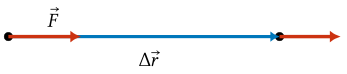
Work done by a constant force
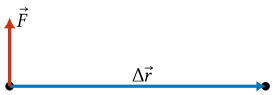
To see how to calculate work, let’s start with the case of a constant force $\vec{F}$ that acts on a particle as it undergoes a displacement $\Delta \vec{r}$. The work done by a constant force is proportional to the magnitude of the displacement $\Delta r$ and the component of the force parallel to the displacement $F_{\parallel}$. We can express the work done by a constant force as
\[\boxed{W = F_{\parallel} \Delta r}\]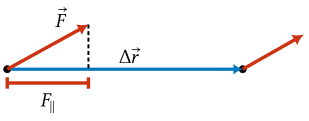
In terms of the angle $\phi$ between the force and the displacement, the parallel component of the force is $F_{\parallel} = F \cos\phi$. So we can write the work done by a constant force as
\[\boxed{W = F \Delta r \cos\phi}\]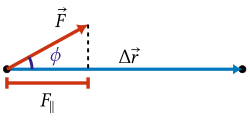
In this equation:
- $F$ is the magnitude of the force,
- $\Delta r$ is the magnitude of the displacement, and
- $\phi$ is the angle between the force and the displacement vector.
Work measures energy input to a system
The numerical value of the work done by a force tells us how much energy is added to a system by that force as the state of the system changes. Work can be positive or negative, and the sign of the work tells us whether energy is added to or removed from the system. Specifically:
- If $W$ is positive, then energy is added to the system by the force.
- If $W$ is negative, then energy is removed from the system by the force.
Determining the sign of work
In the equation $W = F \Delta r \cos\phi$, both $F$ and $\Delta r$ are positive quantities, so the sign of the work is determined by the value of $\cos\phi$.
If the force has a component in the same direction as the displacement (as in the figure above), then the angle $\phi$ is between $0^\circ$ and $90^\circ$, and $\cos\phi$ is positive. In this case, the work is positive and the force adds energy to the system.
If the force has a component in the direction opposite the displacement, then the angle $\phi$ is between $90^\circ$ and $180^\circ$, and $\cos\phi$ is negative. In this case, the work is negative and the force removes energy from the system.
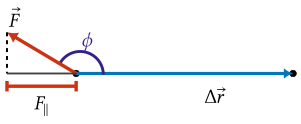
A force that is perpendicular to the displacement (angle $\phi = 90^\circ$) has no component in the direction of the displacement, so $F_{\parallel} = 0$ and the work done by the force is zero.
Example: work done on a ball in free fall
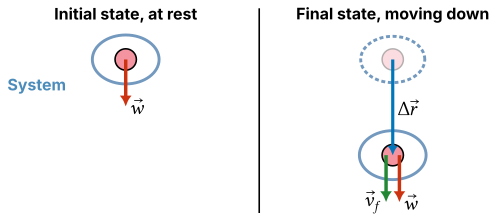
As a concrete example, let’s consider the work done by gravity on a ball in free fall, taking our system to include only the ball. If we model the ball as a point particle, then the only form of energy the system has is kinetic energy $K$. The only energy transfer is the work $W_g$ done by the external gravitational force $\vec{w}$ acting on the ball. So the energy principle for this system is
\[\Delta K = W_g\]or
\[\frac{1}{2} m v_f^2 - \frac{1}{2} m v_i^2 = W_g\]The sign of the work tells us whether the speed of the ball increases or decreases.
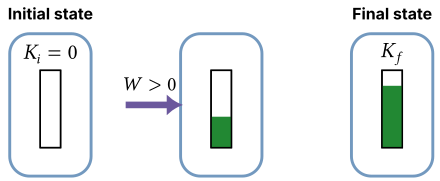
First, consider the case where the ball is dropped from rest, so $v_i = 0$. Since the gravitational force $\vec{w}$ and the displacement both point down, the work done by gravity is positive. The ball increases in speed as it falls.
We can represent energy changes graphically by drawing energy bar charts like the ones below.
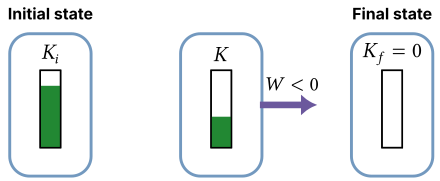
Now consider the case in which the ball is tossed upward with initial speed $v_i$, and take the final state to be when the ball reaches its maximum height and comes to rest, so $v_f = 0$. The speed decreases because the gravitational force is opposite the displacement, so gravity does negative work on the system.
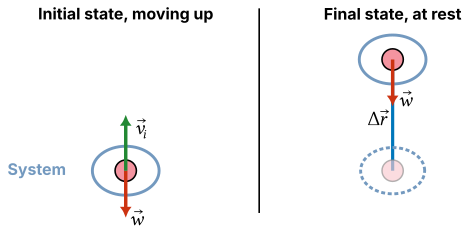
The energy bar charts for this case are shown below. The work done by gravity is negative, which corresponds to a decrease in the kinetic energy of the ball.
Work done by gravity
Since the weight force is constant, and since it only has a vertical component, we can calculate the work done by gravity by multiplying the vertical component of the weight $-mg$ by the vertical displacement $\Delta h$:
\[W_g = - mg \Delta h\]I am using $\Delta h$ to label the vertical component of the displacement instead of $\Delta y$ to emphasize that the vertical displacement does not depend on our choice of $y$-axis.