Center of gravity
In order to calculate the torque due to a force, we need to know where the force is applied relative to the pivot point. It’s clear where the force acts if we apply a contact force to an object, but where does the force of gravity act on an object?
In a sense, gravity acts on every part of an object, but for the purpose of calculating torque, we can treat the gravitational force as if it acts at a single point, called the center of gravity (c.o.g.) of the object. The center of gravity is, roughly speaking, the average position of all of the mass in the object.
For a uniform object, the center of gravity is at the geometric center of the object. For example, the center of gravity of a uniform rod is at its midpoint.
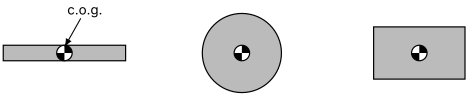
For a non-uniform object, the center of gravity will be closer to the more massive or more dense part of the object. For example, the center of gravity of a hammer is closer to the head than to the handle.
Static equilibrium
In many practical situations, we want to know the forces required to hold an object at rest. For example, how much force do your neck muscles need to exert to hold your head up? How much force must the supports of a bridge exert to hold the bridge up?
We say that an object is in static equilibrium if it is at rest and stays at rest. In order for an object to be in static equilibrium, both the net force and the net torque on the object must be zero.
Key result: The conditions for static equilibrium are \(\boxed{ \begin{aligned} \tau_{\mathrm{net}} &= 0 \\ F_{\mathrm{net},x} &= 0 \\ F_{\mathrm{net},y} &= 0 \end{aligned} }\)
Net torque is zero about any pivot point
Remember that torque is always calculated relative to a chosen pivot point. For an object in static equilibrium, the net torque about any pivot point is zero.
Remember: the torque due to any force acting at the pivot point is zero. When we apply the net torque condition for static equilibrium, we can choose our pivot point at the location of an unknown force or forces. This allows us to eliminate those forces from the torque equation and solve for the remaining unknown forces.
A good rule of thumb: choose your pivot point to eliminate unknown forces that you’re not immediately solving for.
Hinge and joint forces
When an object is attached to a fixed hinge—for example, a mechanical hinge like a door hinge, or an anatomical joint like the shoulder or elbow—the hinge exerts contact forces on the object.
For example, the bones in the elbow joint act as a hinge. The rounded end of the humerus (the trochlea) sits inside a curved notch in the ulna (the trochlear notch), and the two surfaces press against each other.
The individual normal and friction forces exerted at the hinge may be difficult to determine, but we can treat the net force exerted by the hinge as a single contact force acting at the hinge point.
In general, the contact force exerted at a hinge or joint will have both vertical and horizontal components, and its direction is not known in advance. Just like the other unknown forces in a static equilibrium problem, we can solve for the hinge force from the static equilibrium conditions that the net force and net torque on the object must be zero.
Note: When an object is attached to a hinge, you do not need to include separate normal or friction forces at the hinge. These are already included in the overall hinge force.
Example: Forces on the forearm
A person holds their forearm horizontally. The combined center of gravity of the forearm and hand is $17\ \mathrm{cm}$ from the elbow joint, and the weight of the forearm and hand is $15\ \mathrm{N}$. The biceps muscle inserts on the forearm $4.0\ \mathrm{cm}$ from the elbow joint. Model the forearm and hand together as a straight rod. For parts (a) and (b), assume the force from the biceps muscle acts vertically upward, and that this force is applied at the biceps insertion point.
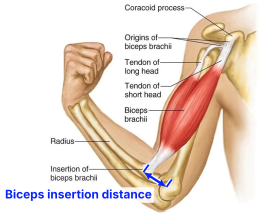
a. What is the magnitude of the force that the biceps muscle exerts on the forearm?
b. What are the horizontal and vertical components of the force that the elbow joint exerts on the forearm?
c. Using a slightly more accurate model, we can treat the biceps force as acting at an angle of about $75^\circ$ from the forearm, rather than straight up. How does this change the answers to the previous parts?
d. Now suppose that the forearm is held at an angle of $30^\circ$ below the horizontal, and the biceps force still acts at $75^\circ$ from the forearm. Find the magnitude of the biceps force in this case.
Solution
Part (a). First we draw a diagram of the forearm modeled as a rod, showing the biceps force, the weight, and the components of the elbow joint force.
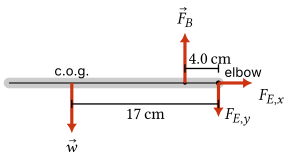
Choose the elbow as the pivot. Then the unknown elbow force exerts zero torque, because it acts at the pivot. The torque from the biceps is negative and the torque from the weight is positive. Because the forces are perpendicular to the forearm, the moment arms are just the distances from the pivot:
\[\begin{aligned} \tau_{\mathrm{net}} &= \tau_w + \tau_B \\ &= r_w w - r_B F_B\\ &= 0. \end{aligned}\]Rearranging to get the biceps force,
\[\begin{aligned} F_B &= \frac{r_w w}{r_B}\\ &= \frac{(17\ \mathrm{cm})(15\ \mathrm{N})}{4.0\ \mathrm{cm}}\\ &= 63.75\ \mathrm{N}. \end{aligned}\]To two significant figures,
\[\boxed{F_B = 64\ \mathrm{N}.}\]Part (b). Since the biceps force is vertical in this model, there are no horizontal forces except the elbow force, so
\[\boxed{F_{E,x} = 0\ \mathrm{N}.}\]The vertical force balance gives
\[\begin{aligned} F_{\mathrm{net},y} &= 0\\ F_{E,y} + F_B - w &= 0\\ F_{E,y} &= w - F_B\\ &= 15\ \mathrm{N} - 63.75\ \mathrm{N}\\ &= -48.75\ \mathrm{N}. \end{aligned}\]Thus
\[\boxed{F_{E,y} = -49\ \mathrm{N}.}\]The negative sign means the elbow joint force points downward in this vertical-force model.
Part (c). The diagram now shows the biceps force acting at $75^\circ$ from the forearm.
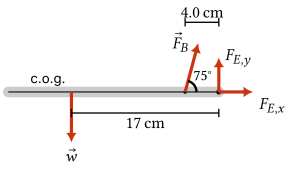
With the biceps force at $75^\circ$ from the forearm, we use the angle formula $\tau = rF\sin\phi$ for the torque from the biceps. The $75^\circ$ angle has the same sine as the angle between the biceps force and its position vector, so the biceps torque is
\[|\tau_B| = r_B F_B \sin(75^\circ).\]The weight is still perpendicular to the forearm, so its torque is unchanged. Taking the elbow as the pivot again, the net torque condition is
\[\tau_{\mathrm{net}} = r_w w - r_B F_B \sin(75^\circ) = 0\] \[\begin{aligned} \rightarrow F_B &= \frac{r_w w}{r_B \sin(75^\circ)}\\ &= \frac{(15\ \mathrm{N})(17\ \mathrm{cm})}{(4.0\ \mathrm{cm})\sin(75^\circ)}\\ &= 66.0\ \mathrm{N}. \end{aligned}\]So the biceps force increases slightly:
\[\boxed{F_B = 66\ \mathrm{N}.}\]The horizontal and vertical components of the biceps force are
\[F_{B,x} = F_B\cos(75^\circ), \qquad F_{B,y} = F_B\sin(75^\circ).\]The horizontal net force condition is
\[F_{\mathrm{net},x} = F_{E,x} + F_{B,x} = 0\]so
\[\begin{aligned} \rightarrow F_{E,x} &= -F_B\cos(75^\circ)\\ &= -(66.0\ \mathrm{N})\cos(75^\circ)\\ &= -17.1\ \mathrm{N}. \end{aligned}\]Note that the vertical component of the biceps force is unchanged from part (a), since it supplies the torque that balances the weight:
\[F_B\sin(75^\circ) = 63.75\ \mathrm{N}.\]From the vertical net force condition, we get
\[\begin{aligned} F_{E,y} &= w - F_B\sin(75^\circ)\\ &= 15\ \mathrm{N} - 63.75\ \mathrm{N}\\ &= -48.75\ \mathrm{N}, \end{aligned}\]so
\[\boxed{F_{E,x} = -17\ \mathrm{N}}, \qquad \boxed{F_{E,y} = -49\ \mathrm{N}}.\]Part (d). Now the forearm is tilted $30^\circ$ below the horizontal.
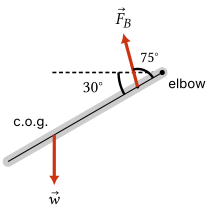
With the forearm $30^\circ$ below the horizontal, the moment arm of the weight is smaller. In this case, the horizontal distance to the center of gravity is
\[r_{\perp,w} = r_w\cos(30^\circ).\]The biceps torque is unchanged, because the biceps force keeps the same $75^\circ$ angle to the forearm. The net torque condition gives
\[r_B F_B \sin(75^\circ) - r_w w \cos(30^\circ) = 0\] \[\begin{aligned} \rightarrow F_B &= \frac{r_w w \cos(30^\circ)}{r_B \sin(75^\circ)}\\ &= \frac{(15\ \mathrm{N})(17\ \mathrm{cm})\cos(30^\circ)}{(4.0\ \mathrm{cm})\sin(75^\circ)}\\ &= 57.2\ \mathrm{N}. \end{aligned}\]To two significant figures,
\[\boxed{F_B = 57\ \mathrm{N}.}\]Forces in the body
The forces exerted by muscles and joints in the body can be unexpectedly large. This is because these forces need to produce enough torque to balance the torques applied by the weight of the body parts and external loads:
\[\lvert\tau_{\mathrm{muscle}}\rvert = \lvert\tau_{\mathrm{load}}\rvert\]Since muscles typically insert close to the joints relative to where the loads are applied, the moment arms of the muscle forces are relatively small. To produce enough torque to balance the load, the muscle forces need to be large:
\[F_{\mathrm{muscle}} = F_{\mathrm{load}} \times \frac{r_{\perp, \mathrm{load}}}{r_{\perp, \mathrm{muscle}}}\]In the biceps example we just saw, the force the biceps muscle must exert is about 4 times larger than the weight of the forearm and hand.