Newton’s third law
The first two of Newton’s laws describe how a single object/particle moves in response to forces. As we’ve discussed, all forces correspond to interactions between two or more objects. For the laws of motion to be complete, they need to tell us how objects interact with each other.
Newton’s 3rd law is the law of interactions. The statement of the 3rd law is:
If object A exerts a force $\vec{F}_{AB}$ on object B, then object B exerts a force $\vec{F}_{BA}$ on object A that is equal in magnitude and opposite in direction.
As an equation, we can write this as
\[\boxed{\vec{F}_{AB} = -\vec{F}_{BA}}\]In the notation I’m using, $\vec{F}_{AB}$ means the force that A exerts on B, and $\vec{F}_{BA}$ is the force that B exerts on A.
Newton’s third law pairs
To explore Newton’s 3rd law in more detail, it helps to introduce the concept of a Newton’s 3rd law pair or N3 pair for short. (Your book calls this an interaction pair.) This is a pair of forces that are related by Newton’s 3rd law, $\vec{F}_{AB}$ and $\vec{F}_{BA}$.
Some important properties of N3 pairs are:
- The two forces in an N3 pair always act on different objects. One acts on object A and the other acts on object B.
- The two forces in an N3 pair are always the same type of force. For example, if one force is a gravitational force, the other force must also be a gravitational force. If one force is a friction force, the other must also be a friction force, and so on.
- Every force has an N3 partner. There are no forces that are not part of an N3 pair.
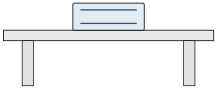
Check your understanding: A textbook is at rest on a table. Identify the forces acting on the textbook, and for each force, identify its N3 partner.
Answer
The two forces acting on the textbook are the weight or gravitational force from the Earth $\vec{w}_{EB}$ and the normal force from the table $\vec{N}_{TB}$.
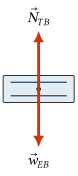
Since the book is at rest, these two forces have equal magnitudes, but they are not a Newton’s third-law pair. They both act on the same object, and they are different types of forces. The Newton’s third-law partners are forces on the other objects in each interaction:
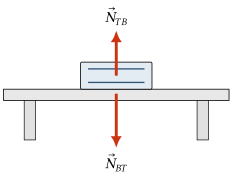
\[\begin{aligned} \vec{N}_{TB} &= -\vec{N}_{BT},\\ \vec{w}_{EB} &= -\vec{w}_{BE}. \end{aligned}\]The N3 partner of the normal force is the normal force $\vec{N}_{BT}$ that the textbook exerts downward on the table.
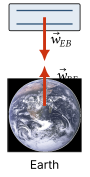
The N3 partner of the weight is the gravitational force $\vec{w}_{BE}$ that the textbook exerts on the Earth, pulling the Earth up toward it.
Earth’s acceleration
In the previous example, the textbook pulls on the Earth with the same strength as the Earth pulls on the textbook! If we drop a textbook, it clearly accelerates toward the Earth. Why don’t we see the Earth accelerating toward the textbook?
Suppose we drop a textbook with a mass of $m = 1.0\ \mathrm{kg}$. We know the weight force the Earth exerts on the textbook has magnitude $w_{EB} = mg = 9.8\ \mathrm{N}$. The weight force exerted on the Earth by the textbook also has magnitude $w_{BE} = 9.8\ \mathrm{N}$.
Since the mass of the Earth is about $M_E = 6.0 \times 10^{24}\ \mathrm{kg}$, the acceleration of the Earth toward the textbook has magnitude
\[a_E = \frac{w_{BE}}{M_E} = 1.6 \times 10^{-24}\ \mathrm{m/s^2},\]which is undetectably small.
Systems with multiple objects
So far, we’ve only applied Newton’s laws to systems consisting of a single object, where all the forces are exerted on the system by the environment. If we choose our system to include multiple objects, we can divide the forces into two categories: internal forces that act between objects inside the system, and external forces exerted on the system by the environment.
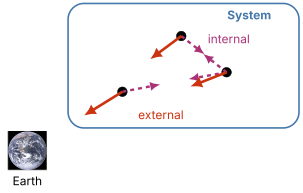
When we apply Newton’s 2nd law to a system with multiple objects, the net force on the system includes only the external forces. We can summarize Newton’s 2nd law for a system of multiple objects as follows:
\[\vec{F}_{\mathrm{ext}} = m_{\mathrm{sys}} \vec{a}_{\mathrm{sys}}\]In this expression,
- $\vec{F}_{\mathrm{ext}}$ is the net external force on the system.
- $m_{\mathrm{sys}}$ is the total mass of the system.
- $\vec{a}_{\mathrm{sys}}$ is the acceleration of the system.
In order to apply this, the objects in the system must share the same acceleration $\vec{a}_{\mathrm{sys}}$. This means they must be connected to each other or otherwise moving together as a single unit. When this is the case, we can treat the system as a single object with mass equal to the sum of the masses of the individual objects.
Combined system vs. separate systems
Since the net force on a system only includes external forces, if we want to know the internal forces exerted between objects in the system, we need to divide the system into smaller subsystems and apply Newton’s 2nd law to each subsystem separately.
I’ll refer to these two approaches as the combined system approach and the separate systems approach. When should we use each approach?
- If multiple objects are constrained to move with the same acceleration, and we just want to know the acceleration of the system, then we can use the combined system approach.
- If we want to know the internal forces between objects in the system, then we need to use the separate systems approach.
Examples with interacting objects
Example: Two books in contact
Two books with masses $m_1 = 1.0\ \mathrm{kg}$ and $m_2 = 2.0\ \mathrm{kg}$ are in contact on a frictionless surface. You push $m_2$ against $m_1$ with a horizontal force of magnitude $F = 5.0\ \mathrm{N}$.
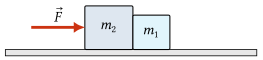
- What is the acceleration of the system of two books?
- What is the magnitude of the normal force that the books exert on each other?
Solution
Take $+x$ to the right. Since the books move together, the $x$-components of their accelerations are the same: $a_{1x} = a_{2x} = a_x$.
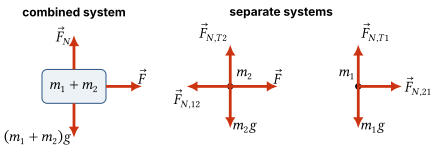
(a) Combined system. First choose the system to be both books together. The normal forces the books exert on each other are internal to this two-book system, so they do not appear in the external force equation. Horizontally,
\[\begin{aligned} F_{\mathrm{ext},x} &= m_{\mathrm{sys}} a_x\\ F &= (m_1 + m_2)a_x. \end{aligned}\]Therefore,
\[\begin{aligned} a_x &= \frac{F}{m_1 + m_2}\\ &= \frac{5.0\ \mathrm{N}}{1.0\ \mathrm{kg} + 2.0\ \mathrm{kg}}\\ &= 1.67\ \mathrm{m/s^2}. \end{aligned}\]To two significant figures, the acceleration is
\[\boxed{1.7\ \mathrm{m/s^2}\text{ to the right}.}\](b) Separate systems. The combined-system approach gives us the acceleration, but it can’t give the internal contact force between the books. For that, separate the books and apply Newton’s second law to one book at a time.
For $m_1$, the only horizontal force is the normal force exerted on it by $m_2$, which we call $F_{N,21}$. Newton’s 2nd law applied to $m_1$ gives
\[\begin{aligned} F_{\mathrm{net},1,x} &= m_1 a_x\\ F_{N,21} &= m_1 a_x\\ &= \left(1.0\ \mathrm{kg}\right)\left(1.67\ \mathrm{m/s^2}\right)\\ &= 1.67\ \mathrm{N}, \end{aligned}\]so the normal force that the books exert on each other has magnitude
\[\boxed{1.7\ \mathrm{N}.}\]As a check, applying Newton’s second law to $m_2$ gives the same contact-force magnitude:
\[\begin{aligned} F - F_{N,12} &= m_2 a_x\\ F_{N,12} &= F - m_2 a_x\\ &= 5.0\ \mathrm{N} - \left(2.0\ \mathrm{kg}\right)\left(1.67\ \mathrm{m/s^2}\right)\\ &= 1.7\ \mathrm{N}. \end{aligned}\]Example: Stacked books without slipping
A book with mass $m_1 = 1.0\ \mathrm{kg}$ is stacked on top of a book with $m_2 = 2.0\ \mathrm{kg}$. The bottom book is free to slide on a frictionless surface. If the coefficient of static friction between the books is $\mu_s = 0.50$, what is the maximum force you can apply to $m_2$ without $m_1$ slipping?
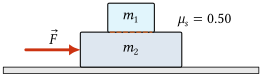
Solution
Take $+x$ to the right. If the top book does not slip, both books move together with acceleration $a_{1x} = a_{2x} = a_x$.
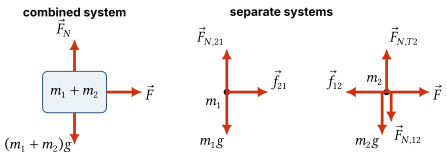
Combined system. For the two-book system, static friction between the books is internal. The only external horizontal force is the applied force $F$, so
\[F = m_{\mathrm{sys}} a_x = (m_1 + m_2)a_x. \tag{1}\]This equation tells us how large the acceleration would be for a given push. To determine whether friction can actually keep the books moving together, we need to consider either the top book or the bottom book separately.
Separate system for the top book. The only horizontal force on $m_1$ is the static friction force $f_{21}$ that $m_2$ exerts on $m_1$. Newton’s second law applied to the top book gives
\[F_{\mathrm{net},1,x} = f_{21} = m_1 a_{1x}. \tag{2}\]For $m_1$ in the vertical direction,
\[\begin{aligned} F_{\mathrm{net},1,y} = F_{N,21} - m_1g &= 0\\ F_{N,21} &= m_1g. \end{aligned}\]The maximum static friction force is
\[f_{21,\max} = \mu_s F_{N,21} = \mu_s m_1 g.\]At the largest allowed push, the required friction in equation (2) equals the maximum static friction:
\[f_{21} = f_{21,\max} = \mu_s m_1 g.\]Now we can plug the acceleration from the combined-system equation (1) and this static friction force into Newton’s second law for the top book (2):
\[\begin{aligned} f_{21} &= m_1 a_{1x}\\ \mu_s m_1 g &= m_1 \left(\frac{F}{m_1 + m_2}\right)\\ \mu_s g &= \frac{F}{m_1 + m_2}\\ F &= \mu_s g (m_1 + m_2)\\ &= (0.50)\left(9.8\ \mathrm{m/s^2}\right)\left(1.0\ \mathrm{kg} + 2.0\ \mathrm{kg}\right)\\ &= 14.7\ \mathrm{N}. \end{aligned}\]To two significant figures,
\[\boxed{F_{\max} = 15\ \mathrm{N}.}\]Separate system for the bottom book. We should get the same result if we apply Newton’s second law to the bottom book instead. The Newton’s 2nd law equation for $m_2$ in the horizontal direction is
\[F_{\mathrm{net},2,x} = F - f_{12} = m_2 a_{2x}. \tag{3}\]The static friction force still takes its maximum value at the largest allowed push, and the acceleration is still given by the combined-system equation (1). Plugging these into equation (3) gives
\[\begin{aligned} F - f_{12} &= m_2 a_{2x}\\ F - \mu_s m_1 g &= m_2 \left(\frac{F}{m_1 + m_2}\right)\\ F - \mu_s m_1 g &= \frac{m_2}{m_1 + m_2} F\\ \left(1 - \frac{m_2}{m_1 + m_2}\right) F &= \mu_s m_1 g\\ \frac{m_1}{m_1 + m_2} F &= \mu_s m_1 g\\ F &= \mu_s g (m_1 + m_2), \end{aligned}\]which is the same result as before.
Example: Atwood machine
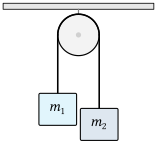
Two blocks with masses $m_1 = 1.0\ \mathrm{kg}$ and $m_2 = 2.0\ \mathrm{kg}$ are connected by a light string passing over a light, frictionless pulley. Find the acceleration of each block.
Solution
Since $m_2 > m_1$, we expect $m_2$ to accelerate downward and $m_1$ to accelerate upward. The string constrains the two blocks to have the same acceleration magnitude, but the blocks will move in opposite directions. So our constraint equation is $a_{1y} = -a_{2y}$. Since the blocks don’t have the same acceleration, we can’t treat them as a combined system. We have to apply Newton’s second law to each block separately.
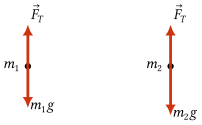
The Newton’s second law equations for the two blocks are
\[\begin{aligned} F_{\mathrm{net},1,y} = F_T - m_1g &= m_1a_{1y}\\ F_{\mathrm{net},2,y} = F_T - m_2g &= m_2a_{2y} \end{aligned}\]Plugging in the constraint equation to eliminate $a_{2y}$ gives
\[F_T - m_2g = -m_2a_{1y}.\]Now we have two equations with two unknowns, $F_T$ and $a_{1y}$.
We can solve for $a_{1y}$ by eliminating $F_T$. Solving for $F_T$ in the first equation gives
\[F_T = m_1g + m_1a_{1y}.\]Plugging this into the second equation gives
\[\begin{aligned} m_1g + m_1a_{1y} - m_2g &= -m_2a_{1y}\\ (m_1 + m_2)a_{1y} &= (m_2 - m_1)g\\ a_{1y} &= \frac{m_2 - m_1}{m_1 + m_2} g\\ &= \frac{2.0\ \mathrm{kg} - 1.0\ \mathrm{kg}}{1.0\ \mathrm{kg} + 2.0\ \mathrm{kg}}\left(9.8\ \mathrm{m/s^2}\right)\\ &= 3.27\ \mathrm{m/s^2}. \end{aligned}\]So the accelerations are
\[\boxed{m_1:\ 3.3\ \mathrm{m/s^2}\text{ upward}}, \qquad \boxed{m_2:\ 3.3\ \mathrm{m/s^2}\text{ downward}.}\]