You’ll be able to:
- convert compound units to SI units, including squared and cubed units, pressures, temperatures, and energies,
- carry units through every step of a calculation,
- check that every term in an equation has the same units,
- recognize quantities that can’t have units, like the argument of a sine, an exponential, or a logarithm.
Check yourself first
Answer these two questions without notes. If you’re not sure, it’s ok to answer “I don’t know yet” rather than guessing.
1. Convert $36\ \mathrm{cm^2}$ to square meters.
2. A sealed container holds $0.10\ \mathrm{mol}$ of an ideal gas at $27^\circ\mathrm{C}$ in a volume of $2.0\ \mathrm{L}$. The ideal gas law is $pV = nRT$, with $R = 8.31\ \mathrm{J/(mol\cdot K)}$. Find the pressure $p$ of the gas in pascals, to two significant figures.
Answers to the entry check
- $3.6 \times 10^{-3}\ \mathrm{m^2}$
- $p = 1.2 \times 10^{5}\ \mathrm{Pa}$
Both right? Skip ahead and take the N2 mastery check in Canvas. Either one wrong, or unsure? Keep reading. The idea section has a step-by-step solution to question 1, and worked example 1 has a solution to question 2.
Where this shows up in Physics 5
- 5A, elasticity. Stress, $\sigma = \frac{F}{A}$, is in pascals, $1\ \mathrm{Pa} = 1\ \mathrm{N/m^2}$, so a tendon’s cross-sectional area given in $\mathrm{mm^2}$ has to be converted to $\mathrm{m^2}$.
- 5A, viscous drag. The Reynolds number, $\mathrm{Re} = \frac{\rho v L}{\eta}$, has no units, and neither does the exponent in $v(t) = v_0 e^{-t/\tau}$.
- 5B, thermodynamics. In the ideal gas law, $pV = nRT$ with $R = 8.31\ \mathrm{J/(mol\cdot K)}$, the pressure must be in pascals, the volume in cubic meters, and the temperature in kelvins.
- 5B, fluids. Blood pressures are given in $\mathrm{mmHg}$, and Poiseuille’s law, $Q = \frac{\pi r^4}{8\eta L}\Delta p$, is often applied to flow rates in liters per minute.
- 5C, light and atoms. Photon energies are usually given in electronvolts, but Planck’s constant in $E = hf$ is in SI units, $h = 6.63 \times 10^{-34}\ \mathrm{J\cdot s}$.
In each of these calculations, every quantity has to be in SI units before you substitute, and you can check the result by looking at its units.
The idea
Quick refresher
- The SI base units you will use most are the meter (m), kilogram (kg), second (s), kelvin (K), and mole (mol).
- Other SI units are combinations of these: $1\ \mathrm{N} = 1\ \mathrm{kg\cdot m/s^2}$, $1\ \mathrm{Pa} = 1\ \mathrm{N/m^2}$, and $1\ \mathrm{J} = 1\ \mathrm{N\cdot m}$.
- A prefix stands for a power of ten, as in $1\ \mathrm{cm} = 10^{-2}\ \mathrm{m}$. The full list is in N1: Scientific notation, prefixes, and your calculator.
The key rule for working with units is:
Key rule: a unit is a factor. Units multiply, divide, and cancel the same way symbols do.
A conversion factor such as $\frac{10^{-2}\ \mathrm{m}}{1\ \mathrm{cm}}$ is equal to 1, because its numerator and denominator are the same length. Multiplying by a conversion factor changes the units without changing the numerical value. We can convert units with these steps:
- Write the conversion factor as a fraction, with the unit you want in the numerator and the unit you are removing in the denominator.
- Raise the fraction to the same power as the unit. Square it for $\mathrm{cm^2}$, and cube it for $\mathrm{cm^3}$.
- Multiply and cancel the units.
Here are the steps on the first question from the entry check:
\[36\ \mathrm{cm^2} \times \left(\frac{10^{-2}\ \mathrm{m}}{1\ \mathrm{cm}}\right)^2 = 36 \times 10^{-4}\ \mathrm{m^2}\]This is $3.6 \times 10^{-3}\ \mathrm{m^2}$. Squaring the fraction squares the power of ten along with the unit, because a square $1\ \mathrm{m}$ on a side holds $100 \times 100 = 10^{4}$ squares that are $1\ \mathrm{cm}$ on a side.
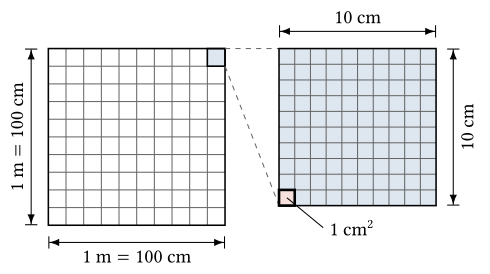
You can use the same steps to convert the blood flow rate out of the heart to SI units. The units of liters and minutes both cancel:
\[Q = 5.0\ \frac{\mathrm{L}}{\mathrm{min}} \times \frac{10^{-3}\ \mathrm{m^3}}{1\ \mathrm{L}} \times \frac{1\ \mathrm{min}}{60\ \mathrm{s}}\] \[Q = 8.3 \times 10^{-5}\ \mathrm{m^3/s}\]These are some other conversion factors you’ll see most often in the 5 Series:
| Quantity | Conversion |
|---|---|
| volume | $1\ \mathrm{L} = 10^{3}\ \mathrm{cm^3} = 10^{-3}\ \mathrm{m^3}$ |
| pressure, atmospheres to pascals | $1\ \mathrm{atm} = 1.013 \times 10^{5}\ \mathrm{Pa}$ |
| pressure, atmospheres to mmHg | $1\ \mathrm{atm} = 760\ \mathrm{mmHg}$ |
| pressure, mmHg to pascals | $1\ \mathrm{mmHg} = 133\ \mathrm{Pa}$ |
| energy | $1\ \mathrm{eV} = 1.60 \times 10^{-19}\ \mathrm{J}$ |
Temperature is different. The Celsius and Kelvin scales have degrees of the same size but different zero points, so you convert a temperature by adding a constant:
\[T[\mathrm{K}] = T[^\circ\mathrm{C}] + 273\]The exact offset is 273.15, and in Physics 5B we round to 273. A temperature difference doesn’t need a conversion, because the offset cancels. For formulas that use $T$ itself, like the ideal gas law, the temperature needs to be in kelvins.
Checking consistency. You can only add, subtract, or set quantities equal when they have the same units. So every term in a correct equation has the same units, and you can check a formula by replacing each symbol with its units. For the speed of a wave on a string, $v = \sqrt{F_T/\mu}$, with the tension $F_T$ in newtons and the linear mass density $\mu$ in kilograms per meter:
\[\sqrt{\frac{\mathrm{kg\cdot m/s^2}}{\mathrm{kg/m}}} = \sqrt{\frac{\mathrm{m^2}}{\mathrm{s^2}}} = \mathrm{m/s}\]These are the units of a speed, so the formula is consistent. Note that you can’t find a missing factor like 2 or $\pi$ by checking units, because pure numbers have no units.
Arguments with no units. The argument of a sine, cosine, exponential, or logarithm can’t have units. In $v = v_0 e^{-t/\tau}$, the ratio $t/\tau$ has units of seconds over seconds. In the isothermal work $W = -nRT\ln(V_f/V_i)$, the argument is a ratio of two volumes. The numerator and denominator of a ratio must be in the same units before you divide. If an argument comes out with units, there is an error earlier in your work.
Check every answer three ways.
- Units. If the units of your answer don’t match the quantity you want, look for an algebra error or a missing conversion.
- Size. Compare with values you know. Atmospheric pressure is about $10^{5}\ \mathrm{Pa}$, and room temperature is about $300\ \mathrm{K}$.
- Limits. At a fixed volume, the pressure of an ideal gas approaches zero as its temperature approaches $0\ \mathrm{K}$. If your result gives zero pressure at $0^\circ\mathrm{C}$, you used the wrong temperature scale.
Worked examples
Worked example 1: the pressure of a gas
Problem. A sealed container holds $n = 0.10\ \mathrm{mol}$ of an ideal gas at $27^\circ\mathrm{C}$ in a volume of $2.0\ \mathrm{L}$. The ideal gas law is $pV = nRT$, with $R = 8.31\ \mathrm{J/(mol\cdot K)}$. Find the pressure of the gas in pascals and in atmospheres.
Solve for the pressure first, by dividing both sides by $V$: $p = \frac{nRT}{V}$.
Convert every other quantity to SI units, because $R$ is in SI units:
\[T = 27 + 273 = 300\ \mathrm{K}\] \[V = 2.0\ \mathrm{L} \times \frac{10^{-3}\ \mathrm{m^3}}{1\ \mathrm{L}} = 2.0 \times 10^{-3}\ \mathrm{m^3}\]Substitute last, with the units:
\[p = \frac{(0.10\ \mathrm{mol})(8.31\ \mathrm{J/(mol\cdot K)})(300\ \mathrm{K})}{2.0 \times 10^{-3}\ \mathrm{m^3}}\] \[p = 1.2 \times 10^{5}\ \mathrm{J/m^3}\]The moles and kelvins cancel. A joule is a newton-meter, so $\mathrm{J/m^3} = \mathrm{N/m^2} = \mathrm{Pa}$, and $p = 1.2 \times 10^{5}\ \mathrm{Pa}$. In atmospheres,
\[p = 1.2 \times 10^{5}\ \mathrm{Pa} \times \frac{1\ \mathrm{atm}}{1.013 \times 10^{5}\ \mathrm{Pa}}\] \[p = 1.2\ \mathrm{atm}\]Check.
- Units: the units reduce to pascals, the unit of pressure.
- Size: $1.2\ \mathrm{atm}$ is close to the pressure of the air around you. Leaving the volume in liters would have given $120\ \mathrm{Pa}$, about a thousandth of an atmosphere.
- Limits: at fixed $n$ and $V$, the pressure is proportional to $T$ in kelvins, so it approaches zero only as $T$ approaches $0\ \mathrm{K}$, not $0^\circ\mathrm{C}$.
Worked example 2: the pressure difference along a tube
Problem. Poiseuille’s law gives the pressure difference needed to drive a fluid with viscosity $\eta$ at a volume flow rate $Q$ through a tube of radius $r$ and length $L$:
\[\Delta p = \frac{8\eta L Q}{\pi r^4}\]Water with viscosity $\eta = 1.0 \times 10^{-3}\ \mathrm{Pa\cdot s}$ flows at $Q = 0.15\ \mathrm{L/min}$ through a tube with radius $2.0\ \mathrm{mm}$ and length $50\ \mathrm{cm}$. Find $\Delta p$ in pascals and in mmHg.
Convert to SI units first. The viscosity is already in SI units, the radius is $r = 2.0 \times 10^{-3}\ \mathrm{m}$, the length is $L = 0.50\ \mathrm{m}$, and the flow rate needs two conversion factors:
\[Q = 0.15\ \frac{\mathrm{L}}{\mathrm{min}} \times \frac{10^{-3}\ \mathrm{m^3}}{1\ \mathrm{L}} \times \frac{1\ \mathrm{min}}{60\ \mathrm{s}}\] \[Q = 2.5 \times 10^{-6}\ \mathrm{m^3/s}\]Your turn. Find $r^4$, substitute into Poiseuille’s law, check that the units reduce to pascals, and convert the result to mmHg. Before you check your answer, explain why multiplying by $\frac{1\ \mathrm{min}}{60\ \mathrm{s}}$ is allowed.
Solution to worked example 2
First find $r^4 = (2.0 \times 10^{-3}\ \mathrm{m})^4$ $= 1.6 \times 10^{-11}\ \mathrm{m^4}$. In SI units, the denominator of Poiseuille’s law is then $\pi r^4 = 5.0 \times 10^{-11}$, and the numerator is
\[\begin{aligned} 8\eta L Q &= 8(1.0 \times 10^{-3})(0.50) \\ &\quad \times (2.5 \times 10^{-6}) \\ &= 1.0 \times 10^{-8} \end{aligned}\]so
\[\Delta p = \frac{1.0 \times 10^{-8}}{5.0 \times 10^{-11}}\ \mathrm{Pa}\] \[\Delta p = 2.0 \times 10^{2}\ \mathrm{Pa}\]The units are $\frac{(\mathrm{Pa\cdot s})(\mathrm{m})(\mathrm{m^3/s})}{\mathrm{m^4}} = \mathrm{Pa}$, because the seconds cancel and so do the $\mathrm{m^4}$. In mmHg,
\[2.0 \times 10^{2}\ \mathrm{Pa} \times \frac{1\ \mathrm{mmHg}}{133\ \mathrm{Pa}} = 1.5\ \mathrm{mmHg}\]One minute and 60 seconds are the same time, so $\frac{1\ \mathrm{min}}{60\ \mathrm{s}}$ is equal to 1. Multiplying by 1 changes the units of the flow rate but not the flow rate itself.
Check: Poiseuille’s law describes smooth (laminar) flow, which in 5B means a Reynolds number below about 2000. The average flow speed is $Q/(\pi r^2) = 0.20\ \mathrm{m/s}$, so $\mathrm{Re} = \rho v d/\eta$, with $d = 2r$ the diameter of the tube, is about 800, and the law applies. At ten times the flow rate, $\mathrm{Re}$ would be about 8000, and the flow would be turbulent.
Worked example 3: a discharging capacitor
Problem. A capacitor with capacitance $C = 50\ \mu\mathrm{F}$ discharges through a resistor with resistance $R = 2.0\ \mathrm{k\Omega}$, and the voltage across the capacitor is $V = V_0 e^{-t/RC}$. Use $1\ \Omega = 1\ \mathrm{V/A}$, $1\ \mathrm{F} = 1\ \mathrm{C/V}$, and $1\ \mathrm{A} = 1\ \mathrm{C/s}$ to show that $RC$ has units of seconds. Then find $V/V_0$ at $t = 30\ \mathrm{ms}$.
Try it yourself before opening the solution.
Solution to worked example 3
Replace each unit with its definition, and cancel:
\[\Omega \cdot \mathrm{F} = \frac{\mathrm{V}}{\mathrm{A}} \cdot \frac{\mathrm{C}}{\mathrm{V}} = \frac{\mathrm{C}}{\mathrm{C/s}} = \mathrm{s}\]With the prefixes replaced, $RC = (2.0 \times 10^{3}\ \Omega)(50 \times 10^{-6}\ \mathrm{F})$ $= 0.10\ \mathrm{s}$. The time must be in seconds too, so the exponent is
\[\frac{t}{RC} = \frac{0.030\ \mathrm{s}}{0.10\ \mathrm{s}} = 0.30\]with no units, which is always the case for the argument of an exponential. Then $\frac{V}{V_0} = e^{-0.30} = 0.74$.
Check: the time is less than $RC$, so more than $e^{-1} = 0.37$ of the initial voltage should remain. Leaving $t$ in milliseconds would give $e^{-300}$, which rounds to zero.
Common issues
- Converting a squared unit with a single factor. $36\ \mathrm{cm^2} = 3.6 \times 10^{-3}\ \mathrm{m^2}$, not $0.36\ \mathrm{m^2}$. Check this with a square $1\ \mathrm{m}$ on a side. Its area is $(100\ \mathrm{cm})^2 = 10^{4}\ \mathrm{cm^2}$, not $100\ \mathrm{cm^2}$.
- Using degrees Celsius in a gas law. In worked example 1, using $T = 27$ in place of $300\ \mathrm{K}$ gives $1.1 \times 10^{4}\ \mathrm{Pa}$, which is 11 times too small. Check this by plugging in $0^\circ\mathrm{C}$, which gives zero pressure for a gas at $273\ \mathrm{K}$.
- Converting a temperature difference. A change of $10^\circ\mathrm{C}$ is a change of $10\ \mathrm{K}$, not $283\ \mathrm{K}$. Check this by plugging in $20^\circ\mathrm{C}$ and $30^\circ\mathrm{C}$, which are $293\ \mathrm{K}$ and $303\ \mathrm{K}$.
- Putting electronvolts into an SI formula. For a photon with $E = 2.0\ \mathrm{eV} = 3.2 \times 10^{-19}\ \mathrm{J}$, $f = E/h$ is $4.8 \times 10^{14}\ \mathrm{Hz}$, but leaving $E$ in electronvolts gives $3.0 \times 10^{33}$. Check this with the units. $\mathrm{J}/(\mathrm{J\cdot s})$ reduces to $\mathrm{Hz}$, but $\mathrm{eV}/(\mathrm{J\cdot s})$ doesn’t cancel until you convert the electronvolts to joules.
- Adding quantities with different units. In $p = p_0 + \rho g d$ with $p_0 = 101.3\ \mathrm{kPa}$ and $\rho g d = 9800\ \mathrm{Pa}$, adding the numbers gives $9901$, which is wrong whether you read it in kilopascals or in pascals. Check this by converting both terms to kilopascals first: $101.3\ \mathrm{kPa} + 9.8\ \mathrm{kPa}$ $= 111.1\ \mathrm{kPa}$.
Practice and the mastery check
Open the Math Toolkit module in your course’s Canvas site. There are three quizzes for N2, and you can retake any of them as often as you like:
- Entry check. The two questions above with feedback.
- Practice set. Questions ranging from plain conversions to physics, with feedback on every answer.
- Mastery check. Five questions. A passing score is 6 of 7 points. The interpretation and application questions are worth 2 points each, so you need both. If you miss twice in a row, stop and work through the lesson section linked in the feedback, or bring the question to office hours.
Go deeper
These OpenStax sections cover the same skills with more practice:
- College Physics 2e, 1.2 Physical Quantities and Units: the “Unit Conversion and Dimensional Analysis” subsection covers conversion factors.
- College Physics 2e, 11.6 Gauge Pressure, Absolute Pressure, and Pressure Measurement: pressure units, including mmHg and atmospheres.
- College Physics 2e, 13.1 Temperature: the Celsius and Kelvin scales and conversions between them.