You’ll be able to:
- convert between degrees and radians, and use $s = r\theta$ with $\theta$ in radians,
- find the sign and value of $\sin\theta$, $\cos\theta$, and $\tan\theta$ at any angle,
- find both angles in one circle that solve an equation like $\sin\theta = 0.5$,
- use the small-angle approximations, and understand when they apply.
Check yourself first
Answer these two questions without notes. If you’re not sure, it’s ok to answer “I don’t know yet” rather than guessing.
1. Find both angles $\theta$ between $0$ and $2\pi$ radians for which $\sin\theta = -\frac{1}{2}$.
2. A block on a spring oscillates with amplitude $A = 8.0\ \mathrm{cm}$. Its position is $x = A\cos\phi$, where $\phi$ is the phase in radians. Find both phases between $0$ and $2\pi\ \mathrm{rad}$ at which the block is at $x = -4.0\ \mathrm{cm}$.
Answers to the entry check
- $\theta = \dfrac{7\pi}{6}$ and $\theta = \dfrac{11\pi}{6}$ (that is, $210^\circ$ and $330^\circ$)
- $\phi = \dfrac{2\pi}{3}$ and $\phi = \dfrac{4\pi}{3}$ (that is, $120^\circ$ and $240^\circ$)
Both right? Skip ahead and take the G4 mastery check in Canvas. Either one wrong, or unsure? Keep reading. The idea section has a step-by-step solution to question 1, and worked example 1 has a solution to question 2.
Where this shows up in the 5 Series
- 5A, circular motion. An object moving on a circle of radius $r$ covers an arc length $s = r\theta$, with $\theta$ in radians, and in uniform circular motion its speed is $v = 2\pi r/T$.
- 5B, simple harmonic motion. The position $x = A\cos\phi$ is the $x$-coordinate of a point at angle $\phi$ on a circle of radius $A$, and the phase increases at the angular frequency $\omega = 2\pi f$, in $\mathrm{rad/s}$.
- 5B, the pendulum. For small angles in radians, $\sin\theta \approx \theta$. With this approximation, a pendulum of length $L$ oscillates with angular frequency $\omega = \sqrt{g/L}$.
- 5B, interference and diffraction. Light through two slits a distance $d$ apart forms bright fringes at angles where $d\sin\theta = m\lambda$. For small angles, the fringes on a screen a distance $L$ away are at $y_m = m\lambda L/d$.
Each of these uses an angle in radians, the sine or cosine of an angle greater than $90^\circ$, or both.
The idea
Quick refresher
- In a right triangle, $\sin\theta$ is the opposite side over the hypotenuse, $\cos\theta$ is the adjacent side over the hypotenuse, and $\tan\theta = \sin\theta/\cos\theta$.
- A circle of radius $r$ has circumference $2\pi r$.
Radians. Start on a circle of radius $r$ and move counterclockwise along it. The distance you travel along the circle is the arc length $s$, and the angle in radians is $\theta = s/r$. Moving clockwise gives a negative angle. A full circle has arc length $2\pi r$, so the angle of a full circle is $2\pi$ radians:
\[2\pi\ \mathrm{rad} = 360^\circ\] \[\pi\ \mathrm{rad} = 180^\circ\]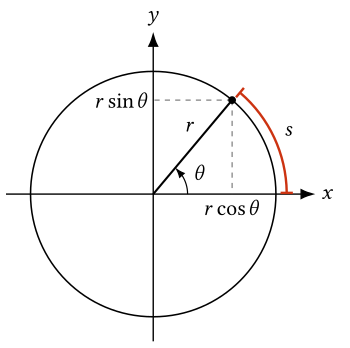
To convert degrees to radians, multiply by $\frac{\pi\ \mathrm{rad}}{180^\circ}$. For example, $30^\circ = \frac{\pi}{6}$ and $90^\circ = \frac{\pi}{2}$. One radian is about $57.3^\circ$. A radian is a length divided by a length, so it has no physical units. The arc length $s = r\theta$ is correct only when $\theta$ is in radians.
A calculator does not keep track of units, so set it to degree or radian mode to match the units of the angle you enter (see N1: Scientific notation, prefixes, and your calculator).
We define can define sine and cosine for any angle with the following rule:
Key rule: measure $\theta$ counterclockwise from the $+x$-axis. The point at angle $\theta$ on a circle of radius $r$, centered at the origin, has coordinates $x = r\cos\theta$ and $y = r\sin\theta$.
Sine and cosine then have a value at every angle, including negative angles and angles larger than $90^\circ$. In the first quadrant, they agree with the right-triangle definitions, because the radius is the hypotenuse of a triangle with legs $x$ and $y$. On the unit circle, where $r = 1$, $\cos\theta$ is the $x$-coordinate of the point and $\sin\theta$ is its $y$-coordinate. Adding $2\pi$ to $\theta$ brings you back to the same point, so sine and cosine repeat every $2\pi$.
Signs by quadrant. The axes divide the plane into quadrants 1 to 4, numbered counterclockwise from the $+x$-axis. The signs of $x$ and $y$ are the signs of $\cos\theta$ and $\sin\theta$, and $\tan\theta = y/x$ is positive where $x$ and $y$ have the same sign:
| Quadrant | Angles | Sign of $\sin\theta$ | Sign of $\cos\theta$ |
|---|---|---|---|
| 1 | $0$ to $\pi/2$ | positive | positive |
| 2 | $\pi/2$ to $\pi$ | positive | negative |
| 3 | $\pi$ to $3\pi/2$ | negative | negative |
| 4 | $3\pi/2$ to $2\pi$ | negative | positive |
The tangent is undefined at $\pi/2$ and $3\pi/2$, where $x = 0$.
Special angles. These values come from the 30-60-90 and 45-45-90 triangles:
| Degrees | Radians | Value of $\sin\theta$ | Value of $\cos\theta$ |
|---|---|---|---|
| $30^\circ$ | $\pi/6$ | $1/2$ | $\sqrt{3}/2$ |
| $45^\circ$ | $\pi/4$ | $\sqrt{2}/2$ | $\sqrt{2}/2$ |
| $60^\circ$ | $\pi/3$ | $\sqrt{3}/2$ | $1/2$ |
In other quadrants, we can use the acute angle between the radius and the $x$-axis to find the magnitudes of the sine and cosine and the quadrant to find their signs. For example, the radius at $150^\circ$ makes a $30^\circ$ angle with the $-x$-axis, so $\sin 150^\circ = \frac{1}{2}$ and $\cos 150^\circ = -\frac{\sqrt{3}}{2}$.
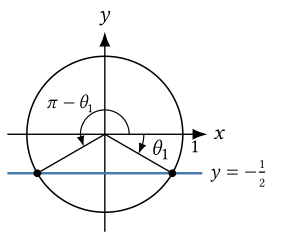
Two solutions in one circle. To solve $\sin\theta = \frac{1}{2}$, look for points on the unit circle at height $y = \frac{1}{2}$. A horizontal line at that height crosses the circle twice, at $30^\circ$ and at $150^\circ$. Your calculator’s $\sin^{-1}$ only returns one angle, $\theta_1$. We can get the other angle from the symmetry of the circle:
| Equation | Range of $\theta_1$ | Second solution | Same value at both points |
|---|---|---|---|
| $\sin\theta = a$ | $-90^\circ$ to $90^\circ$ | $180^\circ - \theta_1$ | $y$ |
| $\cos\theta = a$ | $0^\circ$ to $180^\circ$ | $360^\circ - \theta_1$ | $x$ |
| $\tan\theta = a$ | $-90^\circ$ to $90^\circ$ | $\theta_1 + 180^\circ$ | $y/x$ |
In radians, the second solutions are $\pi - \theta_1$, $2\pi - \theta_1$, and $\theta_1 + \pi$. Add or subtract $360^\circ$, or $2\pi$, to bring a solution into the range you need, then use the physics or geometry of the problem to decide which solutions you need.
Here are the steps on the first question from the entry check. In radian mode, the calculator gives $\theta_1 = \sin^{-1}(-0.5) = -\frac{\pi}{6}$, in quadrant 4. Adding $2\pi$ brings it into the range from $0$ to $2\pi$, and the second solution is $\pi - \theta_1$:
\[\theta = -\frac{\pi}{6} + 2\pi = \frac{11\pi}{6}\] \[\theta = \pi - \left(-\frac{\pi}{6}\right) = \frac{7\pi}{6}\]The angle $7\pi/6$ is in quadrant 3 and $11\pi/6$ is in quadrant 4, where the sine is negative.
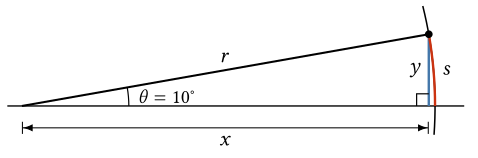
Small angles. For a small angle, the arc $s = r\theta$ and the height $y = r\sin\theta$ are nearly the same length, and the horizontal leg $x = r\cos\theta$ is nearly $r$. So $\tan\theta = y/x$ is nearly $y/r = \sin\theta$, and for small $\theta$ in radians,
\[\sin\theta \approx \tan\theta \approx \theta\]At $10^\circ = 0.1745\ \mathrm{rad}$, $\sin\theta = 0.1736$ and $\tan\theta = 0.1763$, each within about 1% of $\theta$. The approximations become worse as the angle increases, and they never apply to an angle in degrees, because $\sin 10^\circ$ is 0.17, not 10.
Check every answer three ways.
- Units. An angle in radians has no physical units, so $s = r\theta$ has the units of $r$.
- Size. The sizes of $\sin\theta$ and $\cos\theta$ are never larger than 1, and their signs match the quadrant.
- Limits. As $\theta$ approaches zero, $\sin\theta/\theta$ and $\tan\theta/\theta$ approach 1, so the small-angle approximations become exact. When $\sin\theta = 1$, the two solutions are the same angle, $\pi/2$, so there is only one.
Worked examples
Worked example 1: find the phases at a given position
Problem. A block on a spring oscillates with amplitude $A = 8.0\ \mathrm{cm}$, and its position is $x = A\cos\phi$, where $\phi$ is the phase in radians. Find both phases between $0$ and $2\pi\ \mathrm{rad}$ at which the block is at $x = -4.0\ \mathrm{cm}$.
Isolate the cosine by dividing both sides by $A$:
\[\cos\phi = \frac{x}{A} = \frac{-4.0\ \mathrm{cm}}{8.0\ \mathrm{cm}} = -0.50\]Picture the circle. The position $x = A\cos\phi$ is the $x$-coordinate of a point at angle $\phi$ on a circle of radius $A$. A vertical line at $x = -A/2$ crosses that circle twice, so there are two solutions.
Take the inverse cosine. In radian mode, the calculator gives the solution between $0$ and $\pi$:
\[\phi_1 = \cos^{-1}(-0.50) = \frac{2\pi}{3} = 2.09\ \mathrm{rad}\]Find the second solution. The other point with the same $x$-coordinate is the reflection of the first point across the $x$-axis, at angle $-\phi_1$. Adding $2\pi$ brings this angle into the range from $0$ to $2\pi$:
\[\phi_2 = 2\pi - \frac{2\pi}{3} = \frac{4\pi}{3} = 4.19\ \mathrm{rad}\]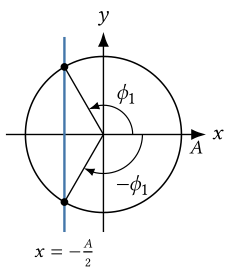
Check.
- Substitution: $\cos(2\pi/3) = \cos(4\pi/3) = -0.50$, so $x = -4.0\ \mathrm{cm}$ at both phases.
- Signs: $2\pi/3$ is in quadrant 2 and $4\pi/3$ is in quadrant 3, where the cosine is negative.
- Limit: at $x = -A$, the equation $\cos\phi = -1$ has the single solution $\phi = \pi$, because at the block’s turning point, the two points on the circle are the same point.
Both phases are physical, because the block passes $x = -4.0\ \mathrm{cm}$ twice in each cycle, once moving in each direction.
Worked example 2: speed and arc length in a centrifuge
Problem. A sample tube in a centrifuge moves on a circle of radius $r = 8.00\ \mathrm{cm}$, and the rotor makes $f = 50.0$ revolutions per second. The angular frequency is $\omega = 2\pi f$, and the speed of the tube is $v = \omega r$, with $\omega$ in $\mathrm{rad/s}$. Find the speed of the tube, and the distance it travels along the circle while the rotor turns through $90^\circ$.
Each revolution is $2\pi$ radians, and the angle in the arc length $s = r\theta$ must be in radians:
\[\omega = (2\pi\ \mathrm{rad})(50.0\ \mathrm{s^{-1}}) = 314\ \mathrm{rad/s}\] \[\theta = 90^\circ \times \frac{\pi\ \mathrm{rad}}{180^\circ} = \frac{\pi}{2}\ \mathrm{rad}\]Your turn. Find $v = \omega r$ and $s = r\theta$. Then explain why you may leave the unit “rad” out of both answers.
Solution to worked example 2
\[\begin{aligned} v &= \omega r = (314\ \mathrm{rad/s})(0.0800\ \mathrm{m}) \\ &= 25.1\ \mathrm{m/s} \end{aligned}\] \[s = r\theta = (8.00\ \mathrm{cm})\left(\frac{\pi}{2}\right) = 12.6\ \mathrm{cm}\]A radian is a length divided by a length, $\theta = s/r$, so it has no physical units. Multiplying by $r$ leaves a length.
Check: the speed is also the circumference divided by the period, $T = 1/f = 0.0200\ \mathrm{s}$, so $v = 2\pi r/T$ $= (0.503\ \mathrm{m})/(0.0200\ \mathrm{s})$ $= 25.1\ \mathrm{m/s}$. The arc length is one quarter of the circumference, $2\pi(8.00\ \mathrm{cm})/4 = 12.6\ \mathrm{cm}$. Using $90$ in place of $\pi/2$ would give $720\ \mathrm{cm}$, much longer than the whole circle.
Worked example 3: double-slit fringes at small angles
Problem. Red light with wavelength $\lambda = 650\ \mathrm{nm}$ passes through two narrow slits a distance $d = 0.200\ \mathrm{mm}$ apart. Bright fringes form at angles $\theta$ that satisfy $d\sin\theta = m\lambda$, where the order $m$ is $0, 1, 2$, and so on. A fringe at angle $\theta$ is a distance $y = L\tan\theta$ from the center of a screen a distance $L = 1.50\ \mathrm{m}$ away. Find $y$ for the $m = 2$ fringe without approximations. Then use the small-angle approximations to show that $y \approx m\lambda L/d$, and compare the two answers.
Try it yourself before opening the solution.
Solution to worked example 3
Solving for the sine and substituting,
\[\sin\theta = \frac{m\lambda}{d}\] \[\sin\theta = \frac{2(650 \times 10^{-9}\ \mathrm{m})}{0.200 \times 10^{-3}\ \mathrm{m}} = 6.50 \times 10^{-3}\]so $\theta = \sin^{-1}(6.50 \times 10^{-3})$ $= 6.50 \times 10^{-3}\ \mathrm{rad}$, which is $0.372^\circ$. Then $y = L\tan\theta = 9.75\ \mathrm{mm}$.
For small $\theta$ in radians, $\sin\theta \approx \theta$ and $\tan\theta \approx \theta$, so $\theta \approx m\lambda/d$ and
\[y \approx L\theta = \frac{m\lambda L}{d} = 9.75\ \mathrm{mm}\]The two answers agree to the three significant figures shown, because $6.50 \times 10^{-3}\ \mathrm{rad}$ is a very small angle.
Check: the order $m$ has no units, and $\lambda L/d$ has units of $(\mathrm{m})(\mathrm{m})/(\mathrm{m}) = \mathrm{m}$, a length. For a diffraction grating with $d = 2.00\ \mu\mathrm{m}$, the $m = 2$ fringe is at a much larger angle, $\theta = 0.708\ \mathrm{rad}$ ($40.5^\circ$). There, $L\tan\theta = 1.28\ \mathrm{m}$, and $m\lambda L/d = 0.975\ \mathrm{m}$ is about 24% too small.
Common issues
- Using degrees in $s = r\theta$. Check this by plugging in a quarter turn on a circle of radius $2.0\ \mathrm{m}$. With $\theta = \pi/2$, $s = 3.1\ \mathrm{m}$. With $\theta = 90$, $s = 180\ \mathrm{m}$, much longer than the whole circle.
- Leaving the calculator in degree mode for an angle in radians. Check this by finding $\sin(\pi/6)$, which is $0.5$. In degree mode, the calculator returns $0.0091$, the sine of $0.52^\circ$.
- Keeping only the calculator’s answer. Check this by plugging in $150^\circ$. $\sin 150^\circ = 0.5$, the same as $\sin 30^\circ$, but $\sin^{-1}(0.5)$ returns only $30^\circ$.
- Using the sine’s second solution for a cosine. For $\cos\theta = 0.5$, the second solution is $360^\circ - 60^\circ = 300^\circ$. Check this by plugging in $180^\circ - 60^\circ = 120^\circ$ instead. $\cos 120^\circ = -0.5$, not $0.5$.
- Taking the sign from the acute angle. Check this by plugging in $210^\circ$. Its acute angle with the $x$-axis is $30^\circ$, but $\sin 210^\circ = -0.5$, not $+0.5$, because $210^\circ$ is in quadrant 3.
- Using a small-angle approximation at a large angle. Check this by plugging in $60^\circ = 1.05\ \mathrm{rad}$. $\sin 60^\circ = 0.87$, which is 17% less than $1.05$.
Practice and the mastery check
Open the Math Toolkit module in your course’s Canvas site. There are three quizzes for G4, and you can retake any of them as often as you like:
- Entry check. The two questions above with feedback.
- Practice set. Questions ranging from plain symbols to physics, with feedback on every answer.
- Mastery check. Five questions. A passing score is 6 of 7 points. The interpretation and application questions are worth 2 points each, so you need to get both correct. If you miss twice in a row, stop and work through the lesson section linked in the feedback, or bring the question to office hours.
Go deeper
These OpenStax sections cover the same math with more practice:
- Algebra and Trigonometry 2e, 7.1 Angles: radians, converting between degrees and radians, and arc length.
- Algebra and Trigonometry 2e, 7.3 Unit Circle: sine and cosine of any angle, and the special angles.
- Algebra and Trigonometry 2e, 8.3 Inverse Trigonometric Functions: the inverse functions and the ranges your calculator uses.